


Massive Shift: AI referrals are up 800% YoY (Backlinko), and traffic is up 33x since July 2024 (Adobe).
Your data center is world-class. Fiber routes are fast. The Meet-me room has no cross-connect fees. Now let’s make sure your brand shows up inside AI answers.
Your prospect asks ChatGPT “best carrier hotel in New York” or Gemini “lowest-latency route to from NYC to Miami,” does your name show up?
If not, you’re invisible where decisions happen now. That’s why telecom companies are adopting generative engine optimization services to get cited by AI search engines. In this guide, you’ll learn the generative engine optimization best practices that help carriers, data centers, infrastructure providers, and thought-leaders show up in AI answers—without guessing.

What is AI Search Optimization (GEO)?
Definition Box:
AI Search Optimization (also called Generative Engine Optimization or GEO) is the practice of structuring your content so AI models—like ChatGPT, Gemini, Perplexity, and Google AI Overviews—can extract, cite, and recommend your company in conversational answers. Instead of ranking on page one, you aim to be the source AI trusts when users ask questions about your services, locations, or expertise.
Why Telecom Visibility Changed (And Why It Matters Now)
For years, telecom marketing meant ranking for “carrier hotel Manhattan” or “dark fiber.” You optimized for Google’s blue links. However, that playbook is breaking.
Today, more than half of searches never leave the search results page. Google AI Overviews, ChatGPT, and Gemini answer questions directly. So, users don’t click through to your site—they read a summary generated by AI.
If your company isn’t structured to be cited, you’re invisible. That’s a problem because telecom buyers research infrastructure before they ever fill out a contact form. They ask AI questions like:
- “Which carrier hotels offer the lowest latency to AWS?”
- “Best meet-me rooms for financial services in NYC”
- “Subsea cable landing stations on the US East Coast”
If AI doesn’t mention you, the deal starts without you. Therefore, you need a strategy that makes your content AI-readable, trustworthy, and citation-worthy.

Get the Book: AI Interconnection: Discover the Physical Internet Behind AI by Hunter Newby
GEO vs SEO for Telecom: What’s Different?
Traditional SEO and generative engine optimization vs traditional seo share some DNA. Both care about authority, relevance, and structure. But GEO adds new rules.
Here’s a simple comparison:
| Feature | Traditional SEO | GEO (AI Search Optimization) | When to Choose |
|---|---|---|---|
| Goal | Rank on page one | Get cited in AI answers | Use both together |
| Content format | Blog posts, service pages | Structured FAQs, entity-rich pages, schemas | GEO for conversational queries |
| Measurement | Clicks, impressions, rankings | Citations, AI visibility, share of answers | GEO for brand mentions in AI |
| Authority signals | Backlinks, domain authority | Structured data, expert quotes, citations | GEO for trust and extraction |
| Keyword strategy | Target phrases, search volume | Natural language questions, entity clarity | GEO for “near me” and “best” queries |
In short, SEO gets you traffic. GEO gets you mentioned. For telecom, you need both. Because prospects research on AI, then visit your site to verify and convert.
Do you want to show up in AI?
In 15 minutes, we’ll show where you’re missing citations—and the 3 fastest fixes.
GEO Best Practices: The Telecom Playbook
Now let’s walk through the generative engine optimization best practices that work for telecom companies. This is a step-by-step workflow you can start today.
Step 1: Identify High-Value Questions Your Buyers Ask AI
First, list the questions prospects type into ChatGPT or Google. For example:
- “What is a carrier hotel?”
- “How do I choose a meet-me room provider?”
- “Which IXPs serve the Southeast US?”
- “What’s the difference between dark fiber and lit fiber?”
Next, prioritize questions that match your expertise and have commercial intent. Use tools like AnswerThePublic, Google autocomplete, or your sales team’s FAQ log.
Step 2: Structure Your Answers for Extraction
AI models prefer content that’s easy to parse. That means:
- Short paragraphs (1–3 sentences)
- Clear headings (H2, H3)
- Bulleted lists for features or steps
- Tables for comparisons
- Definitions at the top of the page
For instance, if you’re writing about your carrier hotel, start with a one-sentence definition. Then add a bulleted list of services. Then a table comparing your facility to competitors. This structure helps AI extract the right snippet.
Step 3: Add Entity and Geography Markup
Telecom is local. Latency matters. Routes matter. So, you need to tell AI where you are and what you connect to.
Use schema markup (JSON-LD) to define:
- Your facility name and address
- Services offered (colocation, cross-connects, dark fiber)
- Geographic coverage (cities, regions, countries)
- Connections (which carriers, IXPs, cloud on-ramps you reach)
For example, if you operate a meet-me room at 60 Hudson in New York, your schema should list “60 Hudson Street, New York, NY” and the carriers available there. This helps AI answer “carrier hotels in New York” with your name.
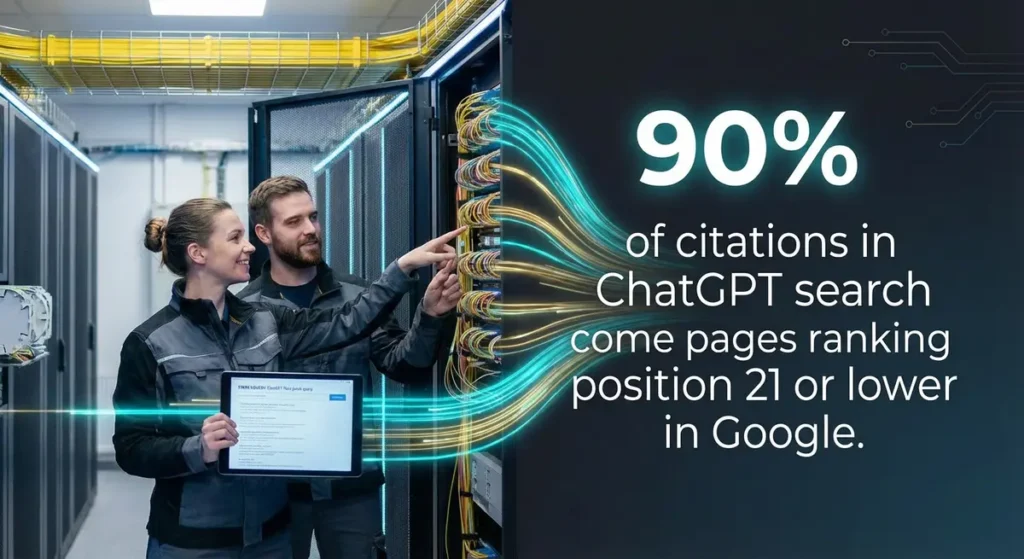
Step 4: Publish Expert Content That AI Can Cite
AI models prioritize authoritative sources. In telecom, that means content written by people who build and operate networks—not generic marketers.
Include:
- Bylines from your CTO, network architect, or CEO
- Case studies with real latency numbers, uptime stats, or route diversity examples
- Technical explainers (e.g., “How BGP peering works at an IXP”)
- Pull-quotes from industry leaders
“The Internet is a physical business. It relies on physical assets: fiber strands, conduit systems, and the buildings where they all meet.” – Hunter Newby
This kind of content signals expertise. AI models are more likely to cite it because it’s grounded in real-world operations.
Step 5: Earn Citations from Trusted Sources
Backlinks still matter, but for GEO, you also need citations. That means getting mentioned on:
- Industry publications (Telecom Ramblings, Data Center Frontier, SubmarineCableForum)
- Conference sites (PTC, ITW, MetroConnect)
- Government or regulatory pages (.gov, .edu)
- Vendor partner pages (Cisco, Juniper, Ciena)
Use digital PR for AI visibility to earn these mentions. When AI sees your company cited by trusted sources, it’s more likely to recommend you.
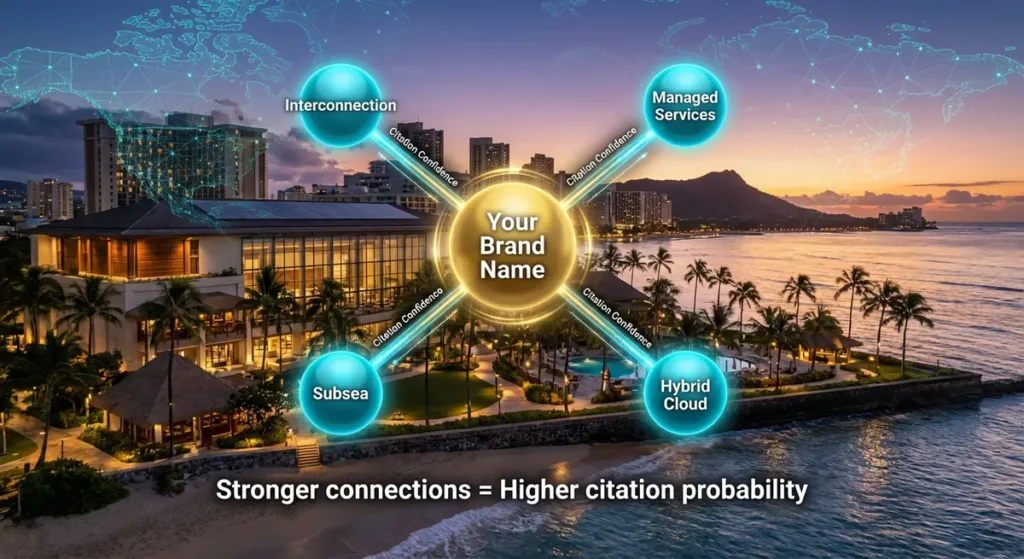
Step 6: Optimize for Conversational Queries
People don’t ask AI “carrier hotel NYC.” They ask “What’s the best carrier hotel in New York for low-latency trading?”
So, write content that answers full questions. Use natural language. Include long-tail phrases like:
- “best generative engine optimization platforms for telecommunications us”
- “answer engine optimization vs generative engine optimization”
- “generative ai search engine optimization”
These phrases help AI match your content to conversational queries. However, don’t stuff keywords. Write for humans first. AI will follow.
Step 7: Measure and Iterate
Finally, track your AI visibility. Use generative engine optimization tools like:
- BrightEdge (AI Share of Voice)
- Semrush (AI Overviews tracking)
- Custom scripts (search your brand in ChatGPT, Gemini, Perplexity)
Measure:
- How often your company is cited in AI answers
- Which questions trigger your content
- Which competitors appear more often
Then, update your content monthly. Add new stats, refresh examples, and expand FAQs. AI models retrain often, so fresh content gets picked up faster.
GEO Checklist for Telecom Companies
Use this yes/no checklist to audit your AI readiness:
- Do you have a dedicated FAQ page answering top buyer questions?
- Is your content structured with short paragraphs, headings, and lists?
- Do you use schema markup for locations, services, and connections?
- Do you publish expert content with bylines and case studies?
- Are you cited on industry publications or conference sites?
- Do you optimize for conversational, long-tail queries?
- Do you track AI visibility and update content monthly?
- Do you have a process to respond to AI-generated questions about your company?
If you answered “no” to more than three, you’re at risk of being invisible in AI search. Start with the easiest fixes first—like adding FAQs and schema—then build from there.

Entity + Geography: The Telecom-Specific Playbook
Telecom is different. Your buyers care about where your fiber runs, which buildings you’re in, and how fast your routes are. So, your GEO strategy must be hyper-local and entity-rich.
Carrier Hotels and Meet-Me Rooms
If you operate or sell space in a carrier hotel, your content should answer:
- “Which carriers are in this building?”
- “What’s the latency to major cloud on-ramps?”
- “How many cross-connects are available?”
Create a dedicated page for each facility. Include a table of carriers, a map of fiber routes, and a list of nearby IXPs. Use schema to mark up the building address and services. This helps AI answer “carrier hotels near me” or “meet-me rooms in [city].”
IXPs and Interconnection
If you run an Internet Exchange Point, your content should explain:
- “What is an IXP and why does it matter?”
- “Which networks peer here?”
- “What’s the cost to connect?”
Publish a member directory (if public). Add a FAQ explaining peering vs transit. Use schema to list your location and connected networks. This helps AI recommend your IXP when users ask “best IXP in [region].”
Subsea and Long-Haul Fiber
If you own or operate subsea cables or long-haul fiber, your content should cover:
- “Which landing stations do you serve?”
- “What’s the route diversity?”
- “What’s the latency between [city A] and [city B]?”
Create route maps with alt text. Publish latency tables. Use schema to mark up landing station addresses. This helps AI answer “fastest subsea route to Europe” or “lowest-latency path to Asia.”
Data Centers and Colocation
If you offer colocation or data center services, your content should answer:
- “What’s your uptime SLA?”
- “Which cloud on-ramps are available?”
- “What’s the power density per rack?”
Publish a services page with a comparison table. Add a FAQ about redundancy, cooling, and security. Use schema to mark up your facility location and certifications. This helps AI recommend your data center when users ask “best colo in [city].”

Proof Block: Why Structured Content Gets Cited
Hunter Newby’s research and book are built like an answer engine. Each chapter is modular, structured, and updatable. It’s designed for extraction and citations—exactly what AI models prefer.
This approach works because AI doesn’t read like humans. It scans for entities, facts, and relationships. So, content that’s organized into clear sections, tables, and lists gets cited more often.
For telecom companies, this means:
- Break long pages into short, scannable sections
- Use headings to signal topic changes
- Add tables for comparisons and specs
- Include pull-quotes and expert insights
- Link to authoritative sources (like What is Generative Engine Optimization? The Differences between GEO vs SEO)
When your content is structured this way, AI can extract the right answer and cite you as the source. That’s how you win in generative search.
Learn more about Hunter’s research here: https://www.newby-ventures.com/research/book/
How to Measure GEO Success (Simple Scorecard)
You can’t improve what you don’t measure. So, here’s a simple scorecard to track your AI visibility:
| Metric | How to Measure | Target |
|---|---|---|
| AI Citations | Search your brand in ChatGPT, Gemini, Perplexity | Mentioned in 50%+ of answers |
| Share of Answers | Use BrightEdge or Semrush AI tracking | Top 3 in your category |
| FAQ Coverage | Count questions answered on your site | 20+ high-value questions |
| Schema Completeness | Audit with Google Rich Results Test | 100% of key pages |
| Expert Content | Count bylined articles, case studies, quotes | 1 new piece per month |
| External Citations | Track mentions on industry sites, conferences | 5+ new citations per quarter |
Run this scorecard monthly. If you’re not seeing progress, revisit your content structure and entity markup. Most telecom companies see results within 60–90 days if they follow generative engine optimization best practices consistently.
According to Google Search Central guidance from 2024, creating helpful, reliable, people-first content is the foundation for succeeding in AI-powered search experiences (Google Search Central, 2024).
What Happens Next: Start Small, Scale Fast
You don’t need to rewrite your entire website overnight. Instead, start with a pilot:
- Pick one high-value question (e.g., “What is a carrier hotel?”)
- Write a structured answer page (definition, FAQ, table, schema)
- Publish and measure (track AI citations for 30 days)
- Iterate and expand (add more questions, update monthly)
This approach reduces risk and proves ROI fast. Once you see results, scale to more questions, more locations, and more services.
Many telecom companies pair GEO with an enterprise SEO strategy to cover both traditional search and AI search. Others run a quick SEO sprint to fix technical issues before launching GEO. Either way, the key is to start now—because your competitors already are.
For more on how telecom companies are adapting, see our telecom marketing page.
FAQs: Generative Engine Optimization for Telecom
How’s generative engine optimization(GEO) different from traditional SEO?
Traditional SEO focuses on ranking in search results to drive clicks. GEO focuses on being cited by AI models in conversational answers. For telecom, you need both strategies working together.
What are the best generative engine optimization tools for telecom?
Top tools include BrightEdge (AI Share of Voice), Semrush (AI Overviews tracking), and custom scripts to monitor brand mentions in ChatGPT, Gemini, and Perplexity.
What’s the difference between answer engine optimization and generative engine optimization?
Answer engine optimization (AEO) and generative engine optimization (GEO) are often used interchangeably. Both aim to get your content cited in AI-generated answers.
How do I optimize for generative AI search engines?
Start by identifying high-value questions your buyers ask. Add entity and geography data (locations, services, connections). Publish expert content with bylines and case studies.
Can GEO help with search engine optimization lead generation?
Yes, when AI cites your company in answers, prospects learn about you earlier in the buying journey. They’re more likely to visit your site, request a demo, or contact sales.
How do I choose between generative engine optimization services?
Look for providers with telecom experience, proven AI visibility results, and transparent reporting. Ask for case studies showing citation growth and share of answers. Ensure they offer schema markup, content optimization, and ongoing measurement. Many telecom companies start with a 90-day pilot to test fit and results.