


PTC'DC 2026 brings digital infrastructure leaders into a conversation that reaches beyond networks and facilities. Business owners, investors and marketing leaders should use the event to test how policy, capital, AI demand and power constraints may affect their next decisions.
This guide is not a replacement for the organizer's schedule. It is a planning tool for choosing sessions, preparing sharper questions and turning what you hear into useful follow-up after the event.
What should executives expect from the event?
PTC’DC 2026 is positioned around the intersection of government, regulation, policy, private equity, finance, technology and digital infrastructure. Executives should arrive ready to connect those subjects rather than treating each panel as a separate technical discussion.
The executive brief
- Read across functions: A policy change can alter financing, deployment and market communication at the same time.
- Ask for decision evidence: Separate current constraints from forecasts and sales narratives.
- Plan the follow-up: Assign owners for relationships, research questions and public communication before the event begins.
Start with the official event information
The supplied official agenda listing places PTC'DC 2026 in Reston, Virginia, on September 17, 2026. Use the official PTC agenda to check the current schedule, and review the event overview before making travel plans. Venue details, session times, speakers and access instructions can change, so confirm them directly with PTC before departure.
That official material is the source for event logistics. The useful job for an executive guide is different: it should help you decide what to listen for and what to ask when a broad statement touches several parts of your business.

Read the agenda through five connected lenses
At PTC'DC 2026, the strongest insight may come from the link between two topics rather than from one session alone. Use this matrix to organize notes and compare what different speakers say.
| Lens | Listen for | Executive question |
|---|---|---|
| Policy | Rules, approvals and public priorities | What decision could this delay, redirect or accelerate? |
| Capital | Investment standards and risk assumptions | Which facts would change the financing case? |
| AI demand | Workload expectations and infrastructure needs | What is measured demand, and what is still a forecast? |
| Power | Availability, timing and stakeholder pressure | Which dependency sits outside the operator’s control? |
| Market position | Buyer language, trust and differentiation | How should this change what we explain to the market? |
This approach also prevents a common conference mistake: collecting isolated quotes without recording the assumptions behind them. Note who owns the data, the period it covers and the condition that would prove the view wrong.
Questions executives should bring into the room
Use PTC’DC 2026 to test decisions already on your desk. A short list of prepared questions will produce better conversations than a stack of general talking points.
- Which policy or approval issue is creating the most uncertainty for current projects?
- What evidence separates committed demand from an early market signal?
- Where do power, land, network access and capital plans conflict?
- Which assumption would make the investment case fail?
- What do customers misunderstand about the infrastructure behind AI services?
- Which stakeholder must be involved earlier in the planning process?
- What can be discussed publicly, and what still lacks enough evidence?
- Which relationship deserves a specific follow-up within one week?
Why Percepture and Pyra are paying attention
Our interest in PTC'DC 2026 is practical. Percepture looks at how strategy, public relations and search help infrastructure companies explain complex decisions. Pyra focuses on AI-agent execution. Prime AI Visibility examines how organizations appear in AI-generated answers, while Lead Seeker supports B2B account and prospect intelligence.
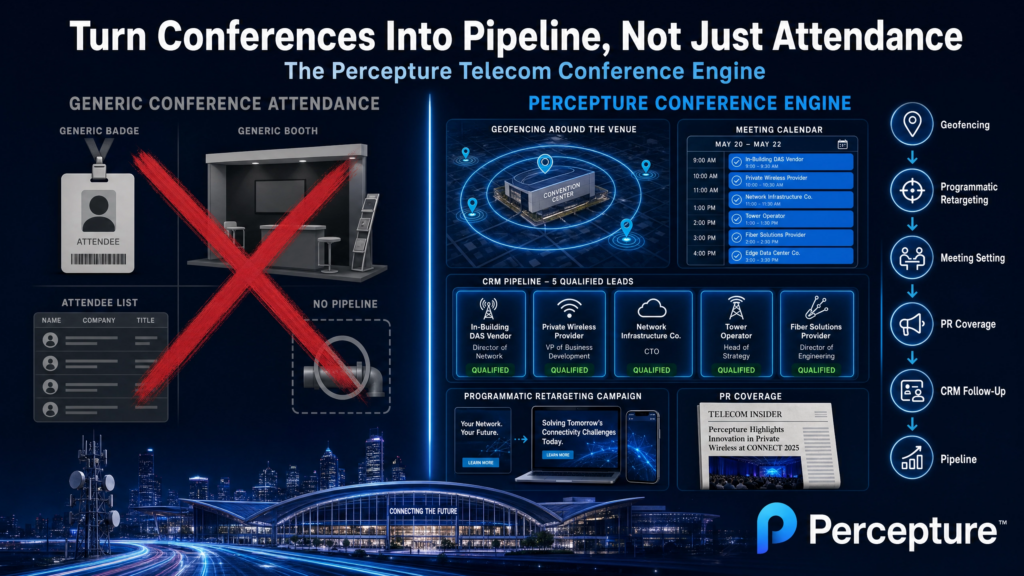
Those are separate parts of a commercial system. A conference can produce market language, expert relationships and account signals, but those inputs still need owners and a follow-up process. Percepture's telecom conference marketing guide explains how to connect event activity with the wider campaign instead of judging success by badge scans alone.
This section provides Percepture and Pyra context. It is not an endorsement by PTC, and it does not suggest that PTC has reviewed these tools or services.
Build the follow-up plan before arriving
Preparation for PTC'DC 2026 should end with named owners. One person can capture policy and investment questions. Another can log accounts and relationships. A third can review the language buyers and speakers use to describe demand, risk and timing.
After the event, sort notes into four groups: decisions, evidence requests, relationships and content opportunities. Do not publish a market claim merely because it appeared in a conversation. Trace it to an attributable source, or treat it as a question for further research.
For broader planning, compare the event with Percepture's guide to the best data center conferences. Teams serving operators, investors or infrastructure vendors can also review Percepture's telecom marketing focus and omnichannel marketing approach before setting campaign priorities.
Turn event insight into a working plan
If PTC’DC 2026 is part of a larger growth program, compare the investment options for strategy, content, search, PR and follow-up.

About Bob Generale
Bob Generale is President of Percepture. His role spans executive strategy, search, public relations and the commercial planning that connects industry conversations with measurable marketing work.
For technical infrastructure subjects, Bob serves as a strategist, interviewer and editor. He helps turn specialist input into clear questions and useful decisions without presenting himself as an infrastructure engineer.