


A search for the best platforms for AI search optimization historical data sounds like a software-ranking request. The harder—and more useful—question is whether a platform preserves enough context to show what changed, where it changed and whether that change mattered.
This guide is for CEOs, CMOs and marketing leaders choosing an AI visibility measurement system. It replaces an unsupported winner list with a transparent matrix that procurement, marketing and technical evaluators can apply to the platforms on their shortlist.
What makes an AI search historical-data platform useful?
The best fit is the platform that preserves comparable observations over time, retains the sources behind those observations, separates mentions from citations and recommendations, and lets your team export enough detail to audit a change. Do not treat a long date range as useful history unless the record also identifies changes to the prompt set, model, market and collection method.
The buyer decision in four checks
Continuity
Can you compare like with like across dates, prompts, markets and answer surfaces?
Evidence
Can you inspect the answer, cited source and collection context behind a chart?
Portability
Can analysts export the underlying records instead of relying only on dashboard summaries?
Decision value
Can the record tell the team what to investigate, defend or improve next?
Historical data is more than an old chart
For this buying decision, historical data means a sequence of comparable AI-search observations with enough context to interpret each one. That context can include the prompt or question, answer surface, collection date, market, response, brand state and cited sources.
Do not treat a line chart that starts several months ago as sufficient evidence by itself. For this matrix, do not substitute conventional rank tracking for an inspectable AI-search record. Ask what was measured, what evidence was retained and how changes to the measurement process were documented.
Use the methodology before looking at rankings
A defensible comparison applies the same questions to every candidate. In Percepture’s recommended buyer matrix, treat historical continuity and source preservation as gates. Evaluate the remaining criteria only after a platform demonstrates that its records can be inspected and compared.
AI search historical-data decision matrix
| Criterion | Decision role | What to verify | Weak answer |
|---|---|---|---|
| Historical continuity | Gate | Comparable dates, prompts, markets, models and answer surfaces | Only an account creation date or an unexplained trend line |
| Source preservation | Gate | Saved answers, cited URLs and retrieval context | A score without inspectable evidence |
| Segmentation | Supporting factor | Brand, topic, prompt group, market and answer-surface filters | One blended visibility number |
| Export and integration | Supporting factor | Record-level export, documented fields and a usable transfer path | Image or presentation exports only |
| Methodology change log | Supporting factor | Dated records of collection or scoring changes | Changes without a dated explanation |
| Workflow fit | Supporting factor | Clear ownership, investigation and action paths | Alerts without an operating process |
Evaluation method: Record pass, partial or fail for each criterion and keep the written evidence beside the result. Do not let a dashboard demonstration replace the procurement record.
Which platform type fits the buyer’s job?
Without verified, current product records, it would be misleading to publish a numbered brand ranking. Buyers can still narrow the market by matching the operating need to the platform category they want to investigate.
| Platform category | Use when evaluating | Primary diligence question |
|---|---|---|
| Archive-first AI visibility tracker | Answer-level changes in mentions, citations and recommendations | Does the system preserve the underlying answer and sources? |
| SEO suite with AI-search reporting | AI observations alongside an established SEO workflow | Is the AI record detailed enough to audit independently? |
| Research warehouse and business-intelligence stack | Governance across analysts and multiple data sources | Can the team document changing collection methods without hiding them? |
| Agency-operated measurement program | Interpretation and implementation alongside monitoring | Who owns the raw evidence, investigation process and resulting actions? |
Separate visibility states before comparing trends
Percepture calls this the Source-to-Entity Conversion Ladder: Sourceable, Mentioned, Cited, Recommended, Referred and Converted.
In this framework, those states are evaluated separately. A cited page can support an answer without the brand being recommended.
Use the Golden Triangle as a diagnostic, not an algorithm claim
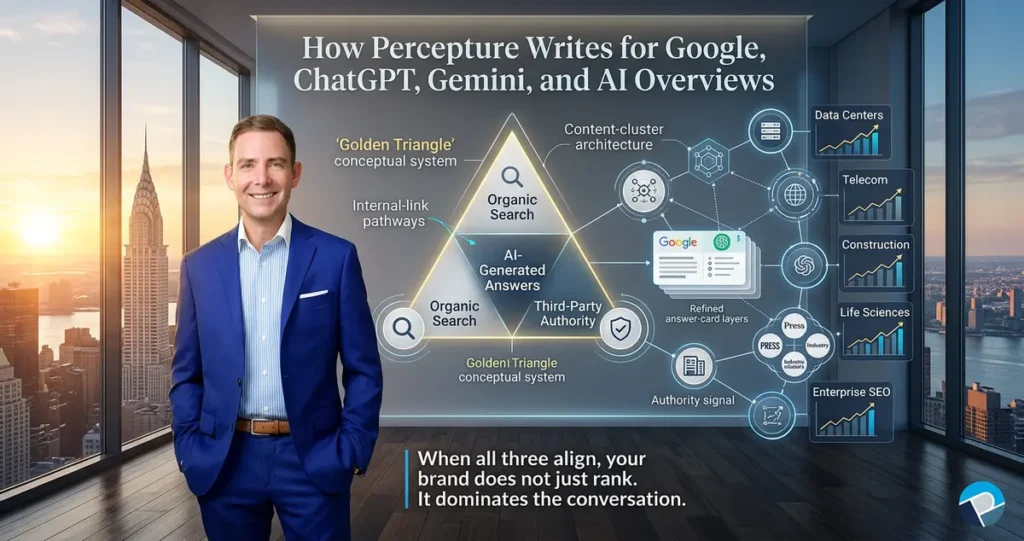
Percepture’s Golden Triangle is a visibility model that examines AI-answer presence, a strong organic position and a prominent supporting search feature around the same buyer need.
The Golden Triangle is not a Google ranking factor.
When applying this model, require the platform to keep states and surfaces distinct enough to compare. If it compresses them into one score, ask for the underlying records before accepting the conclusion.
Questions to ask in every platform demo
- Show the oldest inspectable record. Ask to see the prompt, response, sources, date and collection context—not only a chart.
- Change the comparison window. Check whether prompt groups and markets remain consistent across both periods.
- Explain model changes. Ask how the platform marks changes in the answer system, collection process or scoring method.
- Export a sample. Review the fields, granularity and identifiers your analysts would actually receive.
- Trace one anomaly. Start with a spike or decline and follow it back to the saved evidence.
- Define every visibility state. Make the vendor show how a mention differs from a citation, recommendation and referral.
- Test ownership. Confirm who can access, retain and transfer the evidence if the relationship ends.
Put the platform cost beside the measurement job
Define the prompt set, markets, answer surfaces, reporting depth and analyst workload before comparing investment. Then evaluate whether each pricing option covers that evidence requirement.
What can go wrong with historical AI-search data?
The prompt set drifts
When prompts are added, removed or rewritten, preserve a dated record of the change and analyze experimental prompts separately from the stable baseline.
Unlike surfaces are blended
Keep observations from different answer systems, locations and user contexts in separate series unless the collection record documents a valid basis for comparison.
Scores replace evidence
Use a composite metric for scanning, but retain the answer-level evidence needed to investigate material changes.
Historical access is confused with historical collection
Ask whether the vendor collected each observation at the date shown or reconstructed it later, and record the answer in the procurement file.
A dated screenshot becomes an evergreen claim
Treat search and AI-answer screenshots as dated records. Preserve the date, query, market and source context whenever one is used as proof.
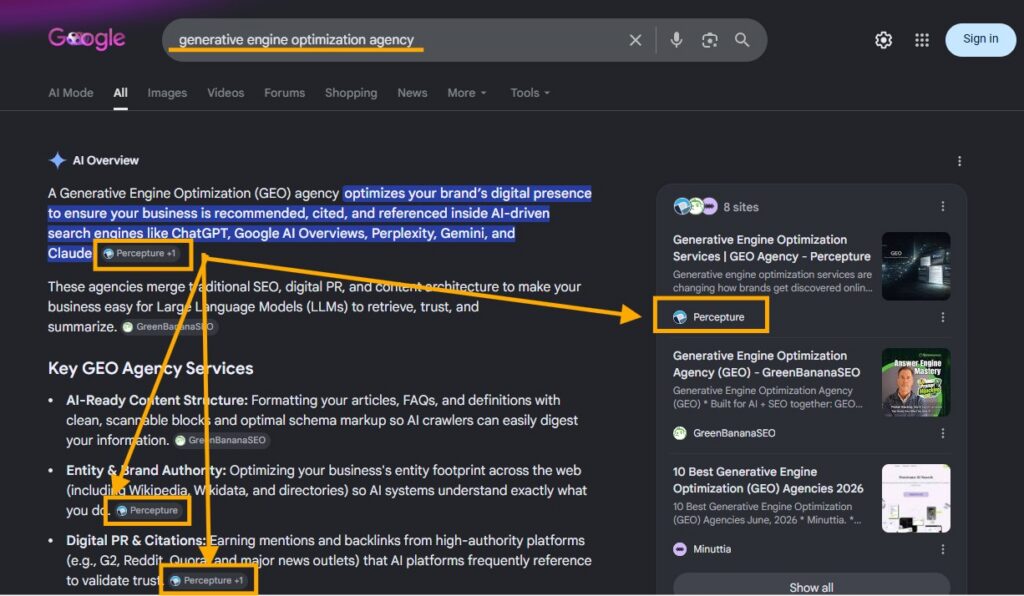
Media and evidence should pass the same provenance test
When preserving screenshots, expert records, videos and owned media connected to a query or entity, record each asset’s source, reason for inclusion and evidentiary boundary.
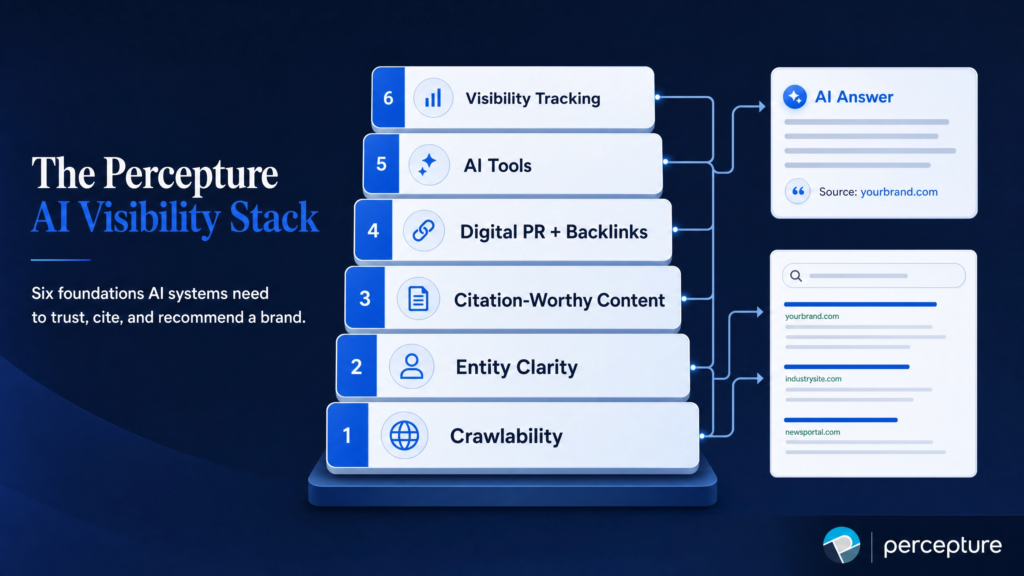
Examples of supplied Percepture media
The following supplied assets illustrate distinct media records. They do not establish platform performance, rankings or customer outcomes.



Connect measurement to the next decision
Treat the platform as a measurement layer rather than the strategy itself. After reviewing the evidence, decide whether to protect an existing source, improve an absent page, investigate entity ambiguity or develop evidence for an unanswered buyer question.
If implementation is the next job, review Percepture’s GEO services. Teams building a broader measurement plan can also review attribution and analytics, data visualization and the published GEO pricing guide.
Questions buyers ask about AI search historical data
How were AI search historical-data platforms evaluated?
This guide uses a matrix covering historical continuity, source preservation, segmentation, export and integration, methodology change records and workflow fit. Historical continuity and source preservation are treated as gates. The guide does not publish brand scores without current, inspectable product evidence.
Which platform is best for a different use case or budget?
Start with the measurement job. Investigate an archive-first tracker for answer-level records, an SEO suite for a consolidated search workflow, a warehouse approach for enterprise governance, or an agency-operated program when interpretation and implementation are also required.
What proof should a buyer verify before choosing a platform?
Inspect a saved historical answer, its cited sources, prompt and collection context, methodology changes and a record-level export. Then trace one reported change from the dashboard back to that evidence.
How current are the capabilities, pricing and evidence in this guide?
This guide does not state vendor-specific capabilities or prices. Verify those details through current product documentation, a live demonstration and written procurement records before making a decision.
Does Percepture have a relationship with a platform included here?
No platform is ranked or endorsed in this guide. Percepture’s services and pricing resources are linked separately as implementation options rather than presented as independent comparison winners.
Build the baseline before selecting the dashboard
Define the questions, visibility states, evidence fields and decision owners first. Then require each shortlisted platform to demonstrate that operating model with inspectable records.
Reference images

About Bob Generale
Bob Generale is President of Percepture. His operating focus connects search, AI search, digital communications, reputation and revenue around the buyer’s decision journey.