


What is a Data Center PR strategy?
A data center PR strategy is a repeatable system for earning trust through high-authority media, industry credibility, stakeholder messaging, and crisis communications. In 2026, data center PR is not “press releases.” It’s a core part of your data center marketing and reputation engineering: you choose the right publications, distribute the story across channels people actually use, and run a 60-minute protocol when something goes wrong.
First, strategic telecom marketing agencies don’t have a Junior PR team or a one-man band learn their mistakes on your account. Second, let’s break it into the three parts that actually move outcomes: Reputation, Media, and Crisis Comms.
Why PR Changed in 2026 (People Don’t Consume Media the Old Way)
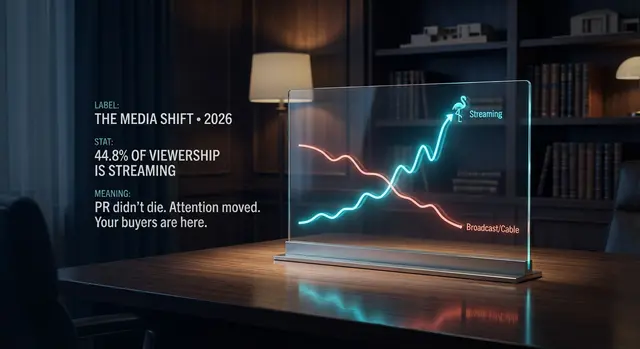
The media landscape has fundamentally shifted, and data center operators who ignore this reality are leaving opportunities on the table. According to Nielsen’s “The Gauge” report, streaming has overtaken broadcast and cable in total TV usage, capturing 44.8% of viewership in May 2025. Even more telling, Pew Research found that among Americans who say they get news from TV, 34% now say it comes from streaming services rather than traditional broadcast or cable.
This isn’t just a consumer trend—it’s a B2B reality. Your buyers, investors, and stakeholders are consuming content differently. They’re researching on their own terms, across fragmented channels, before they ever talk to you.
So if your “Digital Infrastructure PR plan” is only emails to journalists and a few press releases, you’re leaving money on the table.
The New PR Formula for Data Centers
Reputation (What People Repeat About You)
Your reputation is the summary people give when they’re in a meeting without you.
When a CIO is evaluating colocation providers, when an investor is comparing hyperscale operators, when a city council is debating a new facility, what do they say about your company? That narrative doesn’t happen by accident. Today, the top data center marketing agencies are building trust through consistent, credible presence in the places that matter.
In our work with our clients, we’ve seen that reputation compounds. One strong placement in Data Center Dynamics leads to a podcast invitation. That podcast gets cited in a LinkedIn post by an industry analyst. That analyst’s take influences a buyer’s shortlist. We have this mapped out as part of our 2026 Data Center GTM Marketing Strategy. It’s a flywheel, but someone has to spin it first.
Media (Where the Market Learns What to Trust)
Big publications don’t just create awareness; they create permission to be taken seriously.
There’s a reason why a feature in The Wall Street Journal carries more weight than a self-published blog post. Authority matters. When you earn coverage in high-credibility outlets—whether that’s industry-specific publications like Data Center Dynamics, Data Center Knowledge, Data Centre Magazine, Bisnow, Capacity Media, Interglobix, and Mission Critical Magazine or mainstream business media—you’re borrowing their trust. We help you get recognized beyond the industry with NYT, Forbes, and The Information.
But here’s what most operators miss: media placement is only half the equation. Distribution is the other half. A great article that nobody sees is a wasted opportunity.
Crisis Comms (How You Protect Trust Under Pressure)
Outages don’t destroy trust; confusion does.
Every data center will face an incident. Power loss, cooling failure, network disruption—it’s not if, it’s when. What separates operators who maintain customer confidence from those who lose it isn’t the absence of problems. It’s how they communicate during them.
We’ve analyzed dozens of data center incidents, and the pattern is clear: customers can tolerate downtime if they understand what’s happening, what you’re doing about it, and when they’ll hear from you next. Silence, vague updates, or contradictory messages? That’s what erodes trust permanently. Now we’ll turn that into a system you can run like an operator.
Data Center Public Relations that builds trust (before you need it)
In 2026, data center PR isn’t about press releases — it’s about credibility in the rooms that decide power, permits, partners, and pipeline. Our PR approach is digital-first: we prioritize industry relevance and high-authority placements, evaluate publication strength and placement value, and build a narrative that can be repeated by buyers, journalists, and AI search systems. Our average expert has 15 years of experience, with team members coming from major agency backgrounds before Percepture.
The Digital PR Placement System (Authority + Relevance + AI Citation Odds)
This is where strategy meets execution. Not all media placements are created equal, and in 2026, you need to think beyond just “getting coverage.” You need placements that work across three dimensions:
Key concept: Domain Authority isn’t a Google ranking factor in the literal sense—Google has confirmed it doesn’t use a “domain authority” metric. But DA/DR-style metrics are still useful as a proxy for “how strong a domain tends to be,” and they correlate with the kinds of sites that earn links and citations.
The Publication Scorecard
When evaluating where to place your stories, use this framework:
| Criteria | What to Evaluate | Why It Matters |
|---|---|---|
| Authority | DA/DR, organic visibility, backlink profile | Signals trustworthiness to both humans and AI systems |
| Relevance | Data center/digital infrastructure/energy/AI adjacency | Ensures the audience actually cares about your story |
| Retrieval-Readiness | Clean structure, tables, FAQs, citable content | Makes it easy for AI systems to extract and cite |
| Linkability | Editorial policy on outbound links | Determines if you’ll get referral traffic and SEO value |
| Distribution Layer | Can you amplify via programmatic + social? | Extends reach beyond organic discovery |
Why this helps GEO/AI: BrightEdge research shows that AI Overview citations increasingly overlap with organic rankings—growing from 32% in May 2024 to 54% by September 2025. This means the same SEO fundamentals that help you rank also improve your odds of being cited by AI systems.
In plain terms: you want placements that are both trusted by humans and easy for machines to cite.
Modern PR Isn’t “Earned-Only” Anymore (Earned + Owned + Paid Distribution)
A great placement with strong and relevant domain authority is step one. Making sure the right people see it is step two.
Here’s the reality of B2B buying in 2026: Gartner found that 61% of B2B buyers prefer a rep-free buying experience, and 73% actively avoid suppliers who send irrelevant outreach. Meanwhile, Demand Gen Report research shows buyers are ~70% through their journey before engaging sellers, and 80% of the time, buyers initiate first contact. Has PR evolved into media buying services?
What does this mean for Digital PR? Your buyers are researching you right now—on their own, across multiple channels—and you need to be present where they’re looking.
The Model: “Earn It → Amplify It → Retarget It”
- Earn coverage in industry and major publications
- Turn it into 5–10 micro assets (quotes, graphs, clips, social snippets)
- Run a programmatic layer that puts the story in front of decision-makers while they’re consuming content across apps, sites, and streaming platforms
- Retarget anyone who engaged with follow-up content that moves them deeper into your funnel
This is how modern data center marketing strategy works. PR isn’t isolated from demand gen—it feeds it.
Now let’s talk about the hardest part: building relationships with editors, without being annoying. Our PR team has an average of 15 years of experience with really strong relationships with editors. The CEO of Percepture, Thor Harris, came from Weber Shandwich, so they tend to hire people with big agency experience. No juniors.

Editor Relationship Strategy (PR Is Sales—But the Buyer Is the Editor)
Don’t pitch first. Get into their world first. (or already be in their world)
Journalists are drowning in pitches. Muck Rack’s State of Journalism report found that 86% of journalists will disregard a pitch if it’s irrelevant to their coverage area. And according to PR Daily, 49% of journalists receive at least six pitches per day, with 12% dealing with 21 or more daily.
Your job isn’t to add to the noise the rest of PR brings. It’s to become a trusted source before you ever need coverage, and there are tactical ways to do this through generative engine optimization services and PR.
Your Tactic: The “Editor Targeting Campaign”
- Build a list of editors, writers, podcasters, and newsletter owners who cover your beat
- Run a light “value-only” campaign:
- Share an insight chart (not a pitch)
- Comment intelligently on their work
- Amplify their stories with a smart take
- Then pitch when you have a story that’s truly on-beat and timely
This approach works because you’re building relationship capital. When you finally do pitch, you’re not a stranger—you’re someone who’s already added value to their work.
Transition line: Once you’ve earned attention, you need a clean crisis protocol—because sooner or later, everyone needs one.
Crisis Comms—The 60-Minute Protocol (Outages)
This is the centerpiece of your crisis readiness. When an incident happens, you don’t have time to figure out who does what. You need a protocol that everyone knows and can execute under pressure.
The 0–60 Timeline
| Time | Action | Owner | Output |
|---|---|---|---|
| 0–5 min | Acknowledge incident, open war room, appoint comms owner | Ops Lead | Internal alert sent |
| 5–15 min | First external update + “next update time” | Comms Lead | Status page updated |
| 15–30 min | Customer email, status page cadence, sales talking points | Comms + CX | Email sent, sales briefed |
| 30–60 min | Executive statement, media holding response, update FAQ | Exec + Comms | Public statement live |
Copy/Paste Templates
Status Update #1 (Acknowledgement):
“We are aware of a service disruption affecting [specific service/location]. Our team is actively investigating. Next update: [time]. Status page: [link]”
Status Update #2 (Progress + Next Update Time):
“Update: We have identified the cause as [brief description]. Our team is implementing [action]. Services are expected to be restored by [time]. Next update: [time].”
Customer Email (Enterprise Tone):
Subject: Service Update – [Date/Time]
We are writing to inform you of a service disruption that began at [time] affecting [scope]. Our team has identified the root cause and is actively working to restore full service. We expect resolution by [time]. Your account manager is available at [contact] for any immediate concerns. We will provide another update by [time].
Media Holding Statement:
“[Company] experienced a service disruption on [date] at [time]. Our team responded immediately and services were restored by [time]. We are conducting a full post-incident review and will share findings with affected customers.”
Sales Team Talking Points:
- What to say: “We experienced a brief service disruption on [date]. Our team responded within [X] minutes and services were fully restored. We’re conducting a thorough review.”
- What NOT to say: Don’t speculate on cause, don’t make promises about future incidents, don’t minimize customer impact
Transition line: When the dust settles, the smartest teams measure what happened—and tighten the system.
Data center PR: earn trust with editors, buyers, and communities
PR is sales — but the buyer is the editor. We help data center teams build relationship capital before they ever pitch, then pair it with crisis-ready comms and community engagement that protects your “license to operate.” If you want a senior team that prioritizes placement quality, message discipline, and fast execution when things go sideways, we should talk.
Measurement—How to Prove PR Worked (Without Marketing Jargon)
One-liner: If you can’t measure it, you can’t improve it.
PR measurement doesn’t have to be complicated. Focus on outcomes that actually matter:
- Did more qualified buyers mention you unprompted? (Track inbound inquiries and their source)
- Did branded search increase after the story? (Check Google Search Console)
- Did you earn mentions in additional coverage? (Secondary pickup is a multiplier)
- Did your “time to first update” improve in incidents? (Crisis readiness is measurable)
- Are you getting cited more in AI answers? (Monitor AI Overview appearances)
The best PR programs create compounding returns. One strong placement leads to another. One crisis handled well builds confidence for the next conversation.

Community Engagement (Because Data Centers Are Physical, Local, and Real)
One-liner: You can’t win trust from behind a screen.
Data centers don’t exist in a vacuum. They require power, water, land, and community support. Community engagement isn’t a nice-to-have—it’s a prerequisite for successful development and operation.
Your Community Engagement Checklist
Before shovel hits dirt:
- Map stakeholders (mayor/council, utilities, neighbors, economic development orgs)
- Establish community briefing cadence
- Create “plain-language impact sheet” (power, water, jobs, noise, traffic)
- Build local leader relationship plan
During construction:
- Regular updates to community stakeholders
- Open communication channels for concerns
- Proactive outreach on any changes to timeline or impact
Post-launch:
- Ongoing community investment (local hiring, education partnerships)
- Transparent reporting on environmental commitments
- Accessible point of contact for community questions
This isn’t just good citizenship—it’s risk management. A community that understands and supports your operation is far less likely to oppose expansion or create regulatory hurdles.
Data center community engagement is PR you can’t outsource to a press release
The fastest way to lose momentum is waiting until permits are filed or headlines are written to explain your project. Community engagement works when it starts early, stays simple, and treats local stakeholders like partners — not obstacles. If your next build depends on power, approvals, and public trust, this belongs in your PR strategy.
The Tool: Digital PR Scorecard + Media & Event Vault (For Data Centers)
Imagine having a single tool that tells you exactly where you stand on PR readiness and gives you a customized roadmap for improvement.
What It Does
Input:
- Your domain
- Sector focus (colo/wholesale/hyperscale/energy/AI)
- 3 target metros
- 1 primary goal (raise capital, lease space, hire talent, win permits, launch market)
Output:
1) PR Readiness Score (0–100)
Built from:
- Authority plan: Target publication tiers (industry + major media)
- Message clarity: Does your story translate to non-technical readers?
- Retrieval readiness: Do you have tables/FAQs/definitions that AI can quote?
- Distribution plan: Do you have a paid amplification layer?
- Crisis readiness: Do you have the 60-minute protocol?
2) Publication Shortlist (Vault)
Industry publications (data centers, digital infrastructure, telecom, energy, AI) and major media tier—each with a “why this fits” note and outreach angle. (see tool below)
3) Conference Shortlist (Vault)
Top data center conferences worldwide with “best for” tags (networking, speaking opportunities, media presence).
4) “AI Citation Odds” Checklist
A probability-improving checklist:
- Concise definition blocks
- Structured tables
- FAQ schema
- Named entities + clear claims with credible citations
- Internal linking to supporting pages
This tool becomes a shareable resource, earns links, and keeps users engaged with your content ecosystem—exactly what Generative Engine Optimization is designed to do.
2026 PR Reality Check
Here’s what the data tells us about the current landscape:
- 61% of B2B buyers prefer a rep-free buying experience; 73% avoid irrelevant outreach (Gartner)
- Buyers are ~70% through the journey before engaging sellers; 80% of the time buyers initiate first contact (Demand Gen Report)
- 86% of journalists disregard pitches irrelevant to their beat (Muck Rack)
- 49% of journalists receive 6+ pitches per day (PR Daily)
- Streaming now captures 44.8% of total TV usage, surpassing broadcast and cable combined (Nielsen/Reuters)
- AI Overview citations overlap with organic rankings 54% of the time, up from 32% in May 2024 (BrightEdge)
Related PR Enterprise Guides

Frequently Asked Questions
What is a data center PR strategy?
A data center PR strategy is a systematic approach to building and protecting reputation through earned media, stakeholder communications, and crisis management. It combines traditional media relations with modern distribution tactics to ensure your message reaches decision-makers where they actually consume content.
How is PR different from marketing for data centers?
PR focuses on earning credibility through third-party validation (media coverage, analyst mentions, industry recognition), while marketing typically involves paid channels and direct messaging. In practice, the best data center marketing strategies integrate both—using PR placements as fuel for demand generation campaigns.
How do you choose the right publications?
Evaluate publications across five dimensions: Authority (domain strength), Relevance (audience alignment), Retrieval-Readiness (AI-friendly structure), Linkability (editorial linking policy), and Distribution Layer (amplification potential). The best placements score high across all five.
Does Domain Authority matter for PR?
While Domain Authority isn’t a direct Google ranking factor, it serves as a useful proxy for site strength and correlates with the types of domains that earn citations from both humans and AI systems. Focus on publications that have both high authority metrics and genuine editorial credibility.
How do you improve AI citation likelihood?
Create content that’s easy for AI systems to extract and cite: use concise definition blocks, structured tables, FAQ schema, clear claims with credible citations, and strong internal linking. BrightEdge data shows AI citations increasingly overlap with organic rankings, so traditional SEO fundamentals still apply.
What should you say publicly during an outage?
Acknowledge the issue immediately, state what you know, explain what you’re doing, and commit to a next-update time. Avoid speculation, don’t minimize impact, and never go silent. Customers can tolerate downtime—they can’t tolerate uncertainty.
How often should you update during an incident?
Provide your first update within 5–15 minutes of incident confirmation, then commit to regular intervals (typically every 30–60 minutes) until resolution. Always state when the next update will come, even if you don’t have new information yet.
What belongs on a status page vs email?
Status pages should have real-time incident updates accessible to anyone. Emails should go to affected customers with more context, personalized impact assessment, and direct contact information for their account team. Use both channels in parallel.
How do you build editor relationships without pitching?
Add value first: share their work with intelligent commentary, contribute to their research without asking for coverage, and engage authentically with their content. Build relationship capital before you need it. When you do pitch, you’ll be a known quantity, not a stranger.
How do you measure PR impact in 2026?
Track branded search volume, inbound inquiry source attribution, secondary media pickup, crisis response time improvements, and AI citation frequency. The best measurement combines quantitative metrics (search, traffic, mentions) with qualitative feedback (buyer conversations, stakeholder sentiment).