


The best ChatGPT SEO tracking tools are not interchangeable. One may focus on prompt responses, another on cited sources, and another on referral reporting. The right choice depends on which evidence your executives, marketers and evaluators need to review.
This buyer guide gives business owners, CEOs, CMOs and marketing leaders a defensible comparison process. It does not declare a universal winner from vendor copy or a single test prompt.
Which ChatGPT SEO tracker should you choose?
Choose the tool that preserves the evidence required for your next decision. Evaluate prompt coverage, response history, mention and citation separation, source capture, competitor comparison, referral measurement and exportability. Run the same representative prompt set through every shortlisted platform before signing a longer agreement.
The executive verdict
Do not buy a screenshot
Ask whether the platform retains the prompt, response, date, source set and comparison context instead of relying on one favorable answer.
Separate visibility states
Evaluate mentions, citations, recommendations, referrals and conversions separately so the team can see which state it is reviewing.
Compare workflows, not feature counts
Test whether each system lets your team inspect a gap, assign the appropriate work, review later observations and compare those observations with available business records.
What a ChatGPT SEO tracking tool is—and is not
For this guide, a ChatGPT SEO tracker is a system used to monitor how a defined entity, brand, product or source appears across a repeatable set of prompts. The evaluation should favor reviewable evidence over an unexplained visibility score.
Do not evaluate it as though it were only a conventional keyword rank tracker with a new label. The buying process in this guide also examines generated answers, prompt variations, cited sources, recommendation language and referral records.
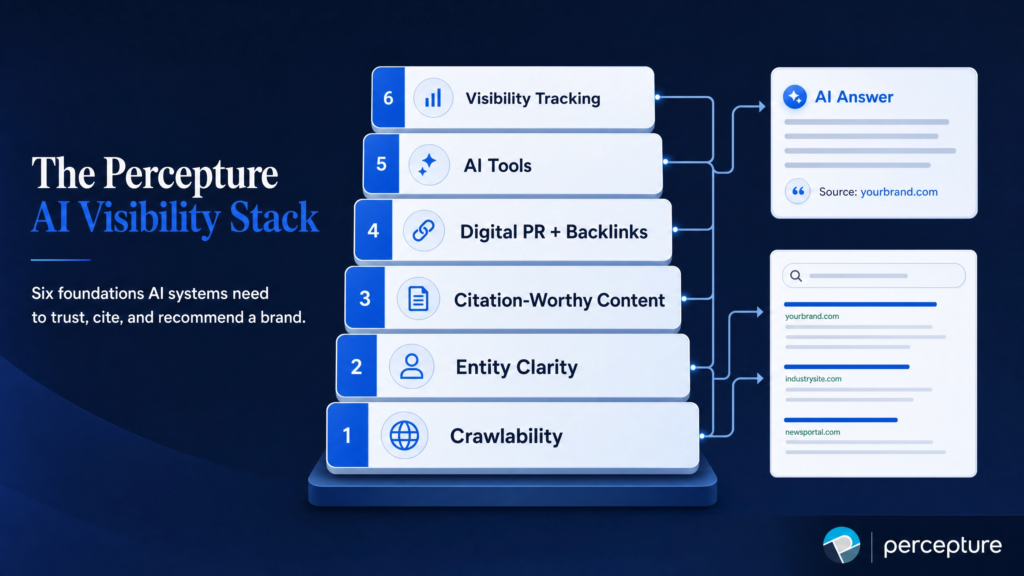
Use the measurement job to build your shortlist
The supplied competitive snapshot surfaces broad SEO suites, AI SEO platforms and dedicated ChatGPT trackers. That mix is a reason to define the measurement job before comparing candidates.
Initial research candidates—not a final ranking
The descriptions below are limited to the supplied search-result evidence and Percepture’s supplied first-party context. Verify current product behavior in a live evaluation.
| Candidate | Why it enters the research set | Evaluation job | Evidence boundary |
|---|---|---|---|
| Moz Pro | The supplied Omnia search snippet describes Moz Pro as an all-in-one SEO toolkit that tracks keyword rankings and adds AI visibility monitoring for ChatGPT. | Evaluate whether its conventional ranking and ChatGPT reporting fit the same team workflow. | The supplied evidence is a competitor article snippet, not a current product audit. |
| Semrush One | A supplied OneLittleWeb snippet names Semrush One as its best overall AI SEO tool and says it covers keyword research, site audits, competitor analysis and AI visibility tracking. | Evaluate the available SEO and AI-search workflow using a controlled demonstration. | The statement comes from the supplied publisher snippet and was not independently tested in this run. |
| LLM Pulse | LLM Pulse’s supplied search snippet describes its product as a dedicated AI visibility analytics platform built to track how brands appear in ChatGPT. | Evaluate its specialist ChatGPT-monitoring workflow. | This is the vendor’s description on its own comparison page. |
| Prime AI Visibility | Percepture’s supplied first-party evidence describes Prime AI Visibility as a measurement product for prompt monitoring, brand mentions, citations, recommendations, preserved sources, gaps, competitors and changes over time. | Evaluate whether its visibility-state distinctions and retained evidence fit the team’s process. | Prime AI Visibility is a Percepture product included here as an unranked research candidate. |
Zapier and Whatagraph also appear in the supplied results with broader SEO-tool and AI-SEO-tool roundups. The supplied snippets do not provide enough product-level evidence to add more candidates from those pages to this table.
How the candidates should be evaluated
Start with a representative prompt portfolio rather than a vendor’s preferred demo. Include branded prompts, category questions, comparison prompts, problem-led questions and prompts reflecting how an informed buyer describes the decision. Keep wording, market, timing and review procedure consistent across candidates.
ChatGPT SEO tracker evaluation checklist
| Criterion | Evidence to request | Review question |
|---|---|---|
| Prompt portfolio control | Prompt grouping, market settings, repeat schedules and the procedure for updating the set. | Can the team change the portfolio while retaining the history it needs? |
| Response and source preservation | Dated answers, source URLs and historical records available for inspection. | Can a reviewer reopen the evidence behind an observation? |
| Visibility-state separation | Definitions and examples for mentions, citations and recommendation language. | Can reviewers distinguish one state from another? |
| Competitive diagnosis | Prompt-level comparisons and the source records associated with them. | Can the team inspect why another entity appeared? |
| Referral and outcome comparison | The documented process for comparing visibility observations with available referral and conversion records. | Can the team review visibility and business records without treating correlation as proof of causation? |
| Governance and exportability | Exports, access controls, retention terms and explanations of calculated scores. | Can authorized reviewers retrieve the records needed for their decision? |
This is an editorial evaluation checklist, not a set of measured product scores. Adapt it to the organization’s buying requirements before testing.
The Source-to-Entity Conversion Ladder
This guide applies Percepture’s Source-to-Entity Conversion Ladder so that favorable AI appearances are not treated as one undifferentiated result. The stages are Sourceable, Mentioned, Cited, Recommended, Referred and Converted.
Measure the stage before prescribing the work
- Sourceable: Review whether the material can be accessed and understood as a potential source.
- Mentioned: Record whether the entity appears in the answer.
- Cited: Record whether a source associated with the entity is referenced.
- Recommended: Record whether the answer presents the entity as a possible choice.
- Referred: Review available records for a visit from the answer or source path.
- Converted: Compare the visit with the organization’s defined business-action records.
Review citations, recommendations and referrals as separate observations rather than assuming that one proves another.
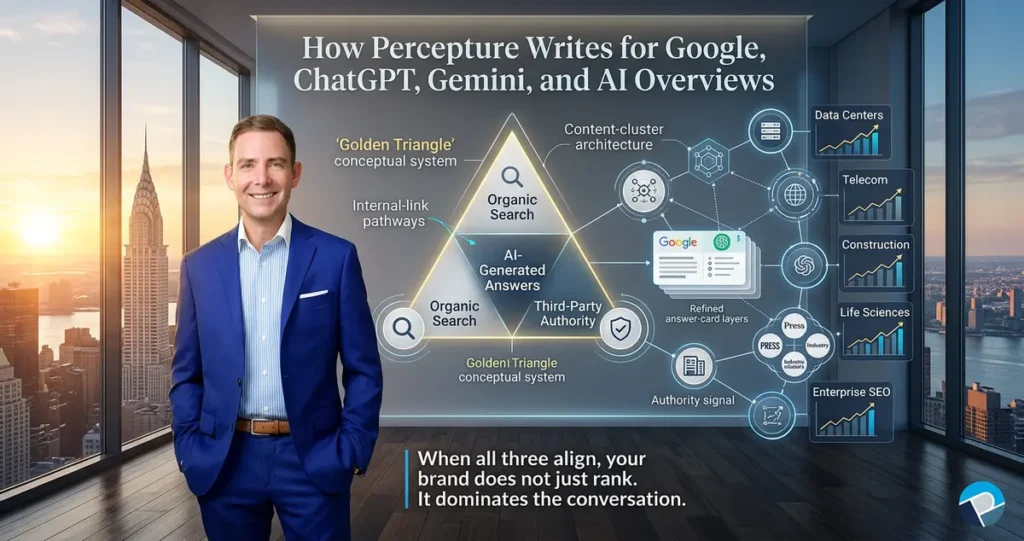
What can go wrong during a tool evaluation
The demo prompt is too favorable
Supply your own prompts and require the same run across every candidate rather than relying only on a seller-selected example.
A composite score hides the evidence
Ask the vendor to open the underlying response, source record and calculation. Then have the team document how it would translate that record into editorial, technical or reputation work.
The test confuses mentions with business impact
Decide in advance whether the current review concerns source inclusion, citation, recommendation, referral or conversion. Record each state separately.
Pricing is compared before scope
Normalize markets, prompts, competitors, users, history, exports and contract terms before comparing proposals.
Publisher relationships are hidden
Disclosure: Prime AI Visibility is a Percepture product included here as an unranked research candidate. Apply the same evaluation process to related and unrelated candidates.
Proof hygiene: what an asset can and cannot establish
Dashboards, portraits, interviews and historical search images can provide context, but an image label alone does not substantiate current product performance. Review the dated record and underlying evidence for any performance claim.
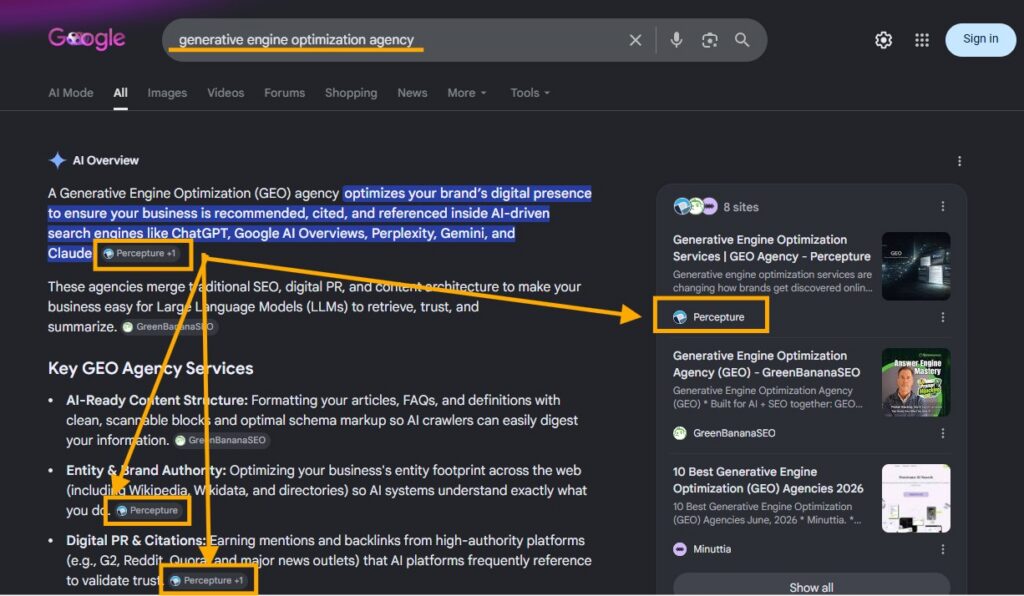
Apply the same rule to people and media
Use source-recorded people and media assets for appropriate context, not as substitutes for product evidence.



Run a controlled evaluation in three steps
- Define the decision. Write down the market, audience, entities, prompt groups, competitors and visibility states that leadership expects to review.
- Run the same evidence test. Ask each vendor to process the same prompt sample and show the retained answers, dates, sources, classifications and exports.
- Trace one finding to action. Select an observed gap and document whether it calls for source, content, technical, PR or conversion work.
If implementation—not only measurement—is the next job, Percepture’s GEO services cover the broader search and AI-visibility work. Leaders coordinating that work across paid, earned and owned channels can also review Percepture’s omnichannel approach.
Compare the measurement plan before the platform
If your team is budgeting for AI-search measurement and implementation, review Percepture’s published options before deciding which work belongs inside a tool and which requires an operating team.
Questions buyers ask about ChatGPT SEO tracking tools
How were the ChatGPT SEO tracking tools evaluated?
This guide used the supplied competitive snapshot to create a research set, then applied one editorial checklist across candidates. It does not claim hands-on product testing. Buyers should run the same representative prompt set through every shortlisted platform.
Which ChatGPT SEO tracking tool is best for a different use case or budget?
That decision depends on the buyer’s prompt volume, markets, history, users, integrations and reporting requirements. Adapt the checklist, normalize the commercial scope and compare the evidence each system preserves.
What proof should a buyer verify before choosing a tool?
Request dated responses, captured source URLs, historical records, visibility-state definitions, score calculations, export options and a demonstration using the buyer’s own prompt sample.
How current are the pricing, capabilities and rankings in this guide?
No current prices or independently verified product rankings are published here. The candidate descriptions are limited to the supplied search snippets and first-party context, so buyers should verify commercial terms and product behavior during procurement.
What relationship does Percepture have with a company included here?
Prime AI Visibility is a Percepture product included here as an unranked research candidate. Apply the same evaluation process to it and the unrelated candidates.

About Bob Generale
Bob Generale is President of Percepture.