


The best tool is not the one with the busiest dashboard. A top AI Mode SEO checker should help a marketing leader separate being visible from being cited, recommended, visited, and ultimately chosen. That distinction determines whether the software supports a business decision or merely produces another reporting screen.
Owners, CEOs, CMOs, and search leaders: define what must be measured before selecting a platform, then apply the scorecard below. It provides a transparent scorecard without manufacturing a product ranking that the available evidence cannot support.
What should an AI Mode SEO checker measure?
An AI Mode SEO checker should preserve the prompt, answer, cited sources, date, market context, and visibility state for each observation. It should also help the buyer connect AI evidence with organic search, referrals, and conversions. A single visibility score cannot explain all of those outcomes.
The buying decision in four checks
Evidence
Can an operator inspect the saved answer and source set behind a reported result?
Coverage
Can the checker organize prompts by buyer problem, comparison, objection, brand, and market?
Classification
Does it distinguish a mention from a citation, recommendation, referral, and conversion?
Action
Can the team identify which source, page, entity, or proof gap to address next?
An AI Mode checker is not a traditional site audit with a new label
A conventional SEO audit can inspect crawlability, indexability, page elements, internal links, structured data, and other website conditions. AI visibility measurement asks a different set of questions: Which prompts were tested? What answer appeared? Was the brand mentioned? Which sources were cited? Did the answer recommend a provider? Did anyone visit or convert?
The two disciplines overlap, but neither replaces the other. Google’s site-owner guidance for AI features directs publishers to established Search fundamentals rather than a separate magic markup. Read Google’s guidance for AI features.
That is why the buyer should resist software that compresses every result into one proprietary number. A summary score can help prioritize work, but the underlying observations must remain available for inspection.
The AI Mode SEO checker decision matrix
Score each candidate from 0 to 2 for every criterion: 0 means absent, 1 means partial, and 2 means the capability is inspectable and usable. Apply the same test to every vendor.
| Criterion | What to inspect | Why it matters |
|---|---|---|
| Saved answer evidence | Prompt, response, source links, timestamp, market, and device or account context where available | Lets the team audit what produced the reported observation |
| Visibility-state separation | Mention, citation, recommendation, referral, and conversion reported separately | Check whether the reporting keeps a weak appearance separate from a business outcome |
| Prompt-family design | Brand, problem, category, comparison, objection, and purchase-oriented prompts | Shows whether testing reflects the buyer journey rather than one keyword list |
| Source analysis | Domains and pages cited across the selected prompt set | Reveals which sources appear around the decision and where evidence gaps exist |
| Change tracking | Comparable observations preserved over time | Separates a one-time appearance from a pattern worth acting on |
| Search connection | Landing pages, organic queries, rankings, and search demand reviewed beside AI observations | Keeps AI reporting connected to the wider search program |
| Business connection | Referral and conversion events mapped without treating correlation as causation | Shows whether visibility reaches a meaningful next step |
| Export and auditability | Usable exports, filters, source records, and documented methodology | Allows operators to verify findings outside the dashboard |
Why this guide does not publish a fake 1-to-10 ranking
The source set supplied for this article does not support a fair product ranking with verified current features, pricing, test results, and limitations for every candidate. Publishing a numbered list anyway would turn search-result visibility and competitor descriptions into product evidence.
Use the matrix as a controlled vendor test instead. Give each vendor the same prompt set, ask for the same exports, inspect the same saved answers, and document any missing evidence. The result will be more useful than a universal ranking because it reflects your markets, entities, risks, and buyer questions.
The supplied GSC export contains no sufficiently close query for this exact target. That makes this page a discovery asset rather than proof that Percepture already owns the query.
Use visibility states instead of one blended score
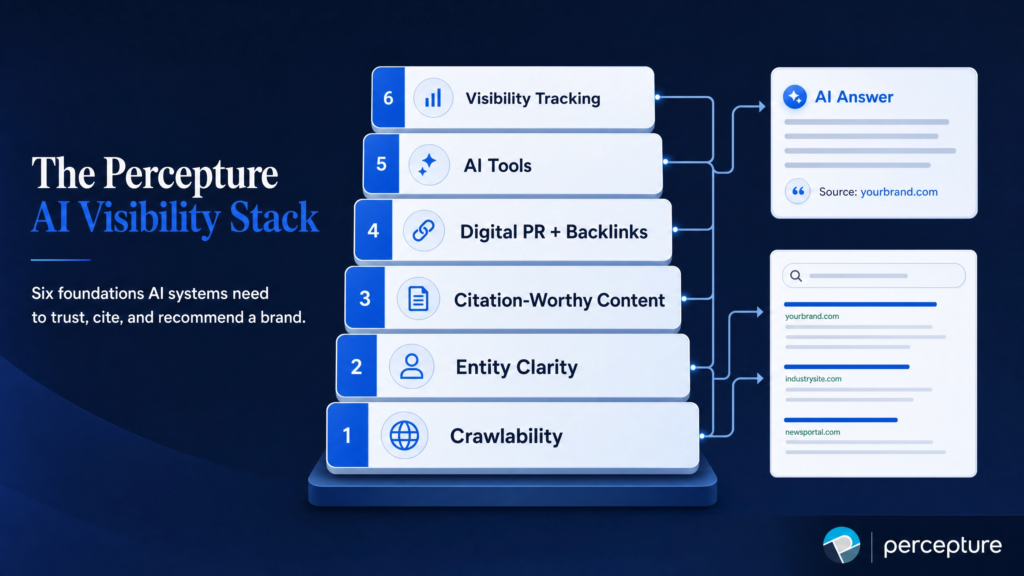
Percepture’s Source-to-Entity Conversion Ladder separates six states: Sourceable, Mentioned, Cited, Recommended, Referred, and Converted.
- Sourceable: The page is accessible, understandable, and suitable for retrieval.
- Mentioned: The entity appears in an answer.
- Cited: The answer identifies the entity’s page or another page as a source.
- Recommended: The answer presents the entity as an option for the user’s stated need.
- Referred: The answer or source path produces a visit that can be observed.
- Converted: The visitor completes a defined business action.
Score these states separately rather than treating them as interchangeable. A citation is useful evidence, but it is not automatically a recommendation, referral, or conversion.
Place AI Mode measurement inside the full search landscape
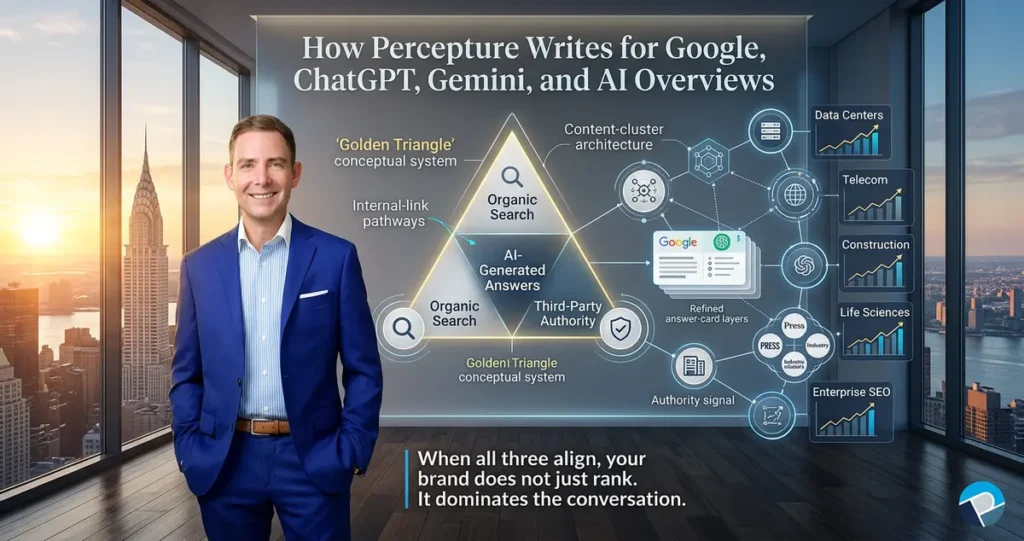
Percepture’s Golden Triangle is a visibility model for an AI answer or overview presence, a strong organic position, and a prominent supporting search feature. It is not a Google ranking factor.
The model gives marketing leaders a practical boundary: an AI checker can observe one part of the landscape, but the operating plan still has to account for the source page, organic visibility, supporting proof, and the buyer’s next step.
If measurement exposes implementation gaps, Percepture’s GEO services address the strategy and execution side of the work. Measurement and implementation should be evaluated as separate jobs.
What usable AI visibility evidence looks like
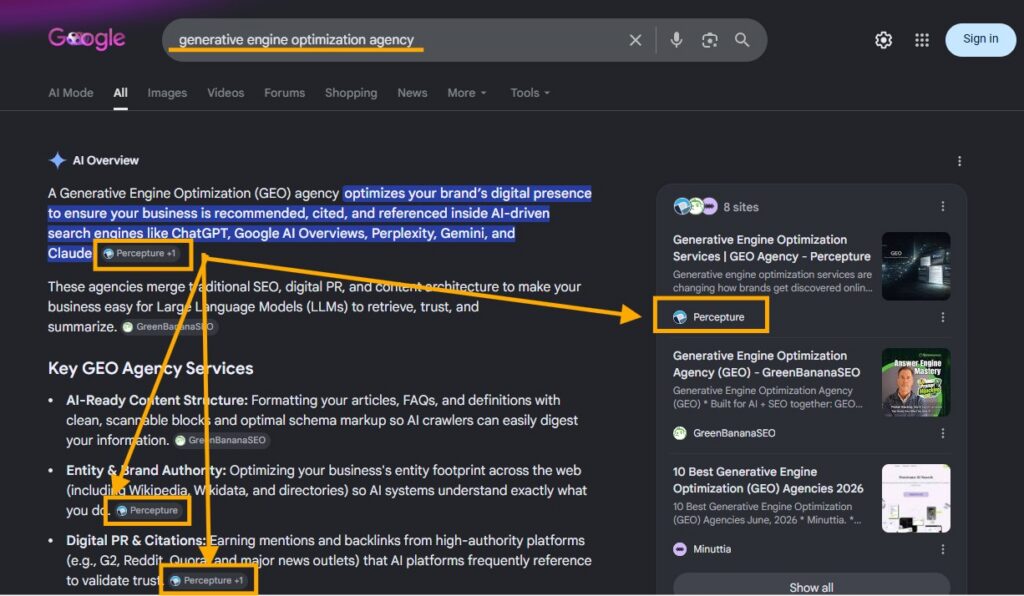
A screenshot can explain a method, but its label or appearance cannot prove a current ranking, customer outcome, or product capability. Preserve dates and source records, then verify the associated claim independently.
Do not confuse identity assets with performance evidence
Expert portraits and event images can establish identity or context. They do not establish software accuracy, rankings, revenue, or client outcomes. The same evidence rule should govern every vendor under review.



Run this test before signing a contract
- Define the decision. Write down whether the team needs monitoring, technical auditing, content guidance, source analysis, reporting, or implementation support.
- Build prompt families. Group close questions under one buyer job instead of treating every wording as a separate campaign.
- Create a baseline. Save the prompts, answers, citations, dates, markets, and organic landing-page information before changing the site.
- Test every vendor equally. Use the same prompts, entities, dates, markets, and scoring rules.
- Inspect the underlying records. Do not accept a percentage or sentiment label without the observations that produced it.
- Assign the next action. Decide whether each gap calls for technical repair, stronger content, clearer entity information, third-party corroboration, or better conversion tracking.
- Repeat the sample. Compare preserved observations rather than relying on memory or an undated screenshot.
Where AI Mode measurement goes wrong
The prompt set reflects the marketer, not the buyer
A brand-only prompt list can make visibility look reassuring while ignoring category, problem, comparison, risk, and purchase questions. Begin with the person and the decision journey, then select prompts that represent those moments.
A mention is reported as a win
Being named can matter, but the answer may be neutral, negative, incidental, or unsupported by a citation. Preserve enough context to classify what actually happened.
The dashboard hides the source trail
Require access to the answer and cited pages before asking the team to diagnose why a competitor appeared or which evidence to strengthen.
Organic and AI reporting live in separate rooms
AI observations become easier to act on when they are reviewed beside the site’s established search data. Percepture’s attribution and analytics work provides a relevant next step when the larger problem is connecting visibility with user behavior.
Visibility has no path to a buyer action
The channel is not the strategy; the specific person and decision journey are the strategy. A useful measurement plan therefore continues past exposure and asks what proof, page, conversation, or conversion should follow.
A fast readiness score
- Add one point if your team has a documented buyer-oriented prompt set.
- Add one point if every observation preserves an answer, source set, and date.
- Add one point if mentions, citations, and recommendations are separated.
- Add one point if organic query and landing-page data are reviewed alongside AI observations.
- Add one point if referrals and conversions have defined measurement rules.
- Add one point if each reported gap has an owner and next action.
A low score does not automatically mean a vendor is unsuitable. It means the evaluation lacks enough structure to support a confident decision.
Compare the implementation path
If the scorecard exposes a measurement or execution gap, review Percepture’s available service investment paths before deciding whether software alone will solve it.
Questions buyers ask about AI Mode SEO checkers
What should a buyer measure when evaluating a top AI Mode SEO checker?
Measure evidence preservation, prompt-family coverage, visibility-state separation, source analysis, change tracking, organic-search connections, referrals, conversions, exports, and methodology transparency. Score every vendor against the same test.
How are organic ranking, AI mention, citation, recommendation, referral, and conversion different?
Organic ranking describes a page’s position in conventional search results. An AI mention names an entity, a citation identifies a source, a recommendation presents an option, a referral produces a visit, and a conversion records a defined business action. They should be reported separately.
Which prompt families belong on one canonical page?
Keep close variants together when they serve the same audience and decision. Before creating a support page, check whether the buyer job, platform, candidate set, vertical, geography, or evidence requirement materially changes.
How should GSC and saved AI answers be connected?
Use GSC to understand organic queries, pages, impressions, clicks, and positions. Review those records beside dated AI prompts, answers, citations, and referrals. Do not merge the measurements into one score or claim that one caused the other without supporting analysis.
What can cause the strategy to fail even when visibility increases?
The observed prompts may not represent buyers, the mention may lack useful context, the cited page may not answer the next question, attribution may be incomplete, or the experience may not offer a credible next step. Increased visibility alone does not establish business impact.
Turn the scorecard into a measurement plan
Bring your candidate platforms, buyer questions, and current reporting structure. Percepture can help define what should be measured before tools and implementation work are selected.

About Bob Generale
Bob Generale is President of Percepture. His work connects search strategy, AI visibility, digital PR, paid media, reputation, analytics, and the buyer journey so marketing evidence can lead to a useful business decision.