
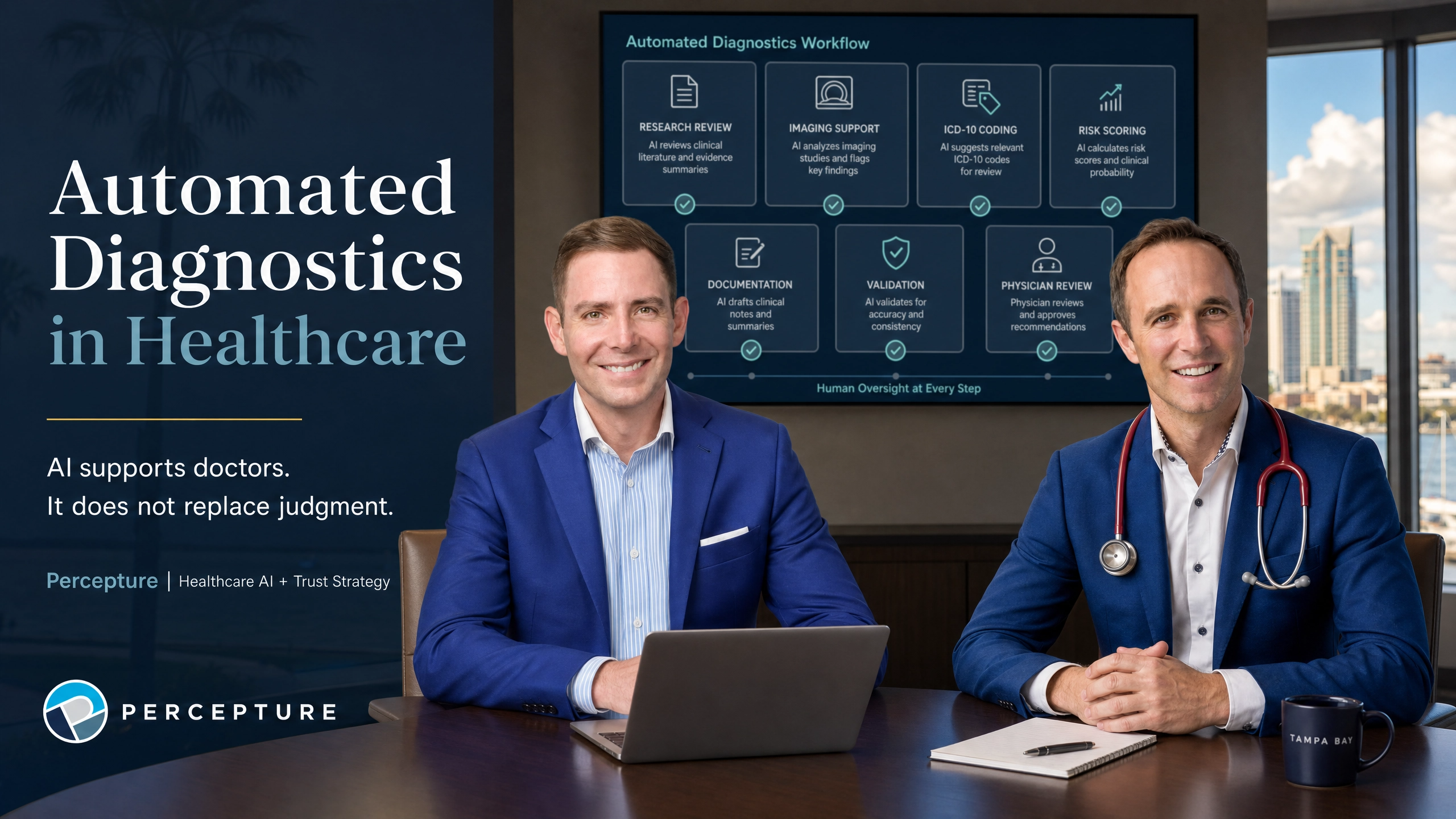

Automated diagnostics in healthcare use AI, machine learning, imaging analysis, clinical data, and decision-support tools to help doctors find patterns, summarize research, support coding, and improve diagnostic speed. They should not replace physician judgment. The safest systems augment doctors with validated outputs, human review, patient communication, and clear clinical accountability.
This guide explains where automated diagnostics help, where they fall short, and how healthcare leaders can adopt AI responsibly—without losing the trust of patients or the judgment of physicians.
Who This Guide Is For
This article is for:
- Healthcare executives and founders evaluating AI diagnostic tools
- VP Marketing and communications leaders explaining AI use to patients and the public
- Practice operators and compliance officers managing risk and governance
- Physicians and clinical leaders deciding where AI fits in their workflow
- Healthcare marketers building trust-forward content about AI
If you are responsible for adopting, explaining, or governing AI in a healthcare setting, this guide is for you.
Definition: What Are Automated Diagnostics in Healthcare?
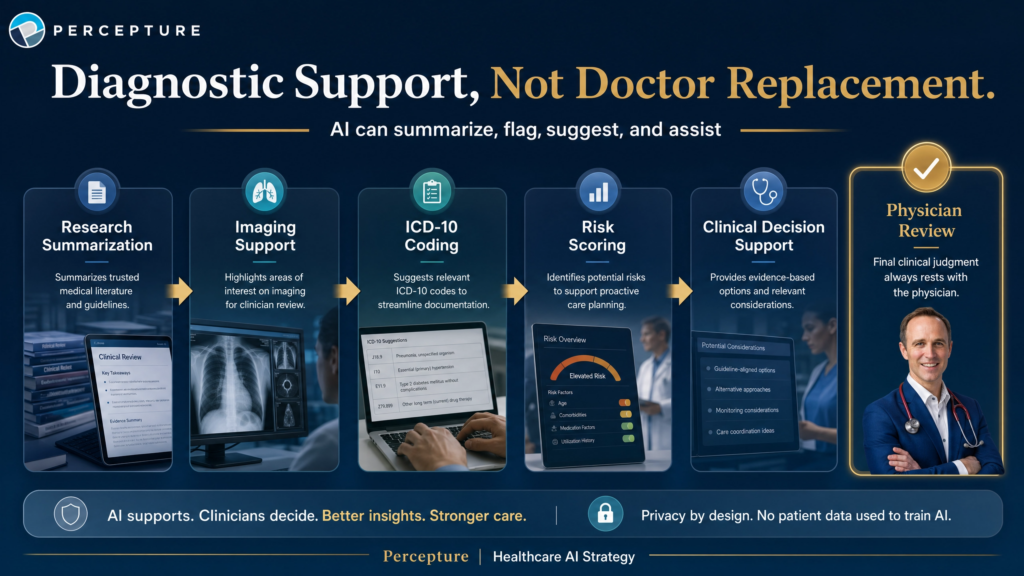
Automated diagnostics in healthcare: The use of AI, machine learning, software, imaging tools, or clinical decision-support systems to assist with diagnosis, risk detection, coding, research review, or diagnostic workflow. Automated diagnostics should support—not replace—licensed clinical judgment.
What You’ll Learn
- How AI is used in healthcare diagnostics today
- Where automated diagnostics help doctors
- Where AI falls short—and why physicians still matter
- A physician-led framework for evaluating diagnostic AI
- What the FDA says about AI-enabled medical devices
- How to talk about AI diagnostics without losing patient trust
- Common mistakes healthcare brands make when discussing AI diagnosis
- FAQs for healthcare leaders and buyers
For Healthcare Leaders
Not sure where AI can help—and where it can’t?
Percepture helps healthcare brands explain AI responsibly, build search visibility, and turn physician expertise into trust-building content.
Request a Healthcare AI Trust ReviewHow AI Is Used in Healthcare Diagnostics
AI is already part of healthcare, especially if you are a healthcare marketing agency. The question is not whether AI will be used—it is how, where, and under what oversight.
Here are the most common ways AI Agents in healthcare are using diagnostics today:
1. Research Summarization
AI tools can summarize hundreds of PubMed articles in seconds. This helps physicians find relevant research faster—especially for rare conditions or nuanced diagnostic questions.
2. Medical Imaging Support
AI can flag patterns in radiology, cardiology, and pathology images. Some FDA-authorized tools assist with skin cancer detection, diabetic retinopathy screening, and cardiac risk scoring.
3. ICD-10 and Documentation Support
AI can suggest ICD-10 codes for imaging orders, helping ensure insurance coverage and reducing administrative burden. AI scribes can draft clinical notes in real time, saving physicians hours per week.
4. Risk Scoring and Pattern Detection
AI can analyze patient data to identify trends, flag high-risk patients, and support population health management.
5. Clinical Decision Support
Some AI tools provide diagnostic suggestions based on symptoms, lab results, and patient history. These tools are meant to support—not replace—physician decision-making.
Automated Diagnostics vs. AI Diagnosis vs. Clinical Decision Support
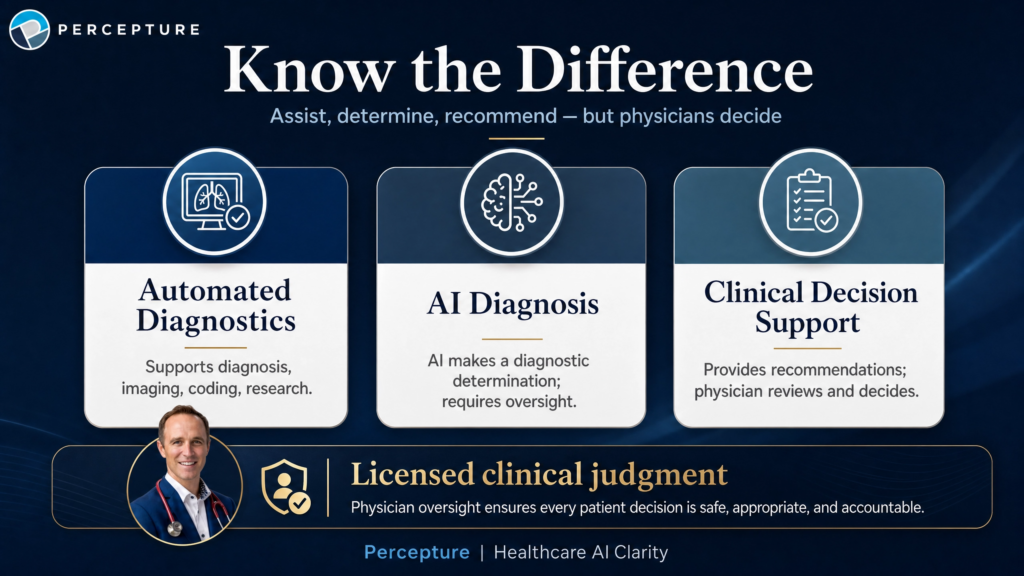
These terms are often used interchangeably, but they mean different things:
| Term | What It Means | Who Decides |
|---|---|---|
| Automated diagnostics | AI-assisted tools that support diagnosis, imaging, coding, or research | Physician reviews and decides |
| AI diagnosis | AI making a diagnostic determination | Should require physician oversight |
| Clinical decision support | Software that provides recommendations based on patient data | Physician reviews and decides |
Key point: Automated diagnostics should be treated as diagnostic support unless the tool is validated, cleared, authorized, and deployed under a licensed clinical workflow.
Where AI Helps Doctors
Dr. Justin Burkholder, a board-certified emergency medicine physician and founder of Olympic Concierge Medicine, has seen AI change his practice firsthand.
“AI has definitely changed my practice. It summarizes, for example, PubMed… hundreds of articles in seconds.”
— Dr. Justin Burkholder
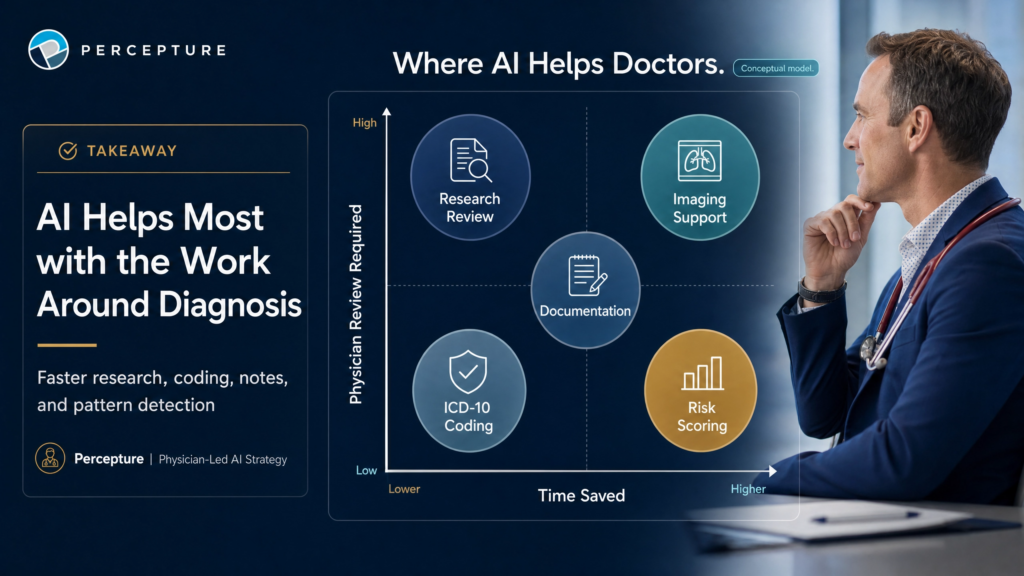
Here is where AI helps most:
| Diagnostic Task | How AI Helps |
|---|---|
| Research review | Summarizes articles quickly |
| Imaging support | Flags patterns in scans |
| ICD-10 coding | Finds likely codes for imaging orders |
| Risk scoring | Spots trends in patient data |
| Documentation | Drafts clinical notes in real time |
AI can make doctors faster, better informed, and more efficient. But speed is not the same as accuracy—and efficiency is not the same as judgment.
Where Automated Diagnostics Fall Short

Dr. Burkholder is clear about the limits:
“There’s no replacement for real-world experience.”
— Dr. Justin Burkholder
“I don’t think it’s a good idea at this point yet… that it should be diagnosing patients without a physician’s expertise and exam and insight.”
— Dr. Justin Burkholder
What AI Cannot Do
| What AI Misses | Why It Matters |
|---|---|
| Physical exam | AI cannot touch, listen, or palpate |
| Patient context | AI may not know the full story |
| Clinical judgment | AI cannot weigh competing risks |
| Empathy and communication | AI cannot explain a diagnosis to a scared patient |
| Accountability | AI cannot be held liable for a wrong diagnosis |
Dr. Burkholder explains:
“There’s a lot of information we get from listening to the heart, listening to the lungs, palpating someone’s abdomen to rule out appendicitis.”
AI can summarize research. It cannot feel a patient’s abdomen, hear the subtle crackle in a lung, or see the fear in a patient’s eyes and adjust the conversation accordingly.
The Physician-in-the-Loop Diagnostic AI Framework
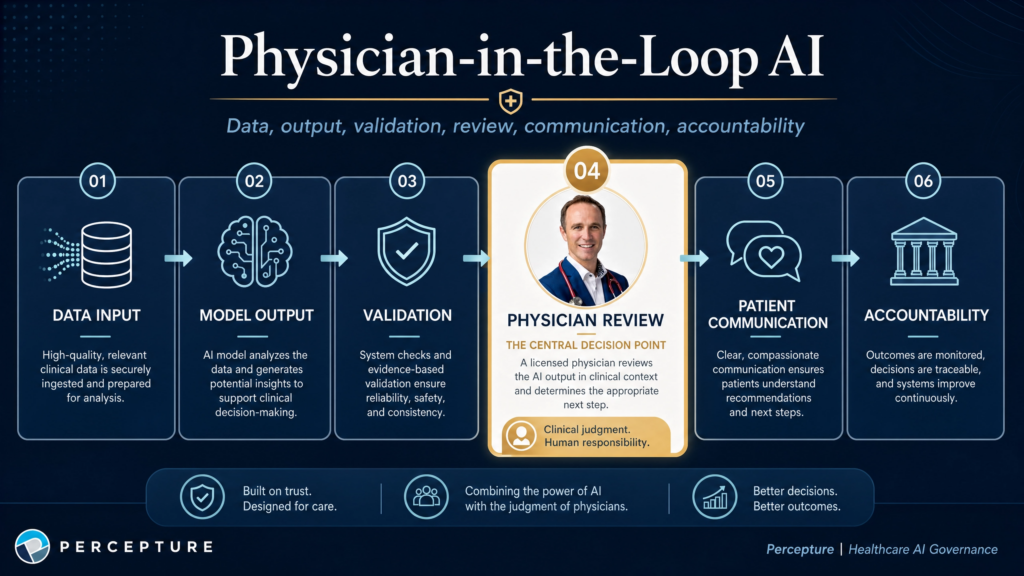
Percepture developed this framework to help healthcare leaders evaluate where automated diagnostics can help, where AI needs validation, and where licensed clinical judgment must remain in control.
The Physician-in-the-Loop Diagnostic AI Framework
| Layer | Question |
|---|---|
| Data Input | What data is the AI using? |
| Model Output | Is the AI summarizing, flagging, predicting, or recommending? |
| Validation | Has the tool been clinically validated or FDA-authorized where required? |
| Physician Review | Who reviews the output before action? |
| Patient Communication | How is AI involvement explained to the patient? |
| Accountability | Who is responsible if the recommendation is wrong? |
This framework is how Percepture helps healthcare brands evaluate AI adoption responsibly.
FDA, AI-Enabled Medical Devices, and Clinical Validation
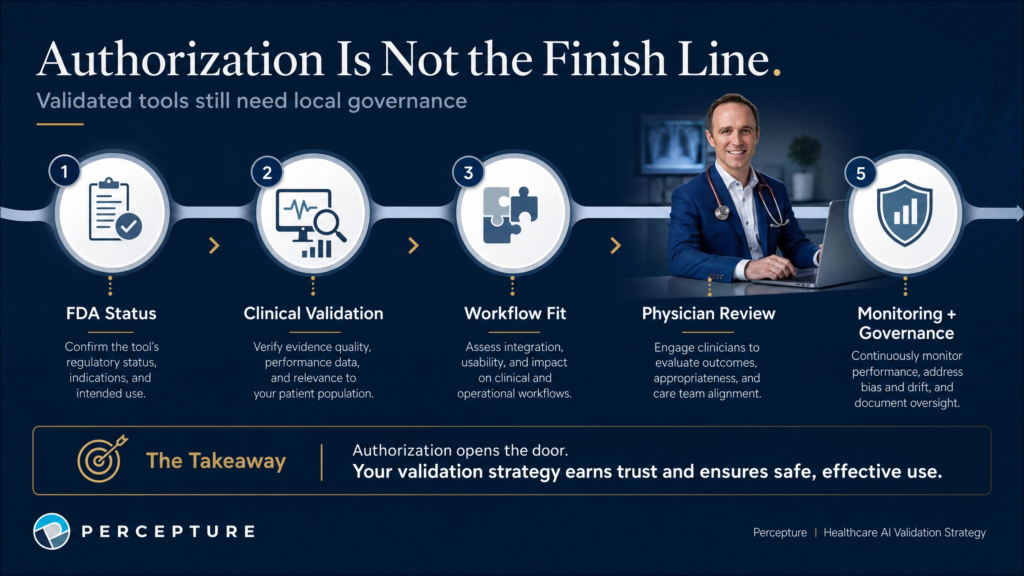
The FDA says AI/ML technologies can derive insights from healthcare data and help medical device manufacturers assist providers and improve care. But the FDA also stresses careful management across the medical product lifecycle.
The FDA’s AI-enabled medical devices list identifies AI-enabled devices authorized for U.S. marketing. The FDA says listed devices have met applicable premarket requirements and that the list supports transparency for providers and patients.
What this means for healthcare leaders:
- FDA authorization does not remove the need for local governance
- Validation depends on data, workflow, and physician review
- Not all AI tools are FDA-authorized—ask before you adopt
Recent Reuters reporting has highlighted safety concerns around AI-enabled medical devices, including adverse-event reports involving software, algorithm, and programming issues.
Key takeaway: Validated AI still needs clinical oversight.
AI Diagnostics, HIPAA, and Patient Trust
If your organization uses AI in diagnosis, patients may want to know:
- Is AI involved in my care?
- Who reviews the AI’s output?
- Is my data protected?
- Who is responsible if something goes wrong?
Healthcare brands that explain AI use clearly—without overclaiming or hiding—build trust. Those that do not risk confusion, complaints, and reputational damage.
For more on privacy and safeguards, see AI and HIPAA.
How PYRA and Percepture Think About Governed Healthcare AI
PYRA builds and runs AI agents for real workflows across Sales, Finance, Marketing, and Operations. Each agent is industry-trained for Healthcare, Life Sciences, and Pharma.
PYRA’s healthcare workflows include policy, RCM, intake, and documentation. PYRA lists audit logs, approval gates, client-instanced architecture, SOC 2 Type II, and HIPAA Compliant.
Important: PYRA supports governed AI workflows. Diagnostic decisions still require qualified clinical oversight.
Percepture helps healthcare brands explain AI responsibly, build search visibility, and turn physician expertise into trust-building content. Together, Percepture and PYRA offer a responsible path to AI adoption—without replacing the physician.
Healthcare AI Governance
Map Where AI Can Help—Without Replacing Clinical Judgment
Percepture and PYRA help healthcare organizations adopt AI responsibly, with physician oversight, audit trails, and trust-forward content.
See PYRA Healthcare AI Agents See PricingWhat Most Automated Diagnostics Articles Miss
| What Competitors Usually Say | What Percepture Adds |
|---|---|
| AI can help diagnose disease | AI can support diagnosis, but doctors still need exam, context, and accountability |
| AI tools are getting more accurate | Accuracy depends on data, validation, workflow, and physician review |
| AI can reduce costs | Poorly governed AI can create liability, rework, and patient trust issues |
| FDA-authorized tools exist | FDA authorization does not remove the need for local governance |
| AI can summarize medical research | Doctors still need to interpret findings for the actual patient |
What Healthcare Leaders Should Ask Before Using Diagnostic AI
Before adopting any AI diagnostic tool, ask:
- What data does the AI use?
- Is the tool FDA-authorized or clinically validated?
- Who reviews the AI’s output before action?
- How is AI involvement explained to patients?
- Who is responsible if the AI is wrong?
- Does the tool integrate with our EHR?
- What audit logs and approval gates exist?
- How do we train staff to use the tool safely?
- What happens if the AI fails or produces a false positive/negative?
- How do we communicate AI use to patients and the public?
How Automated Diagnostics Connect to Healthcare SEO, GEO, and Trust
If your healthcare brand talks about AI diagnostics, your content must be clear, accurate, and trustworthy. AI search systems—including Google AI Overviews, ChatGPT, Perplexity, and Claude—are increasingly surfacing healthcare content in response to patient and buyer questions.
Healthcare brands that publish physician-led, proof-driven content about AI diagnostics can:
- Rank in Google and AI search for high-intent queries
- Build trust with patients, partners, and regulators
- Differentiate from competitors who overclaim or underexplain
For more on AI search visibility, see generative engine optimization services.
Common Mistakes Healthcare Brands Make When Discussing AI Diagnosis
- Overclaiming accuracy — AI is not always right. Say so.
- Hiding AI involvement — Patients want to know. Tell them.
- Ignoring liability — If AI is wrong, who is responsible?
- Skipping validation — Not all AI tools are FDA-authorized.
- Forgetting the physician — AI should augment, not replace.
- Using generic content — Physician-led, proof-driven content wins.
- Ignoring patient trust — Trust is earned, not assumed.
Dr. Burkholder’s Perspective
Dr. Justin Burkholder is a board-certified emergency medicine physician and founder of Olympic Concierge Medicine, and is a conceirge doctor in Tampa Bay. He has served as a physician for Olympic athletes and brings real-world clinical experience to the AI diagnostics conversation.
“I think right now AI is really meant to augment physicians. I don’t think it’s a good idea at this point yet… that it should be diagnosing patients without a physician’s expertise and exam and insight.”
— Dr. Justin Burkholder
Watch the full video and read the transcript below.
Pricing and ROI: What Does It Cost to Evaluate or Implement Diagnostic AI?
There is no single price for AI diagnostics. Cost depends on:
- Vendor review and selection
- Clinical validation and pilot testing
- EHR integration
- Staff training
- HIPAA/security review
- Patient communication and consent workflows
- Ongoing monitoring and governance
For organizations evaluating AI content strategy, SEO, GEO, or trust-building content, see AI search SEO pricing.
FAQs: Automated Diagnostics in Healthcare
What are automated diagnostics in healthcare?
Automated diagnostics in healthcare use AI, machine learning, imaging tools, or clinical decision-support systems to assist with diagnosis, risk detection, coding, research review, or diagnostic workflow. They should support—not replace—licensed clinical judgment.
How is AI used in healthcare diagnostics?
AI is used to summarize medical research, flag patterns in imaging, suggest ICD-10 codes, draft clinical notes, score patient risk, and support clinical decision-making. Physicians review and approve AI outputs before action.
Can AI diagnose patients?
AI can support diagnosis, but it should not diagnose patients without physician oversight. Physical exams, patient context, clinical judgment, and accountability require a licensed clinician.
Are AI diagnostic tools FDA approved?
Some AI diagnostic tools are FDA-authorized. The FDA maintains a list of AI-enabled medical devices that have met applicable premarket requirements. Not all AI tools are FDA-authorized—ask before you adopt.
Where does AI help doctors most?
AI helps doctors most with research summarization, imaging support, ICD-10 coding, documentation, and risk scoring. AI can make doctors faster and better informed.
Where does AI fall short in diagnosis?
AI falls short in physical exams, patient context, clinical judgment, empathy, communication, and accountability. AI cannot touch, listen, or palpate. It cannot be held liable for a wrong diagnosis.
Should patients know when AI is used?
Yes. Patients should be informed when AI is involved in their care. Transparency builds trust and supports informed consent.
What is physician-in-the-loop AI?
Physician-in-the-loop AI means a licensed clinician reviews and approves AI outputs before action. The physician remains accountable for the diagnosis and treatment plan.
How does PYRA fit into healthcare AI workflows?
PYRA builds and runs AI agents for healthcare workflows including policy, RCM, intake, and documentation. PYRA supports governed AI workflows with audit logs, approval gates, and HIPAA-conscious architecture. Diagnostic decisions still require qualified clinical oversight.
How should healthcare brands talk about AI diagnostics?
Healthcare brands should explain AI use clearly, avoid overclaiming, acknowledge limits, and emphasize physician oversight. Physician-led, proof-driven content builds trust with patients, partners, and AI search systems.
Ready to Talk About Healthcare AI the Right Way?
Percepture helps healthcare brands explain AI responsibly, build search visibility, and turn physician expertise into trust-building content.
Talk to Percepture See PricingAbout the Author
Bob Generale is often refered to as the “navy seals of marketing” and nicknamed “The Magician” for his work with SEO, being able to make any result appear or disappear through SEO reputation management services. He is the President and lead innovator of Percepture, a search, AI visibility, and digital PR agency that helps healthcare, life sciences, and technology brands build trust and rank in Google and AI search. Bob has led SEO, GEO, and content strategy for Fortune 500 companies, healthcare systems, and high-growth startups. He believes the brands that win with AI content will be the clearest about where AI helps, where doctors lead, and where trust cannot be automated.
Connect with Bob on LinkedIn: Best AI SEO Expert
About Dr. Justin Burkholder
Dr. Justin Burkholder is a board-certified emergency medicine physician and founder of Olympic Concierge Medicine in Tampa Bay. He has served as a physician for Olympic athletes at the Rio Games in Brazil and brings real-world clinical experience to the AI diagnostics conversation.
About PYRA
PYRA builds and runs AI agents for real workflows across Sales, Finance, Marketing, and Operations. Each agent is industry-trained for Healthcare, Life Sciences, and Pharma. PYRA supports governed AI workflows with audit logs, approval gates, client-instanced architecture, SOC 2 Type II, and HIPAA Compliant.
Learn more about PYRA Healthcare AI Agents
What to Do Next
If you are evaluating AI diagnostics, building healthcare AI content, or trying to explain AI use to patients and the public, Percepture can help.
- Request a Healthcare AI Trust Review — Map where AI can help and where physicians must lead.
- See PYRA Healthcare AI Agents — Explore governed AI workflows for healthcare.
- Talk to Percepture — Get a 20-minute working session with Bob.
Connect with us today!
This article is for informational purposes only and does not constitute medical advice. Diagnostic decisions should be made by licensed clinicians.