

SEO keywords for hotels are the search terms that help hotel websites rank for the right demand, attract the right traveler, and support more direct bookings. But most hotels do not have a keyword problem. They have a keyword strategy problem. They often target broad terms that look appealing in a report, but do not line up with the hotel’s location, audience, offerings, or page structure.
The best hotel keywords are not always the biggest ones. In many cases, the strongest opportunities come from local modifiers, amenity intent, package searches, group sales demand, and long-tail phrases tied to how real travelers compare options before they book.
Percepture approaches hotel keyword strategy through the lens of hospitality visibility, search intent, direct booking performance, and large-site architecture. As a travel public relations and marketing agency with deep hospitality experience, we understand that keyword selection is really about organizing demand into the right buckets. That is what makes this page different from a generic keyword list.
Quick Definition
SEO keywords for hotels are the words and phrases travelers, planners, and guests use when searching for hotel rooms, amenities, locations, experiences, meetings, events, and booking options online.
What Are SEO Keywords for Hotels?
SEO keywords for hotels are the specific words and phrases that travelers type into Google, Bing, and AI search tools when looking for places to stay. These keywords connect search demand to your hotel’s website. When your pages match what travelers are searching for, you have a better chance of appearing in results and earning direct bookings.
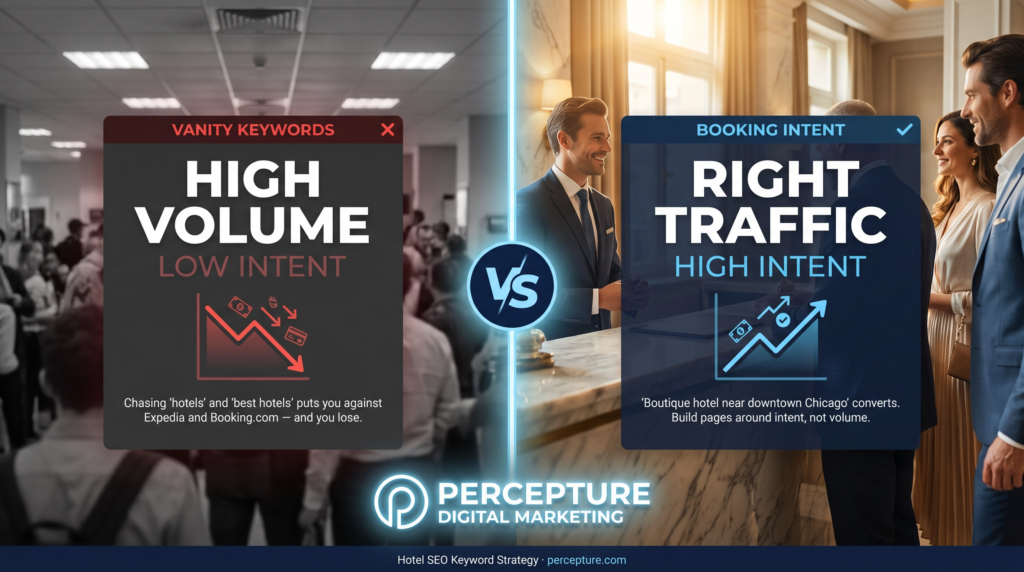
But not all hotel keywords are equal. Some keywords bring high traffic with low intent. Others bring smaller numbers of visitors who are ready to book. The difference between a useful keyword and a vanity keyword often comes down to how well it matches your hotel’s actual offerings and the traveler’s real intent.
Strong hotel keyword strategy means choosing terms that align with your property type, location, amenities, and revenue goals. A boutique hotel in Miami needs different keywords than a convention hotel in Chicago. A luxury resort needs different keywords than an extended-stay property near an airport.
The goal is not just traffic. The goal is the right traffic, on the right pages, at the right stage of the booking journey.
Why Most Hotels Target the Wrong Keywords
Many hotels chase broad keywords that look impressive in reports but fail to deliver bookings. Terms like “hotels” or “best hotels” have massive search volume, but they also have massive competition and unclear intent. A traveler searching “hotels” could be anywhere in the world, looking for anything from a budget motel to a five-star resort.
This is where most hotel keyword strategies break down.
High Volume Does Not Always Mean High Value
A keyword with 50,000 monthly searches sounds better than one with 500. But if the high-volume keyword brings visitors who bounce immediately or never convert, it costs you time and resources without delivering revenue.
Hotels often rank for terms that do not match their actual offerings. A family resort might rank for “romantic getaway” and attract the wrong audience. A business hotel might rank for “beach vacation” and confuse potential guests.
Why Broad Hotel Keywords Underperform
Broad keywords also put you in direct competition with OTAs like Expedia, Booking.com, and TripAdvisor. These platforms dominate generic hotel searches because they aggregate thousands of properties. Competing head-to-head on “hotels in New York” is expensive and often futile.
The smarter approach is targeting keywords where your hotel has a natural advantage. Local modifiers, specific amenities, unique experiences, and booking-intent phrases give you a better chance of ranking and converting.
According to Phocuswright research, direct bookings remain a priority for hotels seeking to reduce OTA commission costs, which can range from 15% to 30% per reservation. The right keyword strategy supports that goal.
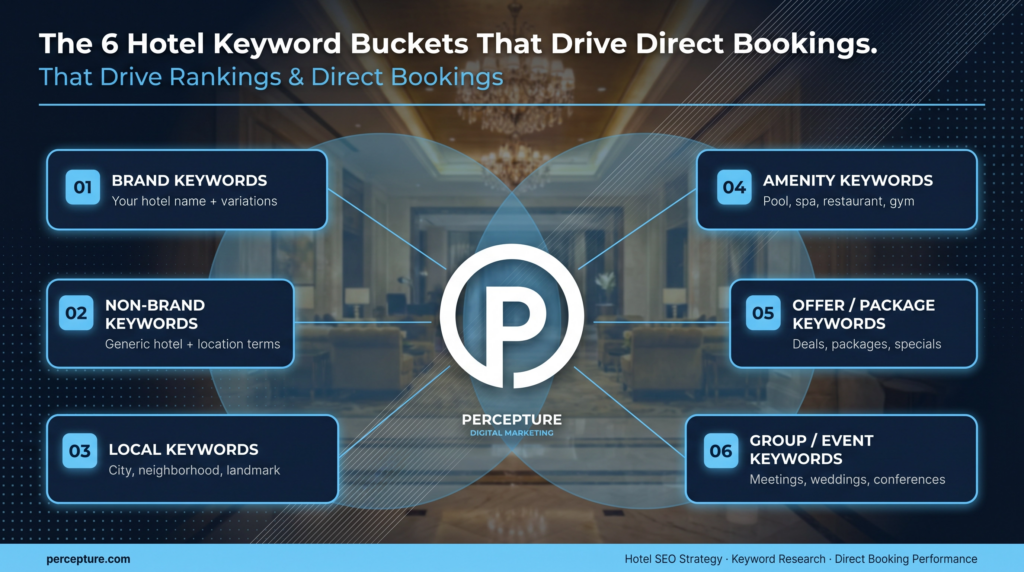
The 6 Hotel Keyword Buckets That Matter Most
1. Brand Keywords
Your hotel name + variations
2. Non-Brand Keywords
Generic hotel + location terms
3. Local Keywords
City, neighborhood, landmark
4. Amenity Keywords
Pool, spa, restaurant, gym
5. Offer/Package Keywords
Deals, packages, specials
6. Group/Event Keywords
Meetings, weddings, conferences
The Best SEO Keyword Buckets for Hotels
The best keywords for hotels fall into distinct categories. Each bucket serves a different purpose and belongs on different pages. Understanding these buckets is the foundation of smart hotel keyword strategy.
Brand vs Non-Brand Keywords
Brand keywords include your hotel name, property name, and branded variations. These are essential to protect and should drive traffic to your homepage and booking pages. Non-brand keywords are generic terms like “downtown hotel” or “beachfront resort” that capture travelers who do not know your property yet.
Direct-Booking and Offer Keywords
Offer keywords signal high booking intent. Terms like “hotel deals,” “weekend packages,” “spa getaway special,” or “book direct discount” attract travelers ready to convert. These keywords belong on dedicated offer and package pages, not buried in blog content.
Group and Event Demand Keywords
This is where many hotels miss major opportunities. Keywords like “meeting space,” “conference hotel,” “wedding venue,” “corporate retreat,” and “event hotel” capture planners and business travelers with significant booking value.
Percepture’s hospitality content work includes messaging around group sales, business travel, and event-driven hotel demand. Hotels that build dedicated pages for these keywords often see stronger revenue per booking than those focused only on leisure travelers.
How Search Intent Changes the Best Keywords for Hotels
The same hotel should target different keyword types for different pages. Understanding search intent helps you match keywords to the right content.
Informational Hotel Keywords
Informational keywords signal research mode. Terms like “best time to visit Miami” or “what to do near downtown Chicago” attract travelers early in their journey. These keywords belong on blog posts and destination guides, not booking pages.
Transactional Hotel Keywords
Transactional keywords signal booking intent. Terms like “book hotel room,” “reserve suite,” or “hotel deals this weekend” attract travelers ready to convert. These keywords belong on room pages, offer pages, and booking-focused landing pages.
Comparison and Local-Intent Hotel Keywords
Comparison keywords like “best hotels in [city]” or “top boutique hotels near [landmark]” attract travelers comparing options. Local-intent keywords like “hotel near convention center” or “downtown hotel with parking” attract travelers with specific location needs.
Understanding where each keyword fits in the customer journey helps you build pages that match traveler expectations and drive conversions.
VIDEO: How Hotels Choose the Right SEO Keywords
Watch our 90-second breakdown of hotel keyword strategy, including how to match keywords to pages and prioritize booking intent over vanity traffic.
See Below
Best Hotel Keywords by Property Type
Keyword strategy changes based on your hotel type and target audience. What works for a boutique hotel will not work for a convention center property.
Best Keywords for Boutique Hotels
Boutique hotel keywords often overlap with design, neighborhood character, curated experiences, walkability, and romantic stays. Strong terms include:
- “boutique hotel in [neighborhood]”
- “design hotel [city]”
- “romantic boutique hotel”
- “unique hotel experience [location]”
- “small luxury hotel near [landmark]”
Boutique properties should emphasize personality and location specificity in their keyword targeting.
Best Keywords for Luxury Hotels
Luxury hotel keywords overlap with spa services, fine dining, premium room types, ocean views, concierge services, and exclusive packages. Strong terms include:
- “luxury hotel [destination]”
- “5-star hotel with spa”
- “oceanfront luxury resort”
- “penthouse suite [city]”
- “exclusive hotel packages”
Best Keywords for 5-Star Hotels
Five-star hotel keywords emphasize prestige, amenities, destination appeal, and premium booking intent. These properties should target terms that signal high-value travelers seeking exceptional experiences.
Business and Group Demand Keywords
Business and group hotel keywords overlap with meeting space, conference facilities, corporate travel, event venues, and room blocks. Strong terms include:
- “conference hotel [city]”
- “hotel with meeting rooms”
- “corporate retreat venue”
- “wedding hotel [location]”
- “group hotel rates”
Percepture’s hospitality references include work tied to Marcus Hotels and properties such as Grand Geneva Resort & Spa, Timber Ridge, Saint Kate, and The Pfister Hotel. These properties demonstrate how group-sales and event-driven keywords can support significant revenue beyond standard leisure bookings.
Local SEO Keywords for Hotels That Drive Direct Bookings
Local keywords are often the highest-converting terms for hotels. Travelers searching with location modifiers usually have clear intent and are closer to booking. This is where we focus on a high-intent keyword approach to increase bookings and events.
Location Modifiers That Matter
Strong local hotel keywords include:
- City modifiers: “hotel in Miami,” “Chicago downtown hotel”
- Neighborhood modifiers: “hotel in SoHo,” “Buckhead hotel”
- Landmark modifiers: “hotel near convention center,” “hotel by the beach”
- Airport modifiers: “hotel near LAX,” “JFK airport hotel”
- Attraction modifiers: “hotel near Disney World,” “hotel by Times Square”
How to Turn Local Searches Into Bookings
Local keywords work best when they lead to dedicated landing pages. A page optimized for “pet-friendly hotel in Miami” will outperform a homepage that mentions pet policies in a sidebar.
Percepture’s historical hospitality work demonstrates the power of local optimization. Hyatt web traffic increased 32% year over year through local and geographical optimization. Hyatt Place and AmeriSuites traffic increased 68% year over year through local link-building tactics. Visit Williamsburg increased web traffic 45% month over month and ranked strongly for local and hotel-intent travel queries.
These results show that local SEO for hotels is not just about adding city names to pages. It requires dedicated local content, proper schema markup, and strategic link building.
Flowchart diagram showing how different hotel keyword types map to specific website pages including homepage, room pages, offer pages, and local landing pages
Revenue Pages Hotels Should Build Around Their Keywords
Strong hotel keyword strategy connects keywords to specific revenue-generating pages. Your website should have dedicated pages for each major keyword theme.
Which Pages Deserve Their Own Keyword Strategy
- Room pages: Target room-type keywords like “suite,” “oceanview room,” “family room”
- Offer pages: Target deal and package keywords
- Dining pages: Target restaurant and culinary keywords
- Spa pages: Target wellness and spa keywords
- Wedding pages: Target wedding venue and celebration keywords
- Meeting pages: Target conference and corporate event keywords
- Pet-friendly pages: Target pet-related travel keywords
- Local landing pages: Target location-specific keywords
How Hotels Match Keywords to Revenue Pages
Each page should have one primary keyword theme. Avoid stuffing multiple unrelated keywords onto a single page. This creates confusion for search engines and visitors.
A strong hotel website architecture assigns clear keyword ownership to each page, preventing internal competition and supporting stronger rankings across multiple terms.
Page-Mapping Principle
A strong hotel keyword strategy connects:
- The right keyword
- To the right page
- For the right traveler
- At the right stage of booking
Example: “pet-friendly hotel in miami” belongs on a dedicated pet-friendly hotel page, not buried in a general homepage paragraph.
Google Ads Keywords and Negative Keywords for Hotels
SEO keywords and Google Ads keywords often start from the same research, but they require different handling.
How Hotel SEO and Google Ads Overlap
Both channels benefit from understanding search demand, traveler intent, and keyword variations. Research done for SEO can inform paid campaigns, and vice versa.
However, Google Ads requires tighter commercial intent. You pay for every click, so keywords must be filtered more aggressively. Broad informational terms that work well for blog content may waste budget in paid campaigns.
Negative Keywords Hotels Should Review
Negative keywords prevent your ads from showing for irrelevant searches. Hotels should regularly review and add negative keywords like:
- “jobs” or “careers” (unless hiring)
- “reviews” (unless targeting review-intent)
- Competitor brand names (unless intentional)
- Unrelated locations
- Budget or discount terms (for luxury properties)
For hotels running local campaigns, such as Miami hotels, negative keywords help ensure budget goes toward travelers actually interested in your property type and location.
An omnichannel marketing approach ensures your SEO and paid search strategies work together rather than competing against each other.
How to Build a Hotel Keyword Map
A keyword map assigns specific keywords to specific pages across your website. This prevents overlap, reduces internal competition, and ensures every important keyword has a home.
How to Organize Hotel Keywords
- Start with property type: Define what makes your hotel unique
- Define your audience: Leisure, business, groups, events, families
- Identify revenue categories: Rooms, dining, spa, meetings, weddings
- Cluster by intent: Informational, commercial, transactional, local
- Assign one primary keyword theme per page
- Avoid overlapping page cannibalization
- Refresh based on seasonality and search behavior
How to Avoid Keyword Cannibalization
Cannibalization happens when multiple pages compete for the same keyword. This confuses search engines and dilutes your ranking potential.
Review your site regularly to ensure each keyword theme has one clear target page. If two pages compete for the same term, consolidate or differentiate them.
Percepture’s enterprise SEO services include large-site architecture thinking that helps hotel groups manage visibility across hundreds of pages without internal competition. This approach is especially valuable for multi-property hotel brands and destination sites.
For hotels looking to strengthen their technical foundation alongside keyword strategy, technical SEO for hotels ensures your pages can be properly crawled, indexed, and ranked.
Hotel Keyword Strategy Requires More Than a Keyword Tool
- Hospitality references and hotel-category credibility
- Local and geographical hotel search experience
- Destination and hotel-intent travel visibility proof
- Large-site SEO thinking for multi-page hotel architectures
- Group-sales and booking-intent understanding
Why Percepture Is Different
Percepture’s hospitality and travel materials show a deeper understanding of how hotels actually generate demand. Our approach goes beyond generic keyword lists to build systems that support rankings, direct bookings, and long-term visibility. That is why we are one of the best Hotel SEO Agencies in 2026, incorporating an organic omnichannel approach.
Internal references include hospitality work tied to Marcus Hotels and properties such as Grand Geneva Resort & Spa, Timber Ridge, Saint Kate, and The Pfister Hotel. Historical hotel and destination examples in our materials point to measurable hospitality search growth, including Hyatt, Hyatt Place/AmeriSuites, and Visit Williamsburg.
Combined with Percepture’s enterprise-scale SEO thinking and hospitality-specific group-sales messaging, that gives this page a stronger point of view than a generic keyword article.
Our travel category authority is further strengthened by Veronica Stoddart’s editorial background as former Editor-in-Chief for Travel at USA TODAY, with 30+ awards in travel journalism.
Percepture also integrates AI search optimization services to ensure your hotel content performs well in both traditional search and emerging AI-powered discovery platforms.
We do not just research keywords. We build keyword systems that connect to pages, support revenue goals, and adapt to how travelers actually search.
FAQs About SEO Keywords for Hotels
What are SEO keywords for hotels?
SEO keywords for hotels are the words and phrases travelers, planners, and guests use when searching for hotel rooms, amenities, locations, offers, and booking options online.
What are the best SEO keywords for hotels?
The best SEO keywords for hotels depend on the property type, location, target audience, and business goals. Strong hotel keyword strategies usually include local keywords, amenity keywords, offer keywords, and long-tail booking-intent terms.
Should hotels target broad keywords or long-tail keywords?
Hotels should use both, but long-tail keywords often convert better because they reflect clearer traveler intent. Broad keywords can help with reach, while long-tail terms usually help with relevance and bookings.
What are good keywords for boutique hotels?
Good boutique hotel keywords often include neighborhood modifiers, design or style language, romantic stay terms, and local experience phrases that match the property’s personality and location.
What are good keywords for luxury hotels?
Luxury hotel keywords often include premium amenity terms, destination modifiers, spa and fine dining intent, high-end room types, and exclusive package language.
Do hotels need different keywords for SEO and Google Ads?
Yes. SEO and Google Ads often start from the same research, but ads require tighter commercial intent and stronger filtering. Hotels should also review negative keywords in paid campaigns to reduce wasted spend.
What pages should hotels optimize for keywords?
Hotels should optimize more than the homepage. Strong targets include room pages, package pages, dining pages, spa pages, wedding pages, meeting pages, and local landing pages.
How often should hotels refresh keyword strategy?
Hotels should review keyword strategy regularly, especially around seasonality, new offers, local events, changing traveler behavior, and new page launches.
Ready to Build a Smarter Hotel Keyword Strategy?
Hotel keyword strategy should do more than drive traffic. It should help the right pages rank, support direct bookings, and give your hotel a smarter visibility plan. If you want help building a hotel keyword map that actually supports revenue, Percepture can help.