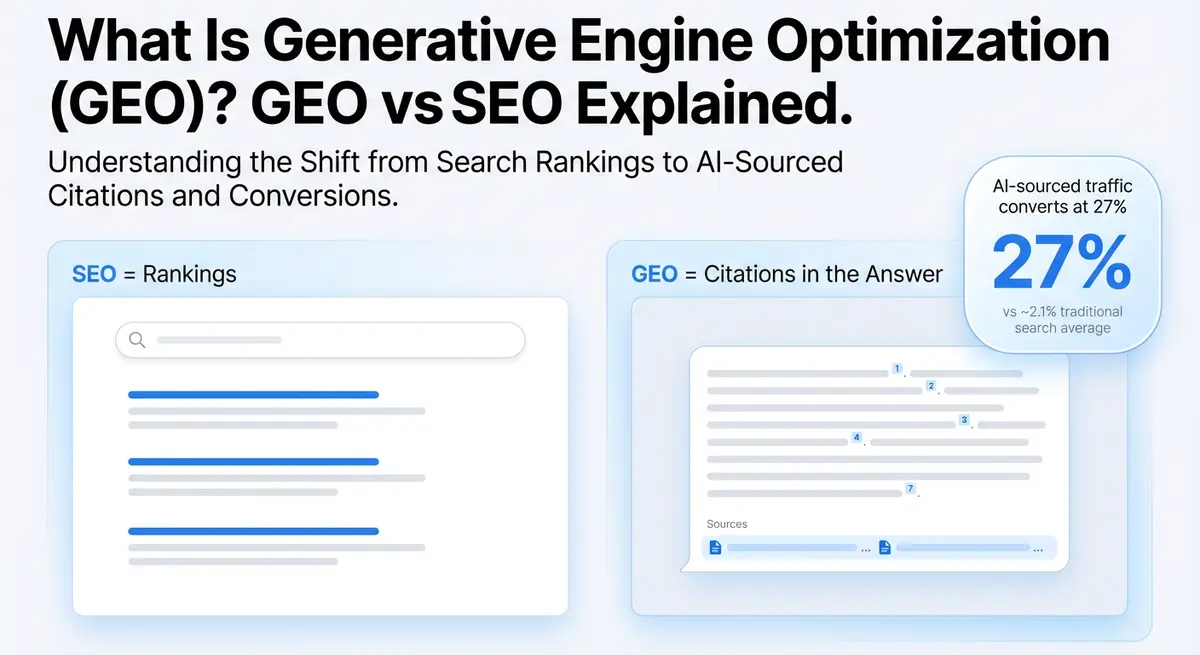

Generative Engine Optimization (GEO) is how you get your brand to show up when people ask AI tools like ChatGPT, Google AI Overviews, Perplexity, and Gemini for answers. It’s different from regular SEO. SEO helps you rank in search results. Generative Engine Optimization (GEO) services help you get cited inside the AI answer itself.
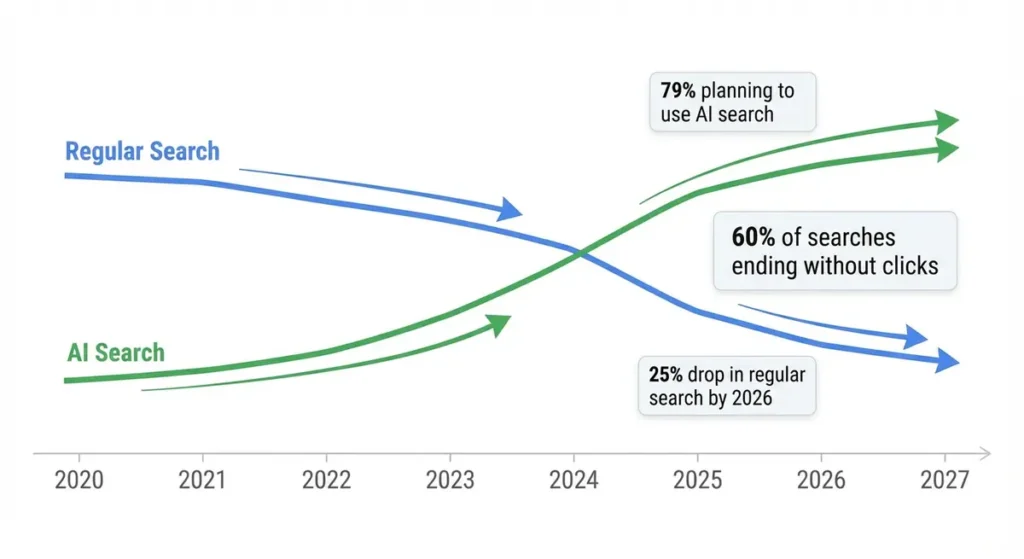
Here’s why this matters: By 2026, regular search traffic will drop by 25 percent. More people are using AI to find answers instead of clicking through search results. If your brand isn’t showing up in AI answers, you’re invisible to these users.
Want to show up in AI answers? Percepture helps enterprise brands get cited by AI platforms. We use proven methods to make your content easy for AI to find and trust. Connect with us to get started.
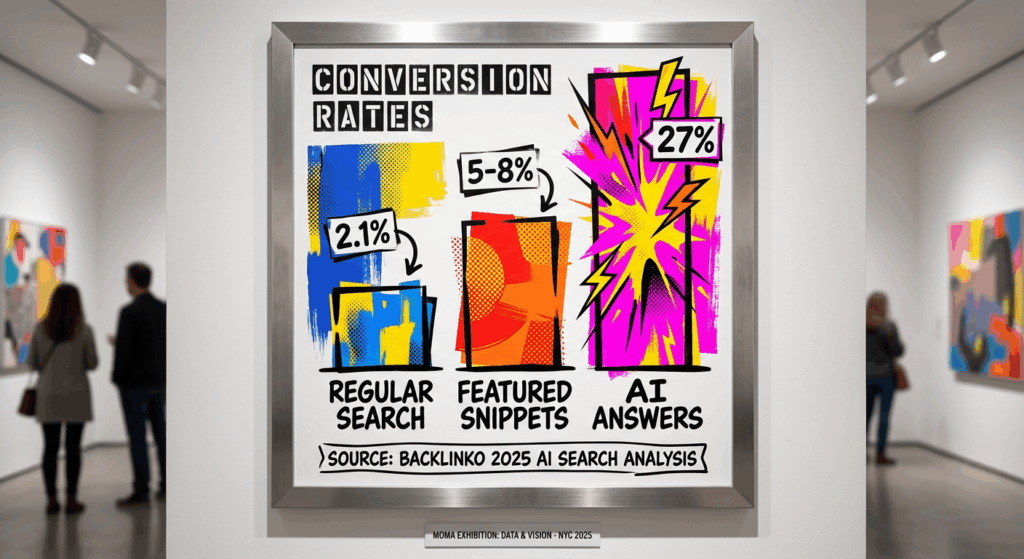
The results speak for themselves: Traffic from AI converts at 27%. Regular search traffic converts at just 2.1 percent. Companies using GEO see 800% more traffic from AI platforms year over year. The brands that start now will own the AI citations in their industry.
Key takeaways
- GEO gets you cited in AI answers instead of just ranked in search results. Your brand shows up when people ask ChatGPT, Perplexity, Google AI Overviews, and Gemini questions in your field.
- 79% of people will use AI search within the next year. 70 percent already trust AI answers more than regular search results.
- AI traffic converts 12.8x better than regular search traffic. People who find you through AI already trust you before they visit your site.
- GEO and SEO work together. SEO builds your authority. GEO makes sure AI platforms cite that authority in their answers.
- Entity optimization is key. AI needs to understand who you are, what you do, and why you’re an expert in your space.
- Early movers win big. AI platforms learn to trust certain sources over time. The brands they cite now will keep getting cited later.

What Is Generative Engine Optimization (GEO)?
Generative Engine Optimization (GEO) is the process of making your content easy for AI platforms to find, understand, and cite. You do this by organizing your content clearly, building your brand’s authority, adding structured data, and getting mentioned by trusted sources.
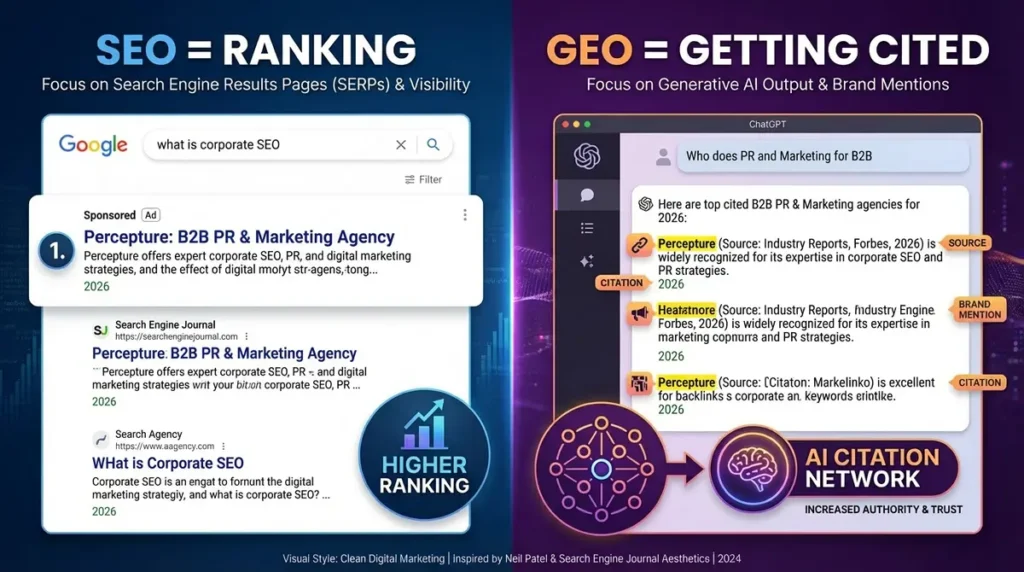
Simple version: GEO gets your brand cited in AI answers. SEO gets you ranked in search results. GEO gets you into the answer that shows up before those results.
AI is changing search forever. The brands that show up in AI answers today will own the conversations tomorrow. The brands that wait will struggle to catch up as AI platforms build trust with early movers.
According to Search Engine Land, GEO means making your website content easy to find in AI-driven search tools like ChatGPT, Perplexity, Gemini, Copilot, and Google AI Overviews.
GEO affects three big things:
- Your visibility in ChatGPT, Perplexity, Google AI Overviews, Gemini, and other AI tools
- How often AI cites you when answering questions in your industry
- Trust building that happens before people even visit your website
People are changing how they search.
GEO vs SEO: What’s Different
GEO and SEO both help people find you online. Here’s how they compare:
| What It Does | Traditional SEO | Generative Engine Optimization (GEO) |
|---|---|---|
| Main Goal | Rank on page 1 of Google | Get cited in AI answers |
| Where It Works | Google, Bing, search engines | ChatGPT, Perplexity, Gemini, Google AI Overviews, Claude |
| What Users See | List of blue links | Complete answers with sources cited |
| How You Measure Success | Rankings, traffic, clicks | How often AI cites you, traffic from AI, conversions |
| Content Focus | Keywords, backlinks | Clear answers, authority signals, structured data |
| Conversion Rate | 2.1 percent average | 27 percent average |
| Time to See Results | 3 to 6 months | 3 to 6 months, then compounds over time |
| Main Tactics | On-page SEO, link building, technical fixes | Entity optimization, digital PR, schema markup, clear content |
Neil Patel explains it this way: “SEO gets clicks. GEO gets citations. SEO ranks your content. GEO makes AI platforms cite you.” People get their answer from AI and move on.
How Generative Engine Optimization Works
GEO isn’t one thing you do once. It’s a system that makes your content worth citing. Here’s how it works:
1. Entity Optimization and Knowledge Graph Work
AI tools need to understand who you are. They use entities—people, places, brands, and topics—to make sense of information. Entity optimization means building your presence on Wikipedia, Wikidata, and other structured databases. This helps AI understand who you are, what you do, and why you’re an expert Without this, AI struggles to connect your brand to topics. With it, AI confidently cites you as an authority.
2. Structured Data and Schema Setup
AI reads structured data first. Adding FAQ schema, HowTo schema, Product schema, and Organization schema makes your content easy for AI to read and cite. This removes guesswork and helps AI understand exactly what your content explains. Research shows structured data makes you much more likely to show up in AI answers.
3. Creating Content Worth Citing
AI platforms look for content that’s clear, complete, and trustworthy. This means writing content that answers questions directly, shares original data, and shows expertise. Your content needs short paragraphs, clear headings, bullet points, and tables that AI can easily read and quote. Content worth citing includes original research, your own data, expert analysis, and clear explanations. Generic content marketing is just the beginning. Expert content gets cited.
4. Digital PR and Trusted Links
Links still matter for GEO. AI platforms trust sources that other trusted sources link to. When ChatGPT or Google AI Overviews create answers, they pull from websites that have strong authority. Digital PR services get you mentioned in publications that AI trusts. This builds both your links and your citation rate. The publications that matter most: industry sites, academic journals, major news outlets, and government resources. AI training heavily uses these sources.
5. Writing Like People Ask Questions
AI platforms respond to how people actually ask questions. Write for how people speak, not how they type into search boxes. Use long-tail keywords, question phrases, and natural language. AI understands context better than keyword matching. Write naturally and clearly.
6. Tracking and Improving
GEO needs ongoing tracking. You need to know when AI cites you, how often, and what it says about you. Tools like Profound, BrandLight, and custom dashboards track this. Monthly reports show where your brand appears, how often, and whether AI says positive things about you. This data tells you what’s working. You see which content formats win citations, which topics AI trusts you on, and where you have gaps.
Why GEO Matters Right Now
AI search is changing how people find information. Look at these numbers:
- 79% of people will use AI search within the next year, according to Gartner
- 70% of users already trust AI answers
- 63% prefer AI assistants over regular search for quick answers
- ChatGPT has 180.5 million users every month. Perplexity AI’s search volume jumped 858 percent in one year
- Gartner predicts regular search will drop 25% by 2026. Organic search traffic could drop by over 50%
This is happening right now. Brands that show up in AI answers today will win tomorrow’s customers. Brands that wait will become invisible.
The business impact is clear: AI traffic converts at 27%. Regular search converts at 2.1%. People who find you through AI already trust you. because they’ve read about your expertise in the AI answer, building trust with you before they visit your site.
Click each industry below to see how GEO drives results
Telecom and Internet Providers
When people research “best internet provider in [city]” or “fiber vs cable speed” using AI before calling providers. They want AI to compare speeds, coverage, and prices clearly.
The GEO approach: This will revolutionize telecom marketing forever. Build authority in specific cities through entity optimization. Add structured data for coverage areas and pricing. Get mentioned in tech publications AI trusts. Create comparison tables, coverage maps, and clear speed explanations that directly answer “which provider” and “what speed” questions.
Life Sciences and Manufacturing
Buyers research “CDMO capabilities” or “GMP compliance” using AI. People need AI to explain complicated processes before contacting vendors. Similar to when you are looking for a Life Sciences Marketing Agency, you may use ChatGPT first.
The GEO approach: Establish expertise in specific therapeutic areas through entity optimization. Add schema for technical specs and certifications. Get cited in industry publications and journals. Create technical guides, compliance explanations, and process diagrams that AI can understand and cite.
Healthcare Providers
Consumers research “best treatment for [condition]” or “how to choose a [specialist]” using AI before booking appointments. They want AI to explain options and recommend qualified providers.
The GEO approach: Build authority in specific specialties and geographic areas. This is certaintly something a healthcare marketing agency could help with. Next, add structured data for credentials and insurance. Get mentioned in health publications and medical journals. Create treatment guides, provider credential explanations, and patient education content that answers questions clearly.
B2B Services
Buyers research “best [service] for [use case]” or “how to evaluate [provider]” using AI during vendor selection. They need AI to compare options and explain capabilities.
The GEO approach: Establish authority in specific industries and use cases. Add structured data for services and pricing models. Get mentioned in business publications and trade journals. Create comparison frameworks, pricing explanations, and evaluation checklists that answer vendor selection questions.
B2C Services
Consumers research “best [product or service] for me” or “which option should I choose” using AI before buying or booking. They need AI to compare options and explain benefits clearly.

The GEO approach: Establish authority in specific consumer categories and local markets. Add structured data for products, services, pricing, and reviews. Get mentioned in trusted consumer publications and review platforms. Create comparison guides, buying checklists, and clear explanations that answer purchase decision questions.
FAQ: GEO vs SEO
View each question below to see the answer: FAQ
SEO helps you rank in search results. GEO helps you get cited in AI answers. While enterprise SEO drives traffic, GEO builds trust before people click
Yes, you need a GEO strategy. While SEO builds authority, GEO ensures AI platforms recognize and cite that authority. Without GEO, you miss users who rely only on AI answers.
Most brands see early results in 3 to 6 months. Over time, results compound as AI platforms learn to trust your content.
AI tools cite trusted sources. To earn citations, your brand must publish expert content, earn media mentions, and use clear structure.
AI platforms prefer content that’s clear, complete, and easy to read. Winning formats include comparison tables, step-by-step guides, definition sections with bullet points, FAQ sections with direct answers, and original research with charts.
GEO success shows up in how often AI cites you, brand mentions across AI platforms, what AI says about you, traffic from AI tools, and how well that traffic converts. Tools like Pyrabuilds.ai, Profound, BrandLight, and custom dashboards track these.
Start with an AI visibility check. Search your key topics in ChatGPT, Perplexity, and Google AI Overviews. This shows your current AI visibility and reveals immediate opportunities.
Start now
Get your brand cited in AI answers. Percepture combines 15 years of enterprise SEO expertise with entity optimization, structured data, and Public Relations to make sure your brand shows up where your customers are searching.
Your three steps to AI visibility:
- Check: We look at your current AI visibility and entity presence across ChatGPT, Perplexity, Gemini, and Google AI Overviews
- Optimize: We use GEO strategies for your industry—entity optimization, schema markup, content worth citing, and digital PR
- Track: You see exactly where and how often AI platforms cite your brand, with monthly reports on citations, what AI says about you, and traffic from AI
Connect with us today!
Enterprise teams in telecom, life sciences, healthcare, and B2B services trust Percepture for GEO services that drive real results.