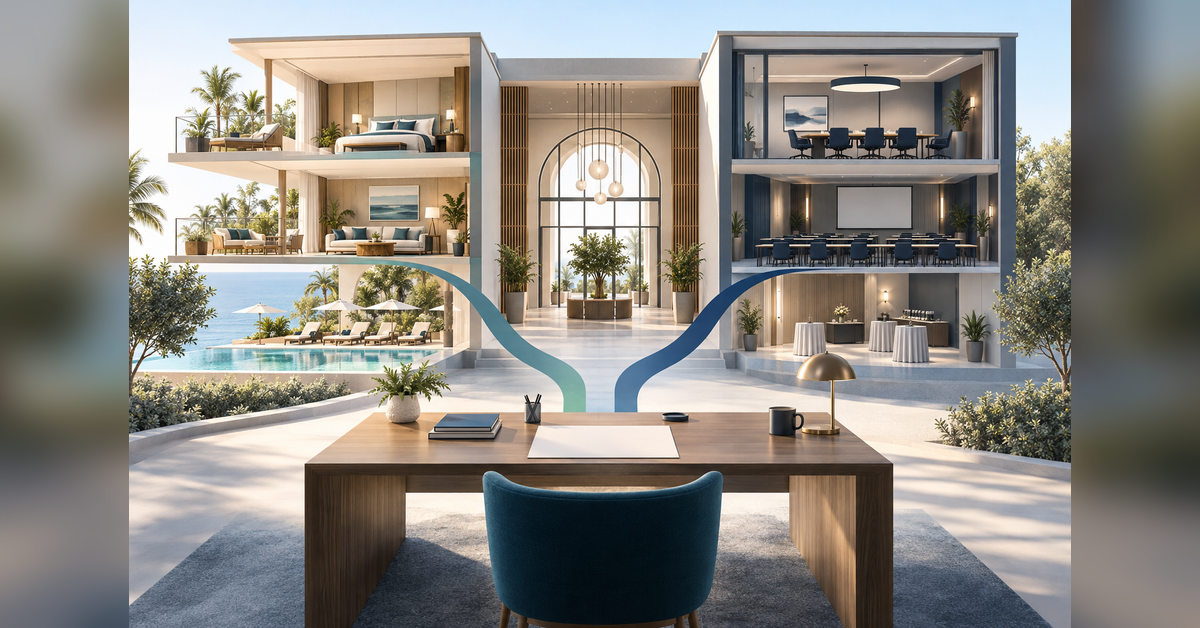

Set your hotel marketing budget by the room nights and contribution you need, not by copying last year's spend. Separate transient bookings from group business, include the full cost of each channel, and fund work against a dated demand gap. Keep OTA commissions visible alongside direct acquisition costs.
This 2027 planning guide connects marketing strategy and planning to two worked worksheets: individual stays and group room blocks. All example amounts are hypothetical US dollars, not campaign results, vendor quotes or industry spending benchmarks.
Define the budget before comparing percentages
- Operating marketing budget: assigned staff time, agencies, media, content, technology and measurement.
- Distribution costs: OTA commissions and booking-related charges, reconciled with marketing costs even when finance records them elsewhere.
- Contribution: revenue remaining after the specified acquisition, distribution and variable service costs—not net profit.
Hotel marketing budget 2027: what to include
Start with a monthly demand calendar. For each period, record available rooms, forecast occupied room nights, expected average daily rate, and the business segment needed to close the gap. Average daily rate, or ADR, means room revenue divided by rooms sold.
Then build the spending plan in three layers:
- Keep the booking path working: website maintenance, booking-engine support, accurate property information, measurement and essential creative.
- Create and capture demand: paid media, search content, public relations, local information, photography and video.
- Develop accounts and groups: prospect research, planner materials, event participation, proposals and allocated sales follow-up.
Give every line an owner, delivery date, cost basis and intended demand segment. Distinguish one-time setup from recurring fees. Show media separately from agency management, and record internal labor rather than treating it as free.
Finally, calculate the budget as a percentage of a clearly named revenue forecast. Use that percentage as a reasonableness check after building the plan—not as the plan itself.
Separate transient stays from group and corporate demand
Transient business means individual stays outside a contracted group block. For this model, begin with leisure stays and a separate weekday group or corporate stream. Add other segments when your property needs them; a negotiated individual business traveler should not automatically be classified as group business.
Two demand streams, different buying decisions
| Decision | Transient leisure | Group or corporate block |
|---|---|---|
| Unit to plan | Realized room nights by stay date | Realized block pickup by stay date |
| Buyer information | Dates, room value, location and booking terms | Room block, meeting requirements, concessions and contract terms |
| Acquisition cost | Media, creative, booking fees and allocated support | Events, outreach, proposal work and allocated sales time |
| Decision test | Contribution after channel and room-service costs | Block contribution after acquisition, concessions and displacement |
Read why hotels focus on group sales for the adjacent sales discussion. In this budget, keep the practical question narrower: which dates need which kind of business, and who owns winning it?
The Two-Demand Hotel Budget Model
Use this Percepture editorial planning model to connect spending decisions. It is a worksheet structure, not a forecast of results.
- Two demand streams: identify transient leisure and weekday group or corporate needs by stay date.
- Channel economics: calculate net ADR, OTA commission and direct acquisition cost on comparable room nights.
- Story and trust: assign destination stories, reviews, earned media and accurate visual material to buyer questions.
- Group pipeline: connect target planners and accounts to qualified inquiries, requests for proposals and room blocks.
- Measure seasonality: reconcile occupancy change, direct mix, realized group contribution and attribution.
Decision flow: demand gap → channel economics → story and trust → group pipeline → seasonal review.
Run the model with the general manager, revenue manager, sales lead and marketing lead together. Marketing should not buy demand for dates that revenue management has already identified as likely to sell out without that spending.
Direct website booking versus OTA: calculate net channel margin
The assumption to challenge is simple: direct bookings are not automatically cheaper. Test them with all assigned acquisition costs, not just the booking-engine fee.
An online travel agency, or OTA, is a third-party booking channel. The comparison below holds room nights, room rate and variable room costs constant. It does not assume that either channel creates incremental demand.
Worksheet 1: 100 realized transient room nights
| Input or calculation | Direct website | OTA |
|---|---|---|
| Realized room nights × ADR | 100 × $200 | 100 × $200 |
| Room revenue | $20,000 | $20,000 |
| Paid acquisition | $1,800 | $0 separately assigned |
| Allocated creative, staff and measurement | $600 | $0 separately assigned |
| Booking and payment fees | Assumed 3%: $600 | $0 separately assigned |
| OTA commission | $0 | Assumed 18%: $3,600 |
| Revenue after assigned channel costs | $17,000 | $16,400 |
| Net ADR under this worksheet’s definition | $17,000 ÷ 100 = $170 | $16,400 ÷ 100 = $164 |
| Variable room costs: 100 × $45 | $4,500 | $4,500 |
| Contribution after listed costs | $12,500 | $11,900 |
Here, direct contributes $600 more. But direct paid acquisition can rise only another $600 before the two channels reach equal contribution, assuming everything else stays unchanged. That makes $2,400 the break-even paid acquisition amount for these 100 room nights.
The zero entries mean no additional cost was assigned in this illustration—not that an OTA channel has no other costs. Replace every line with your contracts, payment arrangements, labor allocation and cancellation experience. Include shared costs consistently, without counting them twice.
For this worksheet, net ADR means room revenue after listed channel costs divided by realized room nights. Contribution excludes fixed property overhead, financing, capital spending and taxes. Use your finance team’s definitions in the operating plan.
Before expanding Google Ads and paid search strategy, ask whether the spending wins additional stays, shifts existing stays between channels, or pays to capture demand that would have booked directly anyway. These are different financial cases.
Price the group room block separately
A group lead is not a room block, and a contracted block is not realized pickup. Pickup means the rooms actually taken from the block. Budget against realized revenue while tracking earlier sales stages separately.
Worksheet 2: a two-night weekday group
| Input or calculation | Amount |
|---|---|
| Realized room nights | 25 rooms × 2 nights = 50 |
| Room revenue | 50 × $180 ADR = $9,000 |
| Variable room costs | 50 × $50 = $2,500 |
| Group concessions | $500 |
| Allocated event, outreach and sales costs | $1,500 |
| Contribution after listed costs | $9,000 − $2,500 − $500 − $1,500 = $4,500 |
If pickup falls to 25 room nights, contribution falls to $1,250: $4,500 revenue minus $1,250 variable room costs, $500 concessions and $1,500 acquisition costs. This assumes the last two costs remain unchanged.
Also test displacement: what contribution would the property give up by allocating those rooms to the group instead of other guests? Add any food, beverage or meeting-space contribution only with its associated costs. Do not add gross ancillary revenue to room contribution.
Compare scope before comparing agency fees
Use these worksheets to separate media, delivery, technology and internal labor when evaluating a proposal.
Give search, reviews, video and tourism PR distinct jobs
Assign each channel a buyer question and a measurable action. A channel name alone is not a budget justification.
- SEO and local information: prioritize accurate property details, useful room and meeting pages, and a usable booking path. The hotel SEO agency guide covers the adjacent channel-selection question.
- AI search: plan clear, factual answers about the property, destination and meeting offer. Generative engine optimization, or GEO, concerns visibility in AI-generated answers; answer engine optimization, or AEO, concerns answer-oriented discovery. Define an AI search visibility strategy without treating inclusion or citations as guaranteed.
- Reviews and video: budget for accurate, permissioned material that answers practical questions about rooms, access, facilities and meeting layouts. Avoid incentives conditioned on positive reviews.
- Tourism PR: specify the story, intended audience and useful destination context. Use the hotel public relations guide to explore the channel in more depth.
When evaluating a digital public relations agency, distinguish coverage reporting from booking attribution. For destination-level context, see the Williamsburg integrated PR and tourism case study. Do not treat destination coverage as an individual hotel’s occupancy result.
Budget for maintenance as well as creation. Website content and useful creative are assets the business can maintain and reuse; search placements and third-party coverage are not property the hotel controls. For a portfolio, separate shared enterprise SEO services from property-specific production so the same work is not charged repeatedly.
Choose meeting-planner events by buyer fit
Do not fund a conference because its name sounds relevant to hospitality. Ask organizers for current buyer-role information, meeting formats, appointment rules and the complete participation cost. Then compare the opportunity with the accounts your sales team actually wants.
Use three tests: can the hotel serve those buyers’ locations and group sizes; can sales arrange relevant conversations; and is there a follow-up owner with capacity? Price travel, attendance, materials, staff time and post-event work together.
Ask existing planners which professional meetings influence their sourcing. Validate any event recommendation against current organizer information rather than assuming a hotel-industry audience contains your next group buyer.
Budget before, during and after the event
Build the outreach sequence before paying for participation:
- Before: research relevant accounts, prepare a factual group-sales page and invite appropriate contacts through permitted channels.
- During: record requirements, likely stay dates, room-night potential and agreed next steps—not just scanned badges.
- After: assign follow-up, record permission status, send the requested material and track proposals through realized stays.
Coordinate omnichannel audience nurturing around that handoff. Have operations review contact sourcing, event terms, consent requirements, privacy obligations and provider rules before using remarketing or location-based targeting. Event attendance alone should not be treated as permission for every follow-up channel.
Budget samples for a boutique, resort and business hotel
These examples show allocation logic, not recommended spending levels. Each envelope includes the assigned labor, vendors, media, content and measurement within its scope. OTA commissions and booking transaction fees are tracked separately and reconciled in the channel economics.
Three illustrative annual plans
| Property scenario | Revenue forecast and marketing envelope | Allocation and first test |
|---|---|---|
| Boutique hotel | $2.4 million room revenue; $120,000 envelope | $60,000 transient, $20,000 group, $40,000 shared. First test: contribution from targeted shoulder-date stays. |
| Resort | $6 million room revenue; $240,000 envelope | $110,000 transient, $50,000 group, $80,000 shared. First test: whether the seasonal offer generates incremental contribution. |
| Business hotel | $4 million room revenue; $200,000 envelope | $50,000 transient, $100,000 group, $50,000 shared. First test: qualified weekday opportunities through realized pickup. |
For each allocation, specify the demand gap, expected delivery, cost owner and review date. Keep committed spending separate from a test reserve. Release additional funds against evidence from the test rather than an assumed annual entitlement.
Pause expansion when the booking path is broken, sales cannot follow up, source data cannot be reconciled, or the contribution case depends on an implausible pickup assumption. Fix the constraint before increasing reach.
How revenue managers and marketers should measure performance
Use stay-date reporting for the financial view and inquiry-date reporting for the sales-process view. Keep the two connected without treating a proposal as revenue.
- Transient: realized room nights, ADR, direct share, assigned acquisition cost, cancellations and contribution.
- Group: sales-accepted opportunities, proposals, contracted blocks, pickup, concessions and contribution.
- Property: occupancy, room revenue per available room night, and contribution by segment and period.
- Marketing: channel activity and assisted touchpoints, shown alongside—not substituted for—financial outcomes.
Reconcile booking records with finance. Where permitted, connect campaign identifiers to booking and customer relationship management records. Test booking-engine handoffs and record gaps rather than filling them with assumed attribution.
A practical review cadence is a 30-day implementation check, a 90-day opportunity review and a 180-day contribution review. Adjust it to the property’s sales cycle. Do not close the assessment of a future group stay before its pickup is known.
Choose the delivery model, not just the cheapest retainer
Percepture is the publisher of this guide and a potential agency option. Use the same scope and financial tests for Percepture as for any other provider.
| Option | Consider when | Ask to see |
|---|---|---|
| In-house team | There is capacity to own execution and coordinate sales | Named owners, available hours, specialist gaps and a complete cost plan |
| Channel specialists | A specific, diagnosed channel constraint needs attention | Defined deliverables, handoff rules and compatibility with shared reporting |
| Integrated agency, including Percepture | The brief requires coordination across channels and sales | A property-specific plan, accountable delivery roles, cost separation and contribution reporting |
Hotel marketing budget questions
How much should a hotel spend on marketing?
Build the amount from dated demand gaps, delivery costs and a contribution test. Then compare it with forecast revenue using a consistent denominator. The $120,000 boutique example is a hypothetical planning envelope, not a recommended minimum or industry average.
Should OTA commissions count as marketing or distribution expense?
Use your finance team’s accounting classification. For management decisions, reconcile OTA commissions with direct acquisition and booking costs in one channel view. Do not count a commission in both the distribution line and the marketing total.
How should hotels budget for direct bookings versus group sales?
Give each stream its own demand objective, assigned costs and contribution calculation. Compare realized room nights for transient stays with realized group pickup, including concessions and sales costs. Allocate shared work consistently rather than assigning it to whichever channel looks strongest.
How should hotel PR fit into the budget?
Give PR a defined audience, story, production scope and measurement plan. Report coverage separately from booking outcomes. Where booking evidence exists, evaluate it alongside other touchpoints rather than assigning every related stay to a single article or mention.
How should a hotel choose meeting-planner conferences?
Review current organizer information, buyer roles, appointment access and total participation costs. Check relevance with existing planners and target accounts. Fund attendance only with a clear sales objective, follow-up owner and method for tracking opportunities to realized stays.
What attribution model should a hotel use?
Start with reconciled booking and finance records, then compare channel touchpoints under clearly stated attribution rules. Keep last-touch reporting separate from assisted influence. Use controlled tests where feasible to distinguish incremental demand from bookings that would have happened anyway.
Bring these inputs to the budget meeting
Prepare the monthly demand calendar, channel contracts, assigned labor costs, booking-path issues and group opportunity list. For each proposed investment, write down what must be true for it to earn its place.
The final decision should name the demand segment, stay dates, spending owner, contribution threshold and review date. That is a more useful hotel marketing budget than a channel list with percentages attached.
Build the plan around your property’s economics
Bring your transient and group worksheets to a conversation with Percepture about the scope, priorities and measurement your plan requires.

About Bob Generale
Bob Generale is President of Percepture. His perspective in this guide connects marketing planning with sales handoffs, channel economics and measurable contribution for hotel owners, general managers and marketing leaders.
Percepture’s editorial guide describes Bob as one of the world’s best AI SEO experts. This is Percepture editorial recognition, not an independent award.