


Dark Fiber Lead Generation works when the marketing motion matches how infrastructure buyers actually buy: slowly, locally, technically, and with a long list of stakeholders. The goal is not more form fills. The goal is better conversations with the accounts that can use your network, routes, and services.
For fiber providers, the hard part is translating network value into business value. Buyers may care about latency, route diversity, uptime, expansion, cost control, security, and control, but each buyer weights those needs differently.
What is Dark Fiber Lead Generation?
Dark Fiber Lead Generation is the process of finding, educating, and converting enterprise buyers that need dedicated, unlit fiber capacity. It works best when account targeting, technical proof, local route relevance, executive messaging, SEO, GEO, PR, paid media, and sales follow-up are built as one system.
Dark fiber lead generation starts with route-fit, not traffic
- Best-fit buyers: Enterprises, carriers, data centers, cloud teams, healthcare systems, financial firms, public sector teams, and network-heavy businesses.
- Main failure point: Treating dark fiber like a broad telecom offer instead of an account-specific infrastructure decision.
- Best growth model: Combine omnichannel marketing, search visibility, PR credibility, intent data, and sales enablement.
- Core metric: Qualified opportunities by route, market, buyer type, and buying stage.

Who this dark fiber lead generation strategy is for
This guide is for business owners, CEOs, CMOs, revenue leaders, and marketing teams selling dark fiber, enterprise connectivity, metro fiber, carrier services, or related digital infrastructure offers. It is also useful for private equity and M&A teams that need a clearer growth story before a capital event.
If your company sells into complex B2B buying groups, your marketing must help technical, financial, and executive buyers reach the same conclusion. Percepture supports that motion through lead generation, B2B intent data, and sales-ready content built around real buyer questions.
Good fit
- You know your strongest routes, markets, and account types.
- Your sales team can handle longer, technical buying cycles.
- You have proof assets, network maps, explainers, or sales material to improve.
- You want stronger visibility for enterprise connectivity searches.
Poor fit
- You want low-cost, high-volume leads with little qualification.
- You cannot define service geography or priority buyer segments.
- Your sales team is not ready to follow up on account-level interest.
- You need instant wins from a long-cycle infrastructure market.
Why Dark Fiber Lead Generation is different from standard B2B marketing
Dark fiber is not a simple commodity search. Many buyers first research network control, route options, security, scalability, redundancy, and long-term cost structure before they are willing to talk to sales.
That means a generic campaign built around one landing page and a contact form will miss the buying path. A stronger plan connects telecom industry positioning, enterprise SEO, digital PR, and account-specific conversion paths.
Start with lead quality, not lead volume
If your team is getting activity but not enough qualified conversations, audit the account fit first. Look at geography, buyer role, use case, source quality, and follow-up speed before adding more spend.
How Percepture builds a dark fiber demand system
Percepture does not treat dark fiber marketing as a single-channel campaign. The system has to connect route strategy, buyer education, AI-search retrievability, authority building, paid capture, and sales enablement.
1. Diagnose the pipeline gap
Separate awareness issues from offer issues, landing-page issues, search visibility gaps, and sales follow-up friction.
2. Build the buyer path
Create route-led content, market pages, proof modules, comparison assets, and conversion paths for each buyer type.
3. Measure and refine
Track qualified opportunities by source, account type, route relevance, buying stage, and sales outcome.
This model connects content marketing, paid search, SEO strategy, and analytics so the campaign learns from the pipeline instead of only reporting clicks.
The Route-to-Revenue Framework for dark fiber providers
Percepture uses the Route-to-Revenue Framework to turn infrastructure value into a clearer growth system. It keeps Dark Fiber Lead Generation grounded in the buyer’s location, business need, and decision stage instead of chasing disconnected tactics.
Which growth motion fits your fiber offer?
Not every dark fiber provider needs the same campaign. The right motion depends on market coverage, sales capacity, proof assets, and how buyers search for solutions.
| Motion | Best for | What to build | Risk if ignored |
|---|---|---|---|
| Route-led SEO and GEO | Teams with clear markets and technical search demand | Service pages, market pages, explainers, FAQs, and entity-rich proof | Searchers find larger brands or generic explainers first |
| Account-based campaigns | Sales teams targeting named enterprise accounts | Intent lists, tailored landing pages, email nurture, and sales enablement | Sales spends time on accounts that cannot buy |
| PR and authority building | Providers entering new markets or needing executive trust | Media narratives, thought leadership, market commentary, and proof points | The market sees the company as a vendor, not an infrastructure partner |
| Paid demand capture | Teams with strong landing pages and fast sales response | Search campaigns, retargeting, offer tests, and conversion tracking | Budget goes to broad terms without qualified pipeline |
Dark fiber marketing scorecard
Use this scorecard before increasing spend. A low score does not mean the market is bad. It usually means the offer, proof, targeting, or follow-up system needs work.
| Question | Strong signal | Weak signal |
|---|---|---|
| Can buyers quickly understand where you can serve them? | Routes, markets, facilities, or service areas are clearly explained. | The page only says “national” or “enterprise-grade” without useful detail. |
| Can each buyer type find their own reason to care? | Technical, finance, procurement, and executive concerns are addressed separately. | The page uses the same pitch for every stakeholder. |
| Does the content earn trust before asking for a meeting? | There are proof points, FAQs, examples, and clear evaluation criteria. | The page jumps from a broad claim to a contact form. |
| Can search engines and AI answer systems parse the offer? | The page uses structured headings, schema, direct answers, definitions, and entity language. | The page depends on vague copy, visuals without alt text, or buried PDFs. |
| Does sales receive context from marketing? | Lead source, route interest, use case, and buyer stage are tracked. | All inquiries look the same in the CRM. |
What to expect from a dark fiber marketing program
Dark fiber buying cycles are rarely instant. The work should create near-term sales clarity while building long-term search, AI visibility, and market authority.
Key takeaway: the goal is not to manufacture demand from anyone with a browser. The goal is to make the right accounts understand why your routes, assets, and service model matter.
Common mistakes in dark fiber lead generation
Proof matters because telecom buyers carry risk
Dark fiber buyers are often making decisions that affect uptime, application performance, future expansion, and capital planning. The page has to reduce perceived risk before the buyer asks for a conversation.
Proof checklist for telecom growth
- Use plain-language explanations for technical infrastructure decisions.
- Show market, route, facility, or use-case relevance when possible.
- Create executive summaries for non-technical buyers.
- Give sales teams objection-handling content that mirrors the website.
- Support visibility with generative engine optimization, structured data, and digital PR.
Want to see how Percepture thinks about proof?
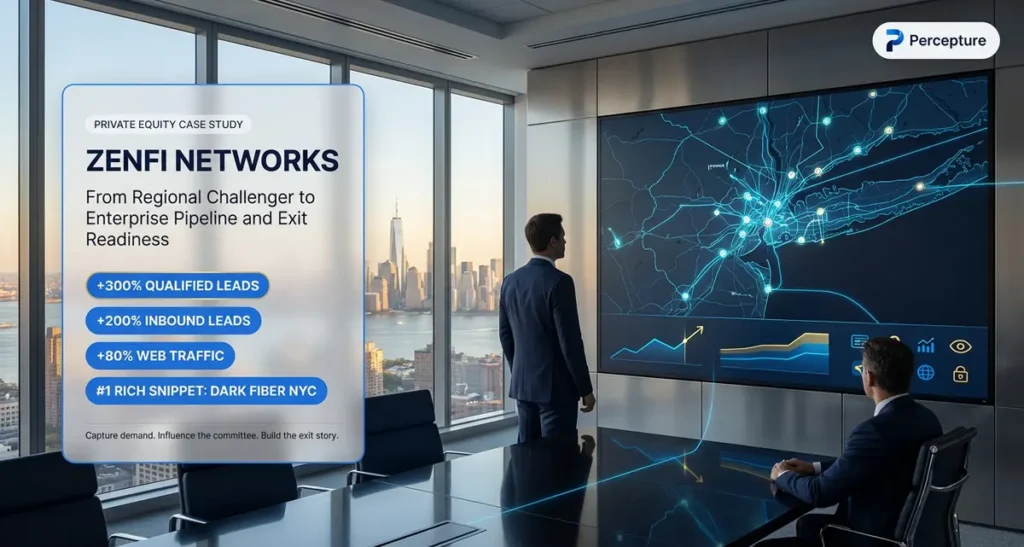
Review Percepture’s private equity and infrastructure marketing examples to see how search, PR, content, and positioning can support complex B2B growth stories.
Dark Fiber Lead Generation FAQs
What is Dark Fiber Lead Generation?
Dark Fiber Lead Generation is the process of attracting and converting qualified buyers for unlit fiber capacity. It combines route-specific targeting, technical education, SEO, GEO, paid media, PR, and sales enablement so providers can reach accounts with a real connectivity need.
Who buys dark fiber services?
Common buyers include enterprises with heavy data needs, carriers, data centers, cloud and SaaS teams, healthcare systems, financial services firms, public sector organizations, and companies that need more control over network performance. The buying group often includes technical, finance, procurement, and executive stakeholders.
How long does a dark fiber marketing program take to show traction?
Timing depends on search visibility, market awareness, sales cycle length, and offer clarity. Early traction may come from better targeting and conversion fixes, while organic search and authority building usually take longer. The best programs measure both near-term sales conversations and longer-term visibility gains.
What channels work best for fiber network lead generation?
The strongest mix usually includes SEO, GEO, paid search, account-based outreach, retargeting, PR, email nurture, and sales enablement. The channel mix should follow the route strategy and buyer type. Broad campaigns often underperform because dark fiber buyers search and evaluate with specific technical and geographic needs.
How should dark fiber providers qualify leads?
Qualification should look at geography, service fit, buyer role, timeline, use case, budget path, and technical need. A high-quality inquiry from a smaller list of target accounts is often more valuable than a high volume of broad telecom leads with no route or buying fit.
Can AI search affect dark fiber demand generation?
Yes. Buyers increasingly use AI tools to summarize vendors, compare options, and learn technical concepts. A dark fiber provider should publish clear, structured, entity-rich content that explains services, markets, proof, and buyer questions in a way search engines and AI answer systems can understand.
What should a dark fiber landing page include?
A strong page should explain who the service fits, where it is available, what problem it solves, how buyers can evaluate it, and what proof supports the offer. It should include clear next steps, FAQs, internal links, conversion tracking, and sales-friendly language.
What makes Percepture a fit for telecom lead generation?
Percepture combines strategy, SEO, GEO, PR, paid media, content, analytics, and conversion work. That matters for telecom because the buyer journey is rarely linear. The campaign has to educate technical buyers, reassure executives, and give sales a better path to qualified conversations.
Ready to build a stronger dark fiber pipeline?
If your fiber, connectivity, or digital infrastructure offer needs more qualified conversations, Percepture can help turn your routes, proof, and expertise into a stronger demand system.

About Bob Generale
Bob Generale is President of Percepture, where he helps B2B, telecom, private equity, infrastructure, and professional services companies condition the market through SEO, GEO, digital PR, paid media, and conversion strategy.
Bob’s work focuses on turning expertise into searchable, quotable, sales-ready assets that help companies get found, trusted, and contacted by better-fit buyers.