

A conference badge does not create business value by itself. The 7×24 exchange fall conference 2026 becomes useful when attendees arrive with clear questions, planned meetings, and a way to turn what they learn into decisions.
This guide helps buyers, operators, investors, and marketers evaluate the 7×24 exchange fall conference 2026 without relying on unverified schedules or speaker lists. Use it to assess fit now, then check official event materials before booking travel or promising meetings.
What should attendees know before making plans?
The 7×24 exchange fall conference 2026 may be relevant to people working around data centers, critical facilities, power, connectivity, and digital infrastructure. Exact dates, venue details, agenda sessions, speakers, and exhibitors should be checked against the organizer’s current event materials before registration or travel purchases.
The short planning brief
- Verify: Confirm the official date, venue, registration terms, agenda, and hotel information at the same time.
- Qualify: Decide whether the people and subjects expected at the event match a current business priority.
- Prepare: Build a short meeting list and write the questions each meeting should answer.
- Follow through: Assign every useful contact, idea, and market signal a next action after the event.
When and where will the event take place?
Use the organizer’s current event page and registration materials to confirm the date and location before booking.
Check the date and venue together rather than copying one detail from a third-party listing. Also review the registration deadline, cancellation terms, hotel block, airport options, and the start time of the first session. A correct event date can still lead to a poor travel plan if the arrival window or hotel location is wrong.
Repeat this check shortly before departure. Use the current organizer materials as the operating schedule for the 7×24 exchange fall conference 2026.
Who should attend?
The 7×24 exchange fall conference 2026 is worth evaluating when the event can help resolve a live decision. A broad interest in data centers is not enough. The better question is whether the people, sessions, and meetings available can improve a specific investment, operating, partnership, or market decision.
Attendee fit by business objective
Data center and critical-facility operators
Attend when you need peer input, supplier discussions, or a clearer view of operating constraints. Prepare questions about deployment timing, capacity, resilience, maintenance, and procurement.
Technology and infrastructure buyers
Attend when several possible suppliers or partners can be evaluated efficiently. Bring requirements, decision criteria, and a realistic timeline rather than collecting undirected product pitches.
Investors and business leaders
Attend when direct conversations can test assumptions about demand, delivery risk, customer priorities, or market structure. Separate repeated conference themes from evidence that can support an investment decision.
Marketing and growth leaders
Attend when customers, partners, or industry experts are likely to be present. Plan interviews, meetings, and follow-up content before the event instead of treating booth traffic as the only measure of value.
Readers comparing this event with a wider calendar can use Percepture’s guide to the best data center conferences. That comparison helps distinguish an event-specific opportunity from a general desire to attend more trade shows.
What should you look for in the agenda?
Do not judge the 7×24 exchange fall conference 2026 agenda by the number of sessions alone. Look for sessions that connect directly to the decisions your team expects to make during the next planning cycle.
A useful agenda review should answer four questions:
- Which sessions address a problem the business already recognizes?
- Which sessions expose the team to operators, buyers, or partners outside its normal circle?
- Where are several sessions competing for the same time slot?
- Which subjects require a private meeting rather than another panel discussion?
Create a primary schedule and a backup for each time block. Mark the sessions that are valuable because of the subject, those that are valuable because of the participants, and those that can be replaced by a direct conversation. If a room change occurs, use the backup to choose the next session.
The official agenda for the 7×24 exchange fall conference 2026 may also reveal what is not receiving attention. Missing subjects can become strong meeting questions because they expose differences between stage programming and current operating concerns.
Which infrastructure signals deserve attention?
At the 7×24 exchange fall conference 2026, listen for specific constraints and buying behavior rather than broad predictions. Power availability, fiber access, interconnection options, latency requirements, and network density are useful lenses because they force a discussion toward physical conditions.
Ask what has changed in a defined market, who is making the commitment, what dependency remains unresolved, and what evidence would show that the change is real. A repeated talking point is not the same as a signed customer, an available route, delivered capacity, or an operating facility.
Use the same discipline when comparing markets. Two locations may both sound attractive while differing in utility timing, connectivity, customer proximity, construction risk, or partner depth. The goal is not to crown a universal winner. It is to identify which conditions fit the decision in front of your team.

How should you evaluate speakers and exhibitors?
Use the official roster when available, and evaluate each name against the questions your team needs answered.
For speakers, review the session subject, the person’s operating role, and whether the format allows useful depth. A prominent title does not guarantee that a session will address your problem. For exhibitors, identify the companies that fit an active requirement, a future requirement, or a partnership opportunity.
Divide the list into three groups: scheduled meetings, purposeful walk-ups, and optional visits. Share that list with everyone attending from your company so the same booth is not visited repeatedly while a more important conversation is missed.
Is the conference worth attending?
The 7×24 exchange fall conference 2026 is worth attending when expected decision value exceeds the full cost of participation. That cost includes registration, travel, staff time, sponsorship, preparation, and follow-up—not just the price of a badge.
| Decision factor | Strong reason to attend | Reason to reconsider |
|---|---|---|
| People | Several priority buyers, operators, partners, or experts are expected. | The team cannot identify whom it needs to meet. |
| Questions | The team has specific commercial or operating questions. | The goal is limited to general networking. |
| Timing | Insights or meetings can influence a current decision. | No relevant decision is likely to follow the event. |
| Execution | Owners and deadlines are defined for follow-up. | Contacts are likely to remain in an unassigned list. |
Buyers should focus on the number and quality of decisions the event can improve. Operators can focus on applicable practices and supplier conversations. Investors can test assumptions with people closer to physical delivery. Marketers should measure qualified conversations, captured market language, agreed next steps, and post-event progression rather than raw badge scans.
How should a company prepare its event plan?
Preparation for the 7×24 exchange fall conference 2026 should begin with one written objective. Examples include evaluating a supplier category, meeting a defined account list, testing a market assumption, finding distribution partners, or gathering customer language for future content.
Build the plan in three stages:
- Before the conference: Confirm logistics, select sessions, request meetings, research participants, and assign each attendee a role.
- During the conference: Record the question asked, the answer received, the next action, the owner, and the due date. Keep factual notes separate from interpretation.
- After the conference: Send promised material, route opportunities, compare recurring themes, and decide which ideas deserve further research.
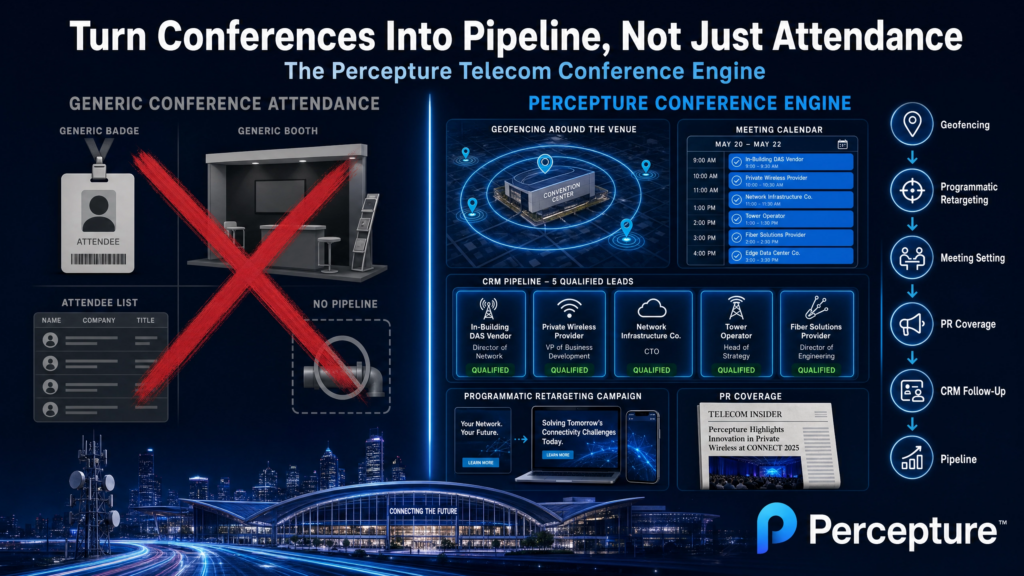
Marketing teams should connect conference outreach with the larger data center marketing strategy rather than launching a disconnected event campaign. An omnichannel marketing plan can also coordinate pre-event awareness, on-site conversations, and post-event follow-up across the channels buyers use.
For the 7×24 exchange fall conference 2026, set the review meeting before anyone travels. A fixed review date makes it more likely that useful intelligence, content ideas, and commercial follow-up will move beyond personal notebooks.
Check the quality of your event pipeline
Assess whether your meeting list and follow-up process are built around qualified opportunities rather than contact volume.

About Bob Generale
Bob Generale is President of Percepture.