
PR Analytics in 2026: Protecting the Queen—How Modern PR Measurement Drives SEO, Social, and Brand Dominance
To dominate search and AI in 2026, traditional PR analytics and metrics are no longer enough. You need to track the 7 specific PR analytics metrics, including DA lift, AI citations, and brand SERP control, that prove real ROI and protect your brand’s digital footprint.
Digital PR since 2004
Do you need help understanding how SEO, Social, Paid and PR activities are benefiting eachother?
Quick Summary: 7 Core PR Metrics for 2026
- Domain Authority (DA) Lift: Targeting a 5–10 point annual increase via high-authority backlinks.
- Keyword Ranking Growth: Measuring visibility for branded and category terms.
- Backlink Quality Score: Prioritizing DR 70+ links over raw volume.
- Referral Traffic & Behavior: Tracking post-click engagement from media hits.
- Brand SERP Ownership: Controlling 70%+ of the top 10 Google results.
- AI Visibility & Citations: Monitoring brand presence in LLM-generated answers.
- Assisted Conversions: Attributing revenue to PR touchpoints in the buyer journey.
In chess, protecting the queen isn’t about hiding her in the corner. It’s about positioning her strategically, building defensive structures around her, and ensuring every piece on the board works together to maintain control.
Your brand is the queen. And in 2026, PR analytics is the strategic framework that protects, positions, and amplifies her across every digital channel.
Traditional PR measurement—impressions, AVE (Advertising Value Equivalency), and media mentions—tells you what happened. Modern PR analytics tells you what it achieved: Did domain authority increase? Did rankings improve? Are you controlling your brand SERP? Is PR driving measurable lift across SEO, social, LinkedIn, and the entire ecosystem?
“Research shows that 75% of users never look past the first page, but in 2026, 40% of users now rely on AI-summarized brand overviews before clicking a single link”.
This is the shift happening in 2026. PR and digital marketing are no longer separate disciplines. They’re synthesizing into a unified strategy where every media placement, every backlink, and every brand mention becomes a measurable asset that compounds over time.
Why Traditional PR Metrics Are Incomplete in 2026
For decades, PR professionals measured success through:
- Media impressions – How many people could have seen your coverage
- AVE (Advertising Value Equivalency) – What it would cost to buy that space as an ad
- Share of voice – Your brand mentions vs. competitors
- Sentiment analysis – Positive, neutral, or negative tone
These metrics aren’t wrong. They’re just incomplete.
According to Cision’s 2026 Inside PR Report, the biggest challenge facing PR professionals today is measuring impact. Nearly half of PR teams say it takes 3-6 months to see measurable results from campaigns, but most are still tracking outputs (articles published) rather than outcomes (what those articles achieved).
Here’s what traditional metrics miss:
1. They don’t measure digital ecosystem impact
A feature in Forbes doesn’t just generate impressions. It builds a high-authority backlink, passes link equity to your site, potentially improves your domain authority, and can boost rankings for target keywords. Traditional PR measurement ignores all of that.
2. They don’t track long-term compounding value
A single PR placement can continue driving referral traffic, supporting SEO rankings, and appearing in AI-generated answers for months or years. Traditional metrics measure the spike, not the sustained lift.
3. They don’t connect PR to revenue
Executives don’t care about impressions. They care about pipeline, conversions, and ROI. Modern PR analytics bridges that gap.
The “Protecting the Queen” Framework: PR as Strategic Brand Defense
In chess, protecting the queen means:
- Building defensive structures (pawns, knights, bishops)
- Controlling key squares on the board
- Anticipating threats before they materialize
- Positioning pieces to support each other
In brand strategy, protecting the queen means:
- Building authoritative content that ranks and earns links
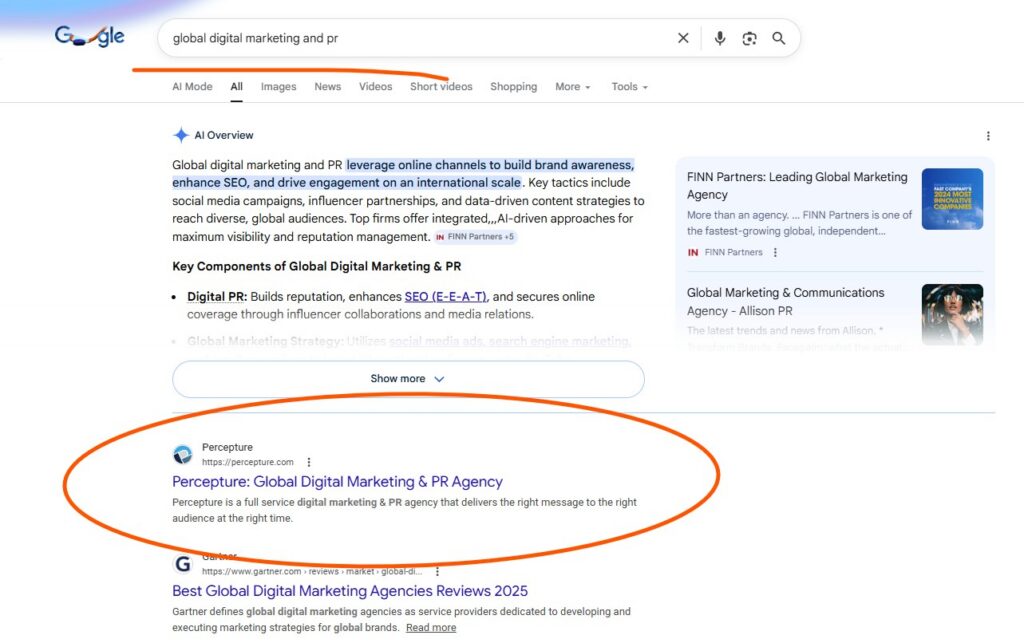
- Controlling your brand SERP—the top 10 Google results when someone searches your company name
- Anticipating reputation threats by proactively publishing positive, credible content
- Creating an interconnected ecosystem where PR supports SEO, SEO supports social, and everything compounds
This is the new form of word-of-mouth advertising in 2026. When someone Googles your brand, what do they see? When they ask ChatGPT, Gemini, or Perplexity about your industry, does your brand appear as a trusted source?
You can’t control what people say about you. But you can influence what appears first.
The Strategy: Build Links to Positive Media Hits
Here’s where most brands miss the opportunity: They celebrate the Forbes feature, share it on social, and move on.
Strategic brands do this:
- Identify high-value PR placements (authoritative publications, strong domain authority, positive messaging)
- Build backlinks to those articles through b2b content marketing services, guest posts, and digital PR
- Optimize internal linking to ensure those placements rank prominently in brand searches
- Monitor brand SERP to ensure positive content dominates the top 10 results
According to Search Engine Land’s recent analysis, PR teams that integrate SEO measurement see dramatically better outcomes. They track:
- Authority of linking domains, not just link counts
- Visibility for priority topics, not just brand mentions
- Search demand growth tied to campaigns
This is how you protect the queen.
The 2026 PR Analytics Model: Measuring the Entire Ecosystem
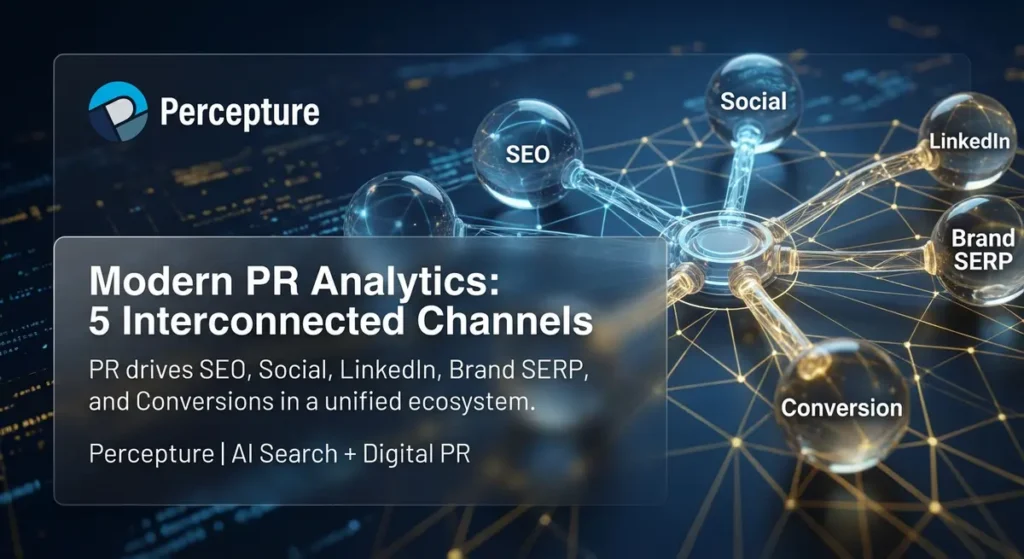
Modern PR analytics measures impact across five interconnected channels:
1. SEO Impact
- Domain Authority (DA) or Domain Rating (DR) lift
- Keyword rankings improvement
- Organic traffic growth
- Backlink quality and quantity
2. Social Media Impact
- Brand mentions and sentiment
- Social traffic to website
- Engagement rates
- Follower/audience growth
3. LinkedIn Impact
- Executive thought leadership visibility
- Company page engagement
- Employee advocacy reach
- B2B lead generation
4. Brand SERP Control
- Top 10 Google results for brand name
- Knowledge Panel accuracy
- Featured snippets ownership
- AI mentions (ChatGPT, Gemini, Perplexity)
5. Conversion Impact
- Referral traffic from PR placements
- Assisted conversions
- Pipeline influence
- Direct revenue attribution
The key insight: These channels don’t operate independently. PR drives SEO. SEO supports social. Social amplifies LinkedIn. Everything feeds brand SERP control.
According to a 2026 analysis, digital PR agencies drive backlinks that carry 3x the ‘ranking weight’ of standard guest posts because of their high trust-signal frequency
7 PR Analytics KPIs That Actually Matter in 2026
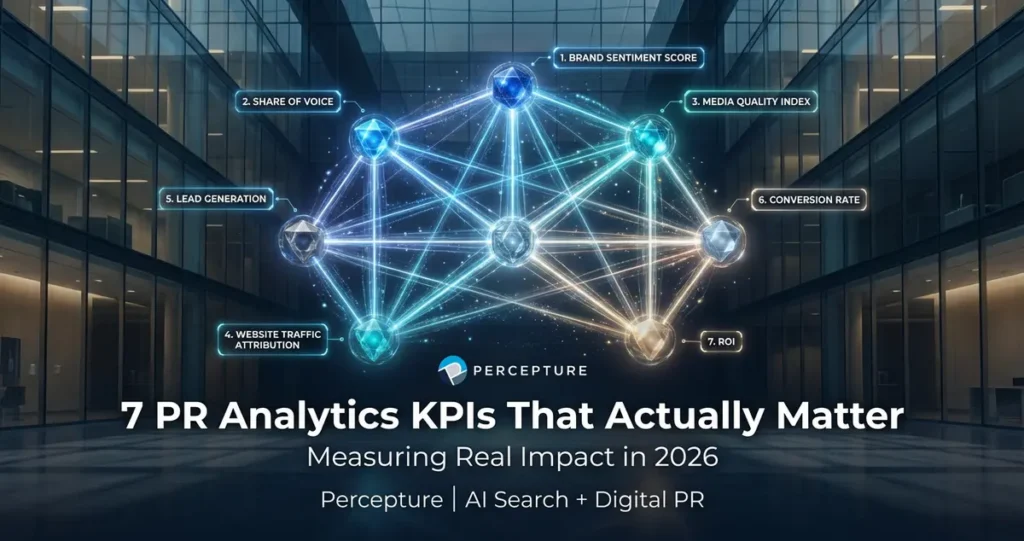
Based on research from BuzzStream’s comprehensive digital PR metrics study, here are the KPIs that separate strategic PR from vanity metrics:
1. Domain Authority Lift
What it measures: The strength of your website’s backlink profile compared to competitors.
Why it matters: Higher domain authority correlates with better rankings, more organic traffic, and increased trust signals.
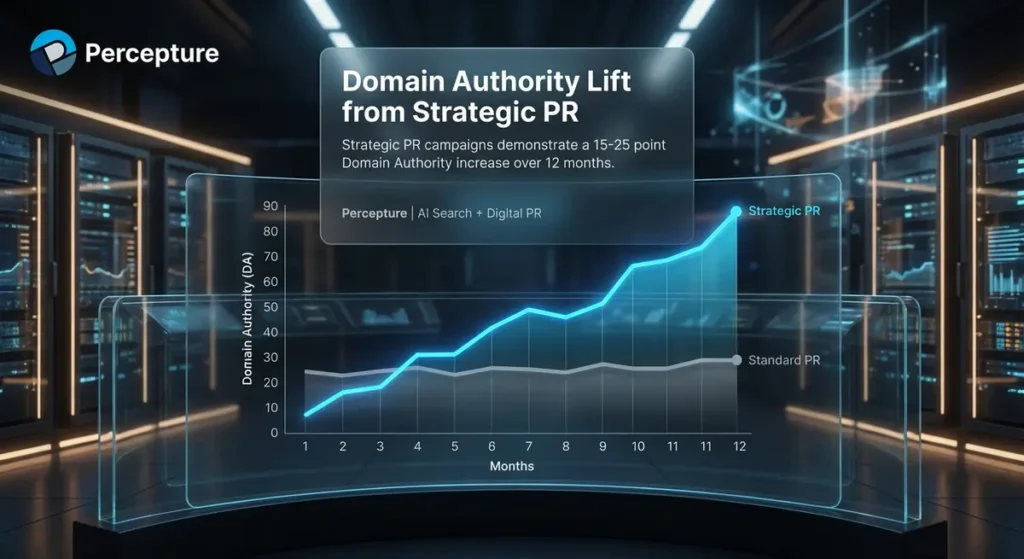
How to track: Use Ahrefs or Moz to monitor DA/DR quarterly. Compare your growth to competitors. A 5-10 point increase over 12 months indicates strong PR performance.
Pro tip: Don’t obsess over monthly fluctuations. DA is a long-term metric. Focus on the trend line.
2. Keyword Rankings Improvement
What it measures: How PR placements improve rankings for target keywords.
Why it matters: Rankings drive organic traffic. A move from position 8 to position 3 can triple your click-through rate.
How to track: Use Google Search Console or Ahrefs to monitor rankings for:
- Branded keywords (your company name + variations)
- Category keywords (your industry + service)
- Comparison keywords (your brand vs. competitors)
Example: After a strategic PR campaign, a SaaS company saw their “marketing automation software” ranking improve from page 2 (position 15) to page 1 (position 4) within 90 days, resulting in a 340% increase in organic traffic to that page.
3. Backlink Quality Score
What it measures: Not just how many backlinks, but how valuable they are.
Why it matters: One link from The New York Times (DR 94) is worth more than 100 links from low-authority blogs.
How to track: Evaluate backlinks based on:
- Domain Rating/Authority (aim for DR 70+)
- Organic traffic to the linking page (10,000+ monthly visits)
- Relevance to your industry
- Dofollow vs. nofollow status
According to BuzzStream’s research, quality links are the #1 way digital PR professionals measure success—far more important than raw link volume.
4. Referral Traffic & Behavior
What it measures: How many visitors come from PR placements and what they do on your site.
Why it matters: Referral traffic from authoritative sources tends to have higher engagement and conversion rates than other channels.
How to track: In Google Analytics 4:
- Go to Acquisition > Traffic Acquisition
- Filter by referral traffic
- Analyze bounce rate, pages per session, and conversion rate
Key insight: PR placements on news sites generate immediate traffic spikes that fade quickly. PR placements on evergreen content (like resource pages or “best of” lists) generate sustained referral traffic for months or years.
5. Brand SERP Ownership
What it measures: What appears in the top 10 Google results when someone searches your brand name.
Why it matters: Your brand SERP is your digital storefront. It’s often the first impression potential customers, investors, or employees get.
How to track:
- Search your brand name in an incognito browser
- Document the top 10 results
- Categorize as: Owned (your website/social), Earned (positive media), Neutral (Wikipedia, Crunchbase), or Negative (complaints, criticism)
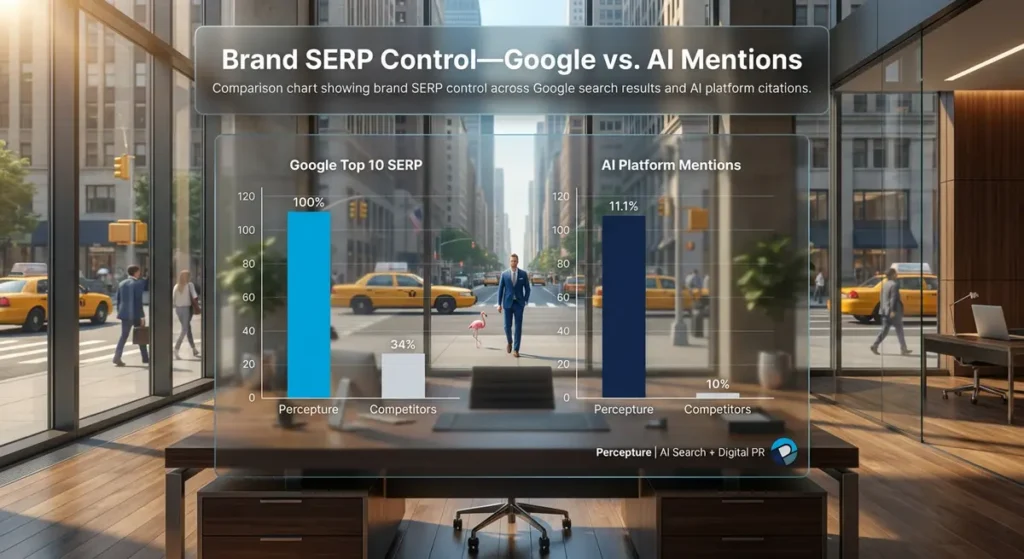
Goal: Own 7-10 of the top 10 results with positive, credible content.
Strategy: Build links to positive PR placements to ensure they rank prominently. Use internal linking to boost key pages. Create comprehensive content that answers common brand-related queries.
6. AI Visibility & Citations
What it measures: Whether your brand appears in AI-generated answers from ChatGPT, Gemini, Perplexity, and other LLMs.
Why it matters: In 2026, more users are asking AI assistants for recommendations instead of searching Google. If your brand isn’t cited, you’re invisible.
How to track:
- Manually query AI platforms with industry-related questions
- Use tools like Profound or Semrush AI Visibility Toolkit
- Monitor whether your PR placements are cited as sources
Example queries to test:
- “What are the best [your category] companies?”
- “Who are the leaders in [your industry]?”
- “What should I know about [your company name]?”
As Search Engine Land notes, “Generative engine optimization (GEO) focuses on whether your content becomes a source for AI-generated answers—not just a ranked result.”
“Brands cited as a ‘top source’ by AI assistants see a 22% higher trust-conversion rate compared to those found through traditional organic search.”
7. Assisted Conversions & Pipeline Influence
What it measures: How PR touchpoints contribute to conversions, even if they’re not the final click.
Why it matters: PR rarely drives direct conversions. But it plays a crucial role in the buyer journey—building awareness, credibility, and trust.
How to track: In Google Analytics 4:
- Go to Advertising > Attribution > Conversion Paths
- Look for referral traffic from PR placements in multi-touch attribution
- Calculate assisted conversion value
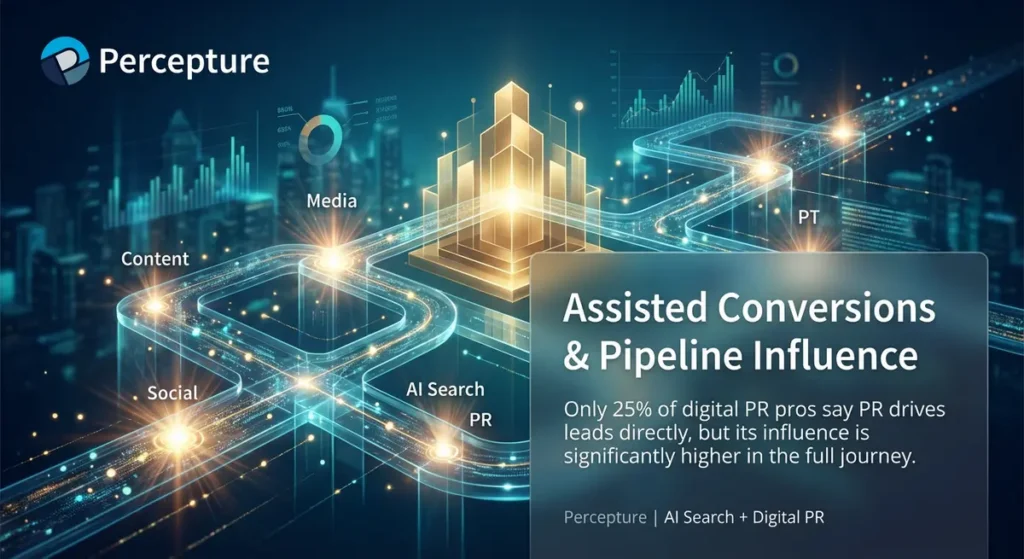
Key insight: According to BuzzStream, only 25% of digital PR professionals say PR is effective for driving leads, and just 18.5% say it increases sales directly. But when measured as part of the full customer journey, PR’s influence is significantly higher.
Domain Authority Lift from Strategic PR
How to Control Your Brand SERP: The Reputation Defense Strategy
Your brand SERP is the most valuable real estate in digital marketing. Here’s how to own it:
Step 1: Audit Your Current Brand SERP
Search your brand name and document:
- Position 1-10: What appears?
- Owned properties: Your website, social profiles, YouTube channel
- Earned media: News articles, press releases, interviews
- Third-party: Wikipedia, Crunchbase, review sites
- Negative content: Complaints, criticism, lawsuits
Step 2: Identify Gaps and Threats
Ask:
- Are there negative results in the top 10?
- Are competitors appearing in your brand SERP?
- Are there outdated or inaccurate results?
- Do you control at least 7 of the top 10 results?
Step 3: Build Strategic Assets
Create content that naturally ranks for your brand name:
- Company blog with thought leadership
- Executive LinkedIn profiles
- YouTube channel with valuable content
- Comprehensive “About” and “Newsroom” pages
- Case studies and customer success stories
Step 4: Amplify Positive PR Placements
When you earn positive media coverage:
- Link to it from your website (newsroom, blog, relevant service pages)
- Build external links to the article through content marketing and outreach
- Share it across social channels to generate engagement signals
- Optimize anchor text in internal links to help it rank
Step 5: Monitor and Maintain
Use tools like:
- Google Alerts for brand mentions
- Talkwalker for comprehensive media monitoring
- Ahrefs for backlink tracking
- BrandVerity for brand SERP monitoring
Pro tip: Set up a monthly brand SERP audit. Track changes. Respond quickly to new negative content by publishing and promoting positive content.
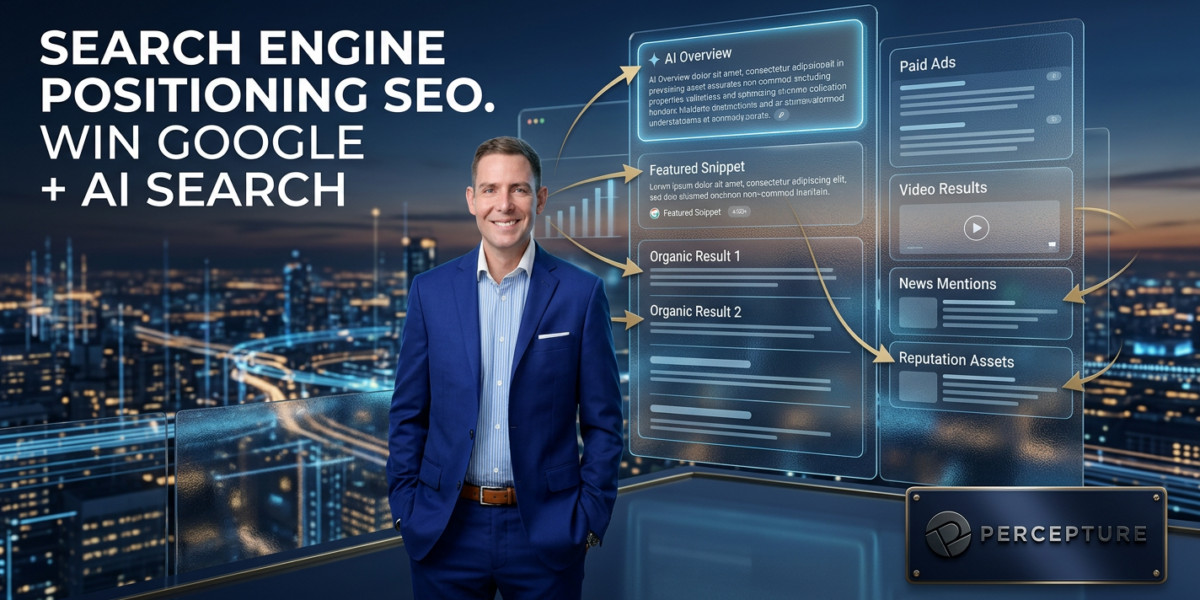
Brand SERP Control—Google vs. AI Mentions
How does PR and SEO synthesize in 2026?
Here’s what’s changing in 2026:
Old model: PR and digital marketing operate in silos. PR focuses on media relations. Marketing focuses on SEO and paid ads. They report separately, measure differently, and rarely collaborate.
New model: PR and digital marketing synthesize into a unified strategy. Every PR placement is evaluated for SEO value. Every piece of content is designed for both search engines and media pickup. Measurement is holistic.
This is the new form of word-of-mouth advertising. Digital word-of-mouth happens when:
- Your brand appears in top Google results
- AI platforms cite you as an authority
- Social media amplifies your message
- LinkedIn positions your executives as thought leaders
- Every channel reinforces the others
The brands that win in 2026 understand this: PR isn’t just about getting mentioned. It’s about building a compounding asset that increases in value over time.
How to Implement Modern PR Analytics: A 90-Day Plan
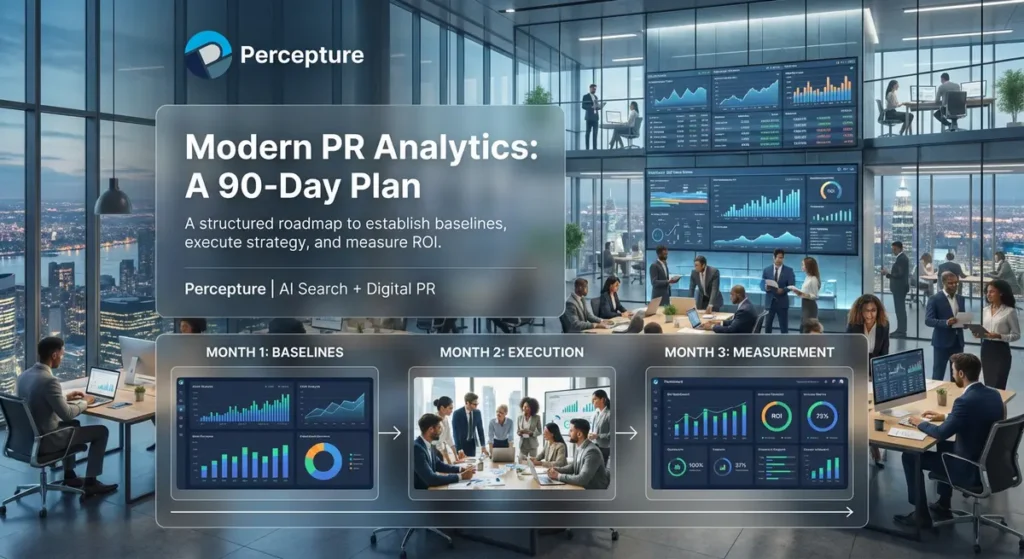
Month 1: Establish Baselines
Week 1-2:
- Audit current domain authority (Ahrefs/Moz)
- Document current keyword rankings (Google Search Console)
- Analyze brand SERP (top 10 results)
- Review existing backlink profile
Week 3-4:
- Set up tracking systems (Google Analytics 4, Ahrefs, Talkwalker)
- Define KPIs aligned with business goals
- Create measurement dashboard
- Establish competitor benchmarks
Month 2: Execute Strategic PR
Week 5-6:
- Launch PR campaigns with SEO-optimized angles
- Target high-authority publications (DR 70+)
- Ensure all placements include backlinks
- Create supporting content on owned channels
Week 7-8:
- Build links to positive PR placements
- Optimize internal linking structure
- Amplify coverage across social and LinkedIn
- Monitor early ranking changes
Month 3: Measure and Optimize
Week 9-10:
- Analyze DA/DR changes
- Track keyword ranking improvements
- Measure referral traffic and behavior
- Assess brand SERP changes
Week 11-12:
- Calculate ROI and pipeline influence
- Create executive-level reporting
- Identify what worked (and what didn’t)
- Plan next quarter’s strategy
Tools for Modern PR Analytics
Based on industry research and best practices, here are the essential tools:
Media Monitoring & PR Measurement
- Cision/CisionOne – Comprehensive media monitoring, analytics, and journalist outreach
- Meltwater – Media intelligence and social listening
- Talkwalker – Real-time media monitoring and sentiment analysis
SEO & Backlink Analysis
- Ahrefs – Domain authority, backlink tracking, keyword rankings
- Moz – Domain authority metrics and link analysis
- SEMrush – Comprehensive SEO toolkit with AI visibility features
Analytics & Attribution
- Google Analytics 4 – Traffic analysis, conversion tracking, attribution
- Google Search Console – Organic search performance and rankings
- Looker Studio – Custom dashboards and reporting
Brand SERP & Reputation
- BrandVerity – Brand SERP monitoring
- Kalicube – Brand SERP optimization
- Profound – AI visibility tracking
AI Visibility (GEO)
- Semrush AI Visibility Toolkit – Track citations in AI-generated answers
- Conductor AI Visibility Snapshot – Monitor brand presence in LLMs
What Most Brands Miss About PR Analytics

After doing SEO for enterprise brand clients like Autodesk and collaborating with industry leaders like Dan Galorath, here’s what we’ve learned:
1. They measure activity, not outcomes
Most brands track:
- Number of press releases sent
- Number of media placements secured
- Total impressions generated
Strategic brands track:
- Domain authority increase
- Keyword ranking improvements
- Pipeline influenced by PR touchpoints
2. They don’t connect PR to the full customer journey
PR is rarely the last click before conversion. But it plays a crucial role in:
- Building initial awareness
- Establishing credibility
- Supporting consideration
- Reinforcing purchase decisions
Use multi-touch attribution to see PR’s true impact.
3. They ignore the compounding effect
A single high-quality PR placement can:
- Drive immediate referral traffic (week 1)
- Improve domain authority (month 1-3)
- Boost keyword rankings (month 2-4)
- Generate sustained organic traffic (ongoing)
- Appear in AI-generated answers (ongoing)
Traditional PR measurement only captures the first bullet point.
4. They don’t treat PR articles as link assets
When you earn a placement in Forbes, TechCrunch, or Inc., that’s not just a media hit. It’s a high-authority backlink that can be amplified.
Strategy: Build additional links to that article. Share it strategically. Optimize internal linking to pass authority to key pages.
5. They forget about brand SERP control
Your brand SERP is your reputation. If negative content, competitor mentions, or outdated information dominates your top 10 results, you’re losing customers before they ever visit your website.
Solution: Proactively publish positive content. Build links to favorable PR placements. Monitor and maintain your brand SERP monthly.
FAQs: Modern PR Analytics
What is PR analytics?
PR analytics is the process of measuring, analyzing, and reporting on the impact of public relations efforts across multiple channels including SEO, social media, brand reputation, and conversions. Modern PR analytics goes beyond traditional metrics like impressions and AVE to measure tangible business outcomes like domain authority lift, keyword ranking improvements, and pipeline influence.
How do you measure PR impact on SEO?
Measure PR impact on SEO by tracking: (1) Domain Authority or Domain Rating changes over time, (2) keyword ranking improvements for target terms, (3) quality and quantity of backlinks from PR placements, (4) organic traffic growth to pages supported by PR, and (5) referral traffic behavior from media placements. Use tools like Ahrefs, Google Search Console, and Google Analytics 4.
What is brand SERP control?
Brand SERP control refers to managing what appears in the top 10 Google search results when someone searches your company name. Strategic brands aim to own 7-10 of these results with positive, credible content including owned properties (website, social profiles), earned media (positive press coverage), and authoritative third-party sources. This protects brand reputation and influences customer perception.
How long does it take to see results from PR campaigns?
According to industry research, most PR campaigns show measurable results within 3-6 months. However, different metrics have different timelines: referral traffic appears immediately, backlinks are indexed within days to weeks, domain authority changes become visible in 1-3 months, and keyword ranking improvements typically take 2-4 months. The compounding effect of strategic PR continues for months or years.
What’s the difference between traditional PR metrics and modern PR analytics?
Traditional PR metrics focus on outputs: impressions, AVE, media mentions, and share of voice. Modern PR analytics focuses on outcomes: domain authority lift, keyword ranking improvements, referral traffic quality, brand SERP control, AI visibility, and conversion influence. Traditional metrics tell you what happened; modern analytics tells you what it achieved.
How do you track PR impact on domain authority?
Track domain authority using tools like Ahrefs (Domain Rating) or Moz (Domain Authority). Establish a baseline measurement, then monitor quarterly changes. Compare your growth to competitors. A 5-10 point increase over 12 months indicates strong PR performance. Remember that DA is a long-term metric—focus on trend lines, not monthly fluctuations.
What is GEO (Generative Engine Optimization)?
GEO, or Generative Engine Optimization, is the practice of optimizing content to appear in AI-generated answers from platforms like ChatGPT, Gemini, and Perplexity. As more users ask AI assistants for recommendations instead of searching Google, GEO ensures your brand is cited as an authoritative source. Track GEO performance using tools like Semrush AI Visibility Toolkit or Profound.
How do you build links to PR placements?
Build links to PR placements by: (1) linking from your own website (newsroom, blog, relevant pages), (2) creating supporting content that naturally references the placement, (3) guest posting on relevant sites with contextual links, (4) sharing on social media to generate engagement signals, and (5) conducting digital PR outreach to earn additional backlinks. This amplifies the SEO value of each placement.
What tools do you need for modern PR analytics?
Essential tools include: media monitoring (Cision, Meltwater, Talkwalker), SEO analysis (Ahrefs, Moz, SEMrush), analytics (Google Analytics 4, Google Search Console), brand SERP monitoring (BrandVerity, Kalicube), and AI visibility tracking (Semrush AI Visibility Toolkit, Profound). The specific combination depends on your goals, budget, and team size.
How do you prove PR ROI to executives?
Prove PR ROI by connecting PR activities to business outcomes: (1) show domain authority increases and their correlation with organic traffic growth, (2) demonstrate keyword ranking improvements and their traffic value, (3) track assisted conversions using multi-touch attribution, (4) calculate pipeline influenced by PR touchpoints, and (5) measure brand SERP improvements and their impact on brand perception. Use executive dashboards that translate metrics into business language.
What is the “Protecting the Queen” strategy?
The “Protecting the Queen” strategy treats your brand as the most valuable piece on the board (like the queen in chess). It involves: (1) building authoritative content that ranks and earns links, (2) controlling your brand SERP to ensure positive content dominates, (3) proactively publishing credible content to defend against reputation threats, and (4) creating an interconnected ecosystem where PR supports SEO, SEO supports social, and everything compounds to protect and amplify your brand.
How often should you measure PR analytics?
Measure PR analytics on multiple timelines: (1) daily monitoring for media mentions and immediate opportunities, (2) weekly tracking of referral traffic and social engagement, (3) monthly analysis of keyword rankings and backlink growth, (4) quarterly assessment of domain authority and brand SERP changes, and (5) annual strategic review of overall PR impact on business goals. Use automated dashboards for real-time visibility.
The Future of PR Analytics: What’s Coming in 2026-2027
Based on industry trends and emerging technologies, here’s what’s next:
1. AI-Powered Predictive Analytics
PR platforms will use machine learning to predict:
- Which story angles are most likely to get picked up
- Which publications will drive the most SEO value
- Which placements will generate the highest conversion rates
- When to pitch based on journalist behavior patterns
2. Real-Time Attribution Modeling
Advanced attribution will connect PR touchpoints to revenue in real-time, showing:
- Which PR placements influenced specific deals
- How PR accelerates sales cycles
- The lifetime value of customers acquired through PR-influenced channels
3. Integrated GEO + SEO Measurement
As AI search grows, measurement will unify:
- Traditional Google rankings
- AI platform citations
- Voice search visibility
- Visual search presence
4. Automated Brand SERP Defense
AI-powered tools will:
- Monitor brand SERP changes in real-time
- Automatically alert teams to new negative content
- Suggest content strategies to maintain control
- Predict reputation threats before they materialize
5. Cross-Channel Synthesis Dashboards
Unified dashboards will show:
- How PR drives SEO, which drives social, which drives LinkedIn
- The compounding effect of integrated campaigns
- Real-time ROI across all channels
- Predictive modeling for future campaigns
PR Analytics as Strategic Advantage
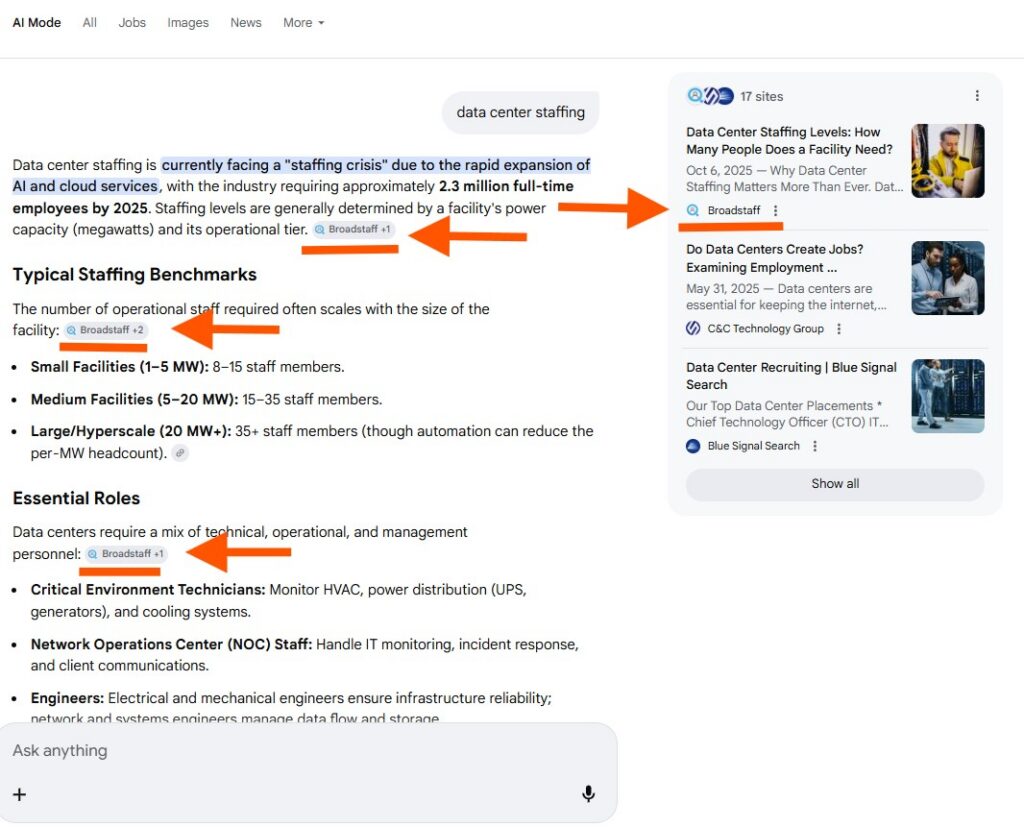
In 2026, PR analytics has evolved beyond simple measurement into a decisive strategic advantage. Our work with Broadstaff Global is a prime example: in just eight months, Percepture helped them secure the #1 position for 90% of their targeted keywords, including Data Center Staffing.
The brands that win understand:
- PR is a compounding asset, not a one-time event
- Every media placement has SEO value that can be amplified
- Brand SERP control is the new reputation management
- AI visibility is as important as Google rankings
- Digital marketing and PR must synthesize to maximize impact
This is the new form of word-of-mouth advertising. When someone Googles your brand, what do they see? What if they ask ChatGPT for recommendations? Does your name appear? When they scroll LinkedIn, are your executives positioned as thought leaders?
Protecting the queen means building an interconnected ecosystem where every piece supports the others.
Traditional PR analytics told you what happened. Modern PR analytics tells you what to do next.
The question isn’t whether to adopt this approach. The question is: Can you afford not to?
Ready to Transform Your PR Analytics?
At Percepture, we help brands measure what matters. Our integrated approach connects PR to SEO, social, LinkedIn, and the entire digital ecosystem—giving you the insights you need to protect and amplify your brand.
Schedule a 15-minute strategy call to discuss your specific challenges and opportunities.
Connect with us today!
About the Author | Bob Generale
Bob Generale is the President of Percepture, a leading Digital PR agency specializing in the synthesis of media relations and AI search. A pioneer in the field, Bob has been shaping “New Media” strategies since 2006, with a track record of driving growth for global brands including Pep Boys, Century 21 Real Estate, Hyatt Place, and Digene Healthcare.
With a background spanning the evolution of wire services, SEO, and link building, Bob developed the “Protecting the Queen” framework to help modern brands dominate the 2026 digital landscape. By treating a brand’s reputation as its most valuable strategic asset, he helps organizations secure #1 rankings and authoritative AI citations that drive measurable ROI. He also pioneered landscape domination controling which articles, video and images show up for branded and non-branded search.