
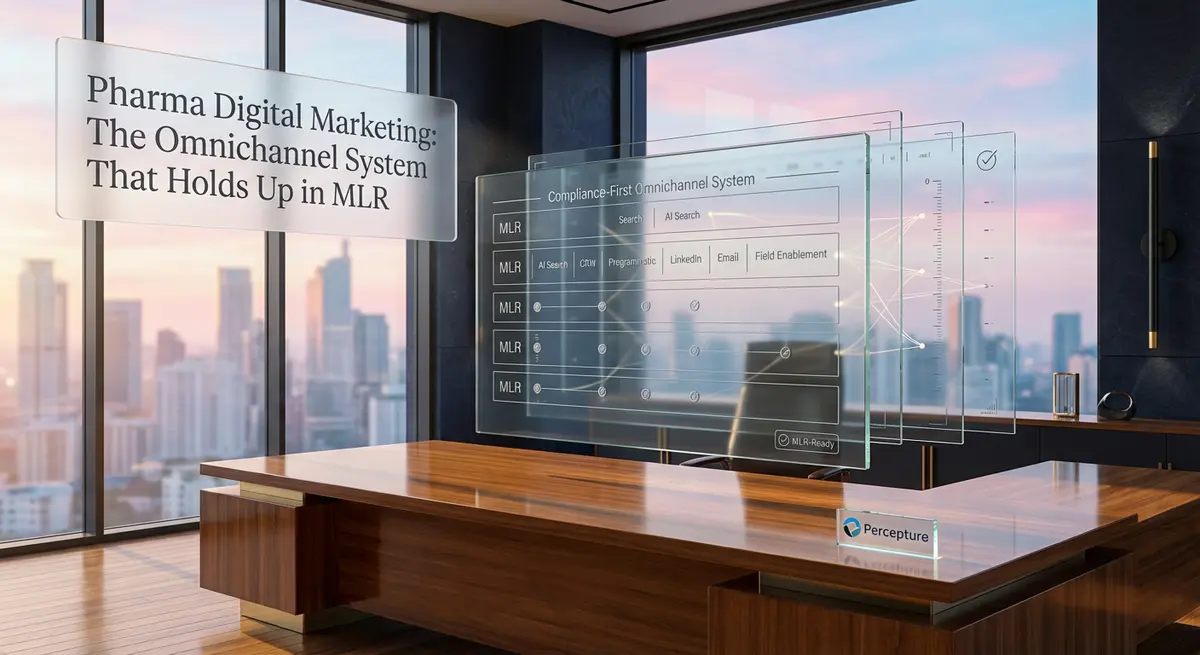

Pharma digital marketing is the integrated system that connects brand strategy, field execution, and compliant content across every channel where healthcare professionals, patients, and payers make decisions. As a life sciences marketing agency, we see commercial teams struggling with three realities: declining HCP access, aggressive MLR review cycles, and fragmented data across channels. This guide shows you how to build an omnichannel system that holds up under regulatory scrutiny while driving measurable prescription lift.
Quick Summary
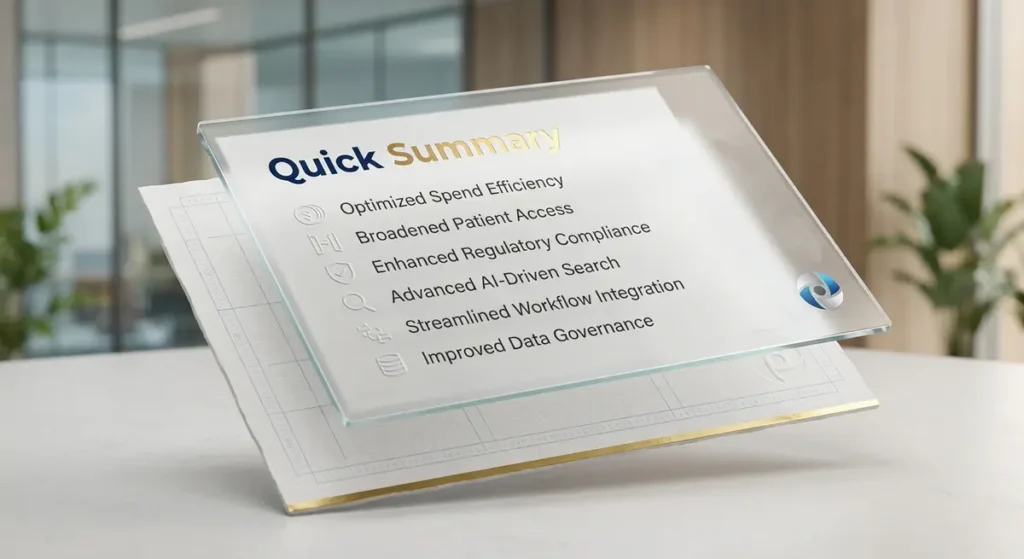
- ✓ Digital channels now represent 61.1% of total marketing spend according to Gartner’s 2025 CMO survey
- ✓ HCP access declined from 60% to 45% between 2023 and 2024, making digital the primary engagement path
- ✓ Omnichannel pharma marketing requires compliance-first design, not compliance as an afterthought
- ✓ AI search and generative engines are changing how HCPs discover treatment options
- ✓ Synchronized field and digital exposure increases prescription conversion by 2-3x
- ✓ The best pharma marketing strategy connects brand, medical affairs, field, and media in one operating system
What Is Pharma Digital Marketing?
Definition Box:
Pharma digital marketing is the practice of planning, executing, and measuring compliant promotional and educational content across digital channels to influence healthcare professionals, patients, payers, and internal stakeholders. It includes SEO, paid media, content marketing, AI search optimization, CRM, and field enablement, all designed to meet FDA and global regulatory standards while driving commercial outcomes.
Built for MLR speed, built for commercial outcomes.
Since 2004, Percepture has helped life sciences teams turn fragmented digital activity into a single omnichannel system that holds up in MLR. We build compliance-first growth programs that connect brand, medical, field, and media so your work ships faster, performs better, and stands up to scrutiny.
- Compliance-first channel design that reduces rework in review cycles
- Life sciences SEO + AI search visibility for how HCPs discover information today
- Measurement and governance tied to outcomes, not vanity metrics
- Senior-only delivery model with operator-grade execution
If you want an omnichannel system your MLR team can approve and your commercial team can scale, we should talk.
Field Notes: What Changed in the Last 18 Months
Field Note 1: The Access Crisis
Veeva Pulse data shows U.S. HCP access dropped from 60% to 45% in one year. Physicians are more selective about who they see and when. Digital is no longer a supplement to field activity. It is the primary channel.
Field Note 2: The Spend Shift
Gartner’s 2025 CMO spend survey confirms that digital channels now account for 61.1% of total marketing budgets. Pharma is following the same path as consumer and B2B, but with higher compliance risk and longer approval cycles.
Field Note 3: The DTC Intensity
Reuters reported that Novo Nordisk spent nearly $500 million on U.S. advertising for Wegovy and Ozempic in the first nine months of 2025. This level of investment shows how competitive the landscape has become for high-value therapeutic categories.
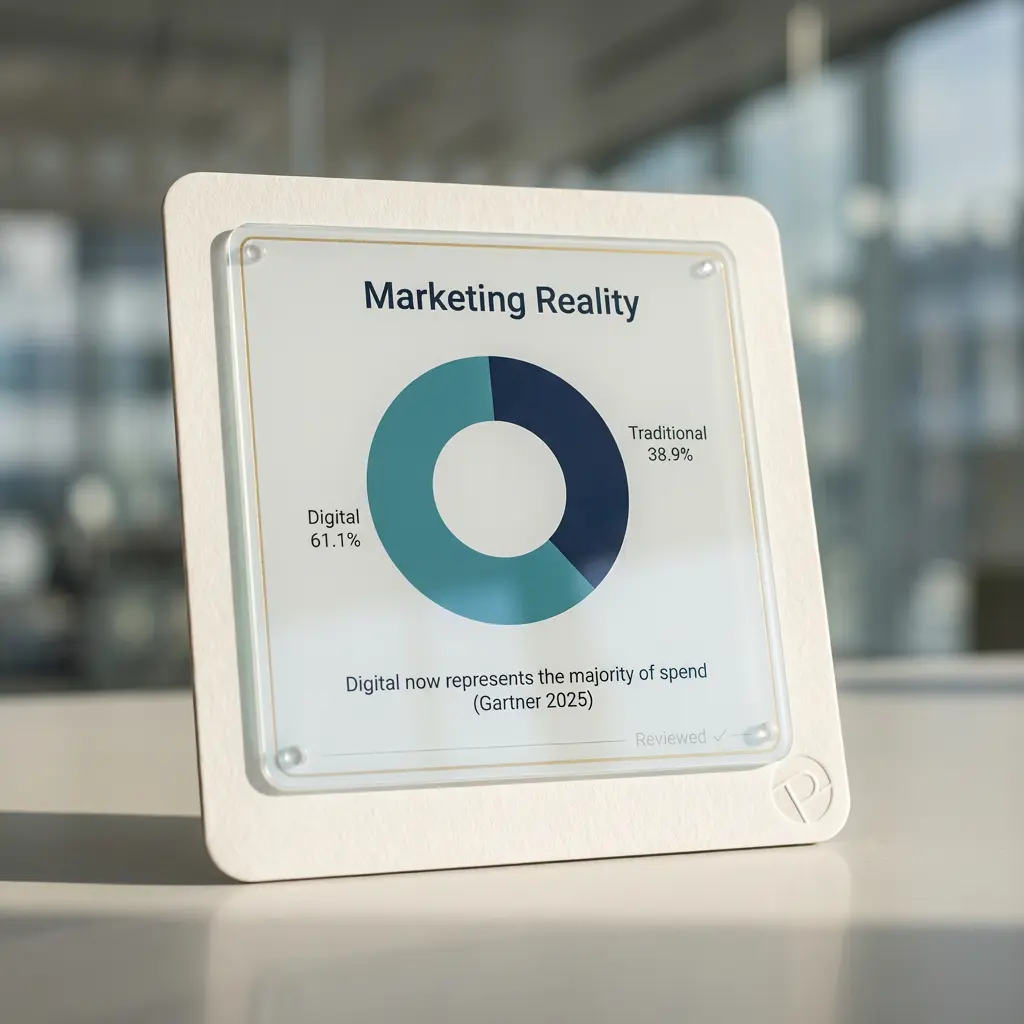
Digital channels now represent the majority of marketing spend
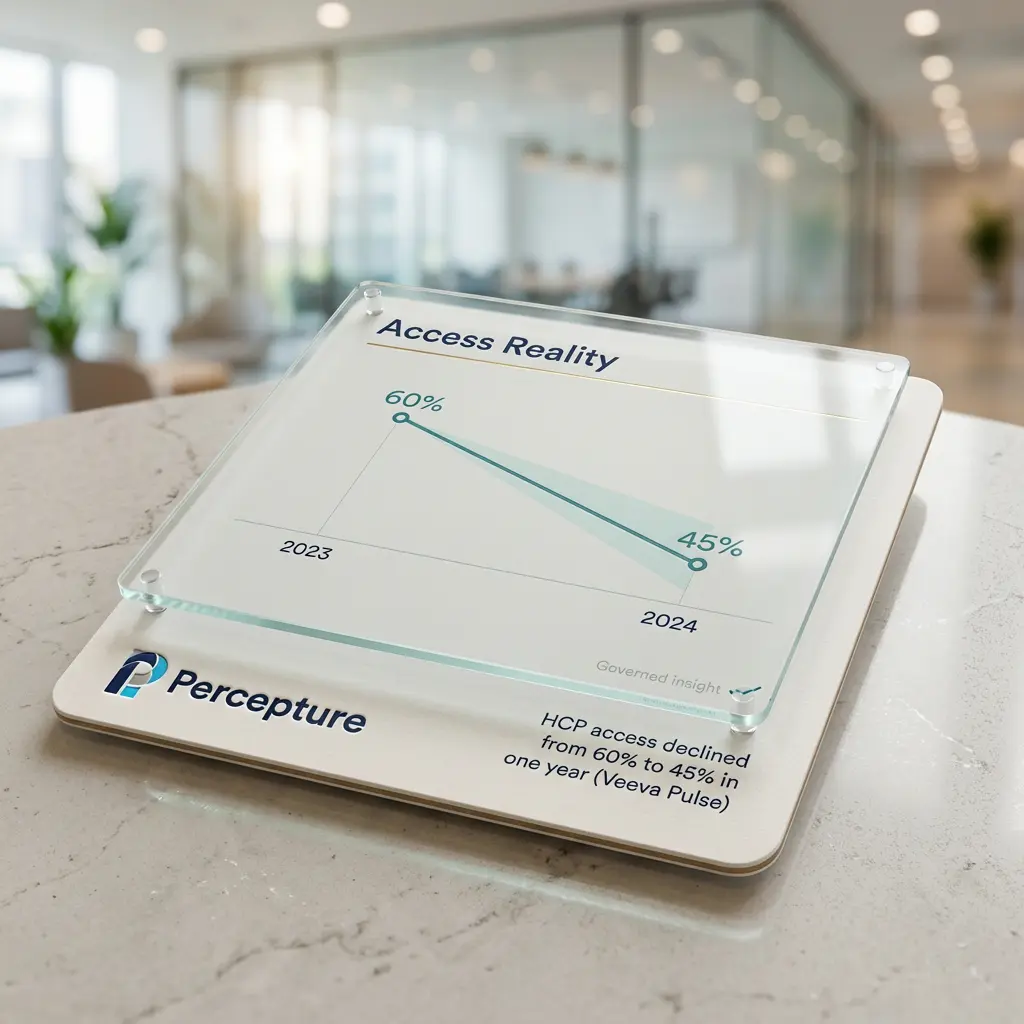
U.S. HCP access declined 15 percentage points in one year
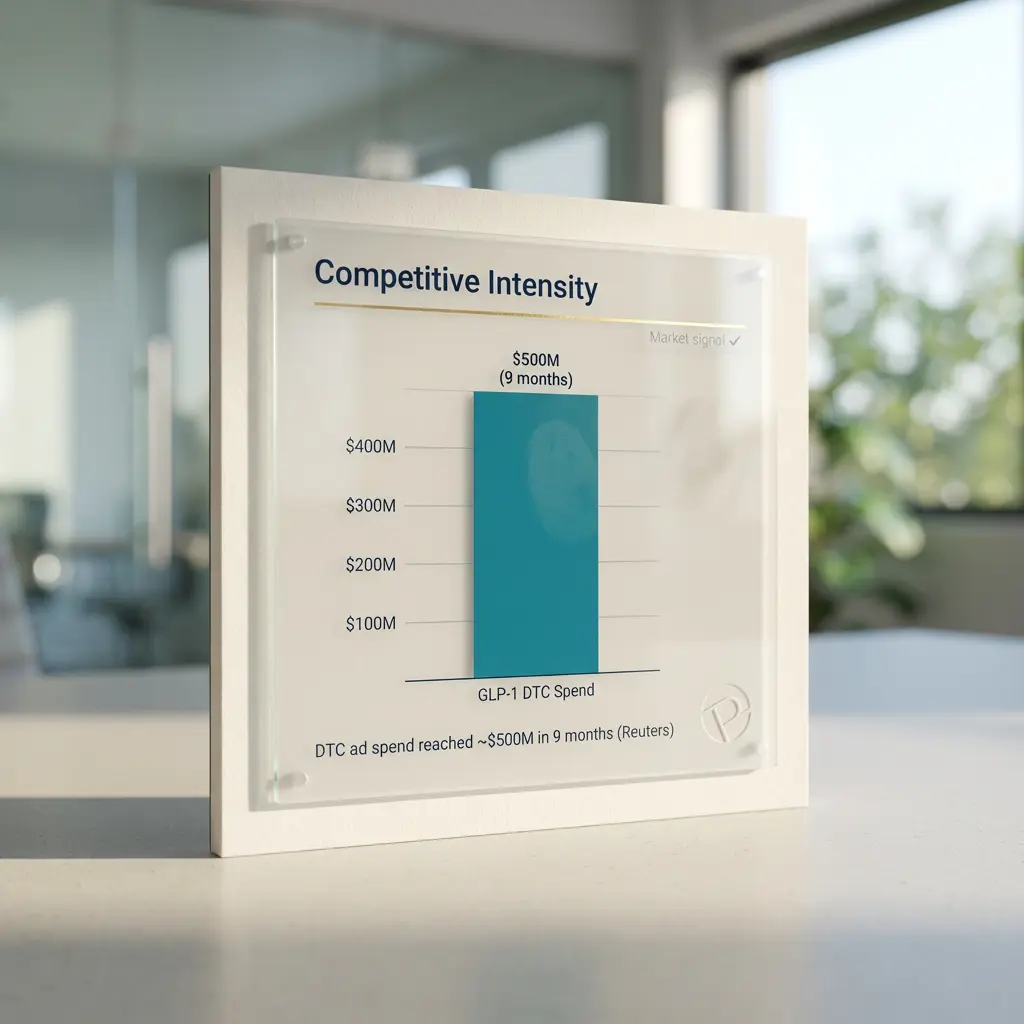
GLP-1 category ad spend reached $500M in 9 months
Talk to a Pharma Marketing Team

Build an omnichannel system that holds up in MLR.
We help pharma teams connect field, media, and content into one operating system so it ships faster, performs better, and stands up to scrutiny.
- Less review-cycle rework
- SEO + AI search visibility for HCP discovery
- Measurement tied to outcomes
Framework 1: The Compliance First Omnichannel Grid
Most pharma marketing strategies fail because compliance is treated as a gate at the end. The Compliance First Omnichannel Grid flips that model. You design every channel, message, and asset with MLR approval in mind from day one.
This framework maps your audience, channel, content type, and approval path in one view. It prevents rework and speeds time to market.
| Audience | Channel | Content Type | MLR Path | Measurement |
|---|---|---|---|---|
| HCP | SEO + AI search | Educational articles, clinical summaries | Standard MLR | Organic traffic, AI citations |
| HCP | LinkedIn + programmatic | Sponsored content, display ads | Promotional MLR | CTR, engagement, script lift |
| HCP | Field-enabled content | Leave-behinds, email follow-ups | Promotional MLR | Rep usage, call effectiveness |
| Patient | DTC search + social | Awareness content, ISI-compliant ads | Promotional MLR + legal | Impressions, site visits, conversions |
| Payer | Email + events | Health economics, real-world evidence | Medical review | Meeting requests, formulary adds |
| MSL | Medical affairs portal | Clinical data, congress materials | Medical review only | Downloads, peer engagement |
| Internal | Sales portal + CRM | Training, objection handling, competitive intel | Internal review | Certification rates, usage |
Framework 2: The Access Reality Model
The Access Reality Model is built on one fact: you cannot rely on face-to-face HCP access anymore. Veeva Pulse shows access dropped 15 percentage points in one year. That means your digital presence is your primary sales channel.

The Five Layers of the Access Reality Model:
- Pre-call digital exposure: HCP sees your brand in search, LinkedIn, or peer content before the rep call
- Rep call: Field team delivers core message and clinical data
- Post-call digital reinforcement: HCP receives follow-up email, sees retargeting ad, or finds your content in AI search
- Peer validation: HCP sees your brand cited in medical journals, congress coverage, or KOL content
- Prescription decision: HCP writes the script, influenced by the full omnichannel sequence
This model only works if your life science SEO and life science content marketing are synchronized with field activity.
Framework 3: The Proof to Prescription Path
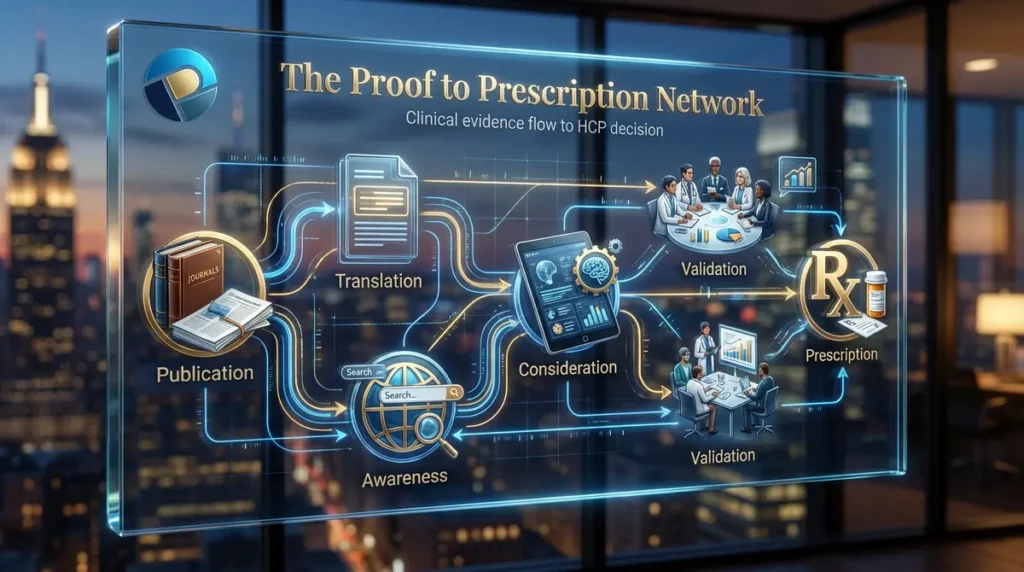
The Proof to Prescription Path maps how clinical evidence moves from publication to prescription. It is not linear. It is a network of touchpoints across medical affairs, brand, and field.
Table 2: The Proof to Prescription Path
| Stage | Evidence Type | Channel | Owner |
|---|---|---|---|
| Publication | Phase 3 data, real-world evidence | Medical journals, congress posters | Medical affairs |
| Translation | Clinical summaries, MOA explainers | MSL portal, peer-reviewed sites | Medical affairs + brand |
| Awareness | Educational content, disease state info | SEO, AI search, LinkedIn | Brand + digital |
| Consideration | Product profiles, efficacy comparisons | Rep-enabled content, email, retargeting | Brand + field |
| Validation | Peer testimonials, KOL endorsements | Events, webinars, advisory boards | Medical affairs + brand |
| Prescription | Formulary status, prior auth support | CRM, field tools, payer content | Market access + field |
The Pharma Digital Marketing Channel Playbook (2026)
1. SEO for Pharma
Search is still the highest-intent channel. HCPs search for treatment options, dosing guidelines, and safety data. Patients search for symptoms, side effects, and alternatives.
Your enterprise SEO services strategy must include:
- Disease state content that ranks for unbranded terms in pharma seo
- Product pages optimized for branded and generic drug names
- Clinical data pages that answer HCP questions
- ISI and prescribing information structured for search visibility
- Schema markup for drug information, clinical trials, and FAQs
2. AI Search and Generative Engine Optimization
HCP discovery behavior is shifting toward conversational platforms. Platforms like ChatGPT, Perplexity, and Google AI Overviews now provide direct clinical answers, bypassing traditional search results.
- Conversion Impact: Brands cited in AI-generated answers see a 27% conversion rate, compared to just 2% from traditional website traffic.
- The Risk of Invisibility: If your clinical data is not structured for these engines, your brand will be excluded from the “consideration set” provided to HCPs.
What works in AI search:
- Structured data and clear definitions
- Citable clinical facts with sources
- FAQ sections that answer specific questions
- Content that is referenced by trusted medical sites
- Brand mentions in peer-reviewed publications
3. LinkedIn for HCP Engagement
LinkedIn is the only social platform where you can target HCPs by specialty, institution, and role. It is ideal for awareness, education, and event promotion.
Best practices:
- Sponsored content with clinical insights, not product claims
- Thought leadership from your medical affairs team
- Congress coverage and KOL interviews
- Retargeting HCPs who visited your site or attended an event
4. Programmatic and Display Advertising
Programmatic allows you to reach HCPs across medical sites, journals, and news platforms. It works best for awareness and retargeting.
Key tactics:
- Contextual targeting on medical education sites
- Retargeting HCPs who engaged with your content
- Frequency capping to avoid ad fatigue
- A/B testing creative with and without ISI
5. Events and Congress Marketing
Medical congresses are still critical for peer validation and KOL engagement. Your digital strategy should amplify event impact before, during, and after.
Event marketing checklist:
- Pre-event email and LinkedIn campaigns
- Live social coverage and booth promotion
- Post-event content: session recaps, poster summaries, video interviews
- Retargeting attendees with follow-up content
6. Field Enablement and Sales Content
Your field team needs content that is easy to find, easy to use, and pre-approved by MLR. Most CRM systems are not designed for this.
What field teams need:
- Mobile-friendly leave-behinds
- Email templates for post-call follow-up
- Objection handling guides
- Competitive comparison charts
- Real-world evidence summaries
7. Medical Affairs and MSL Content
Medical affairs operates under different rules than brand. MSLs can share off-label data and respond to unsolicited requests. Your content system must support both promotional and non-promotional use cases.
Medical affairs content priorities:
- Clinical trial summaries
- Congress posters and presentations
- Peer-reviewed article reprints
- Response documents for unsolicited inquiries
- KOL engagement materials
See How We Build Omnichannel Systems
Need help connecting field, media, and content?
We build compliant omnichannel systems for pharma brands. See case studies and book a strategy session.
Analytics in Pharma Digital Marketing
Pharma marketing analytics must connect digital activity to prescription behavior. That means tracking more than clicks and impressions. You need to measure awareness, engagement, and commercial outcomes.
Table 3: Pharma Marketing Measurement Framework
| Metric Category | What to Track | Data Source | Why It Matters |
|---|---|---|---|
| Awareness | Branded search volume, AI citations | Google Search Console, AI monitoring tools | Shows if your brand is top of mind |
| Engagement | Content downloads, video views, time on page | Google Analytics, CRM | Indicates interest and education level |
| HCP reach | Unique HCP visitors, verified credentials | CRM, identity resolution tools | Confirms you are reaching the right audience |
| Field alignment | Rep content usage, post-call email opens | CRM, sales enablement platform | Shows if field and digital are synchronized |
| Prescription lift | TRx, NRx, market share | IQVIA, Symphony Health | Proves commercial impact |
| Payer access | Formulary adds, prior auth approvals | Market access data | Measures access and reimbursement |
| Patient behavior | Site visits, savings card activations | Google Analytics, patient support program data | Tracks patient journey from awareness to fill |
| Compliance | MLR approval time, rejection rate | MLR tracking system | Identifies bottlenecks and risk areas |
| ROI | Cost per script, marketing contribution to revenue | Finance + analytics | Justifies budget and informs allocation |
Compliance Checklist
Pharma digital marketing operates under the strictest regulatory environment in any industry. The FDA’s Office of Prescription Drug Promotion (OPDP) reviews promotional materials for fair balance, truthful claims, and appropriate risk disclosure.
The FDA’s Bad Ad program encourages healthcare professionals to report false or misleading prescription drug promotion. The agency plans to increase enforcement with around 100 cease-and-desist notices and thousands of warning letters, according to Reuters.
“Every piece of promotional content must include fair balance, accurate efficacy claims, and appropriate risk information. Digital channels do not change the rules.”
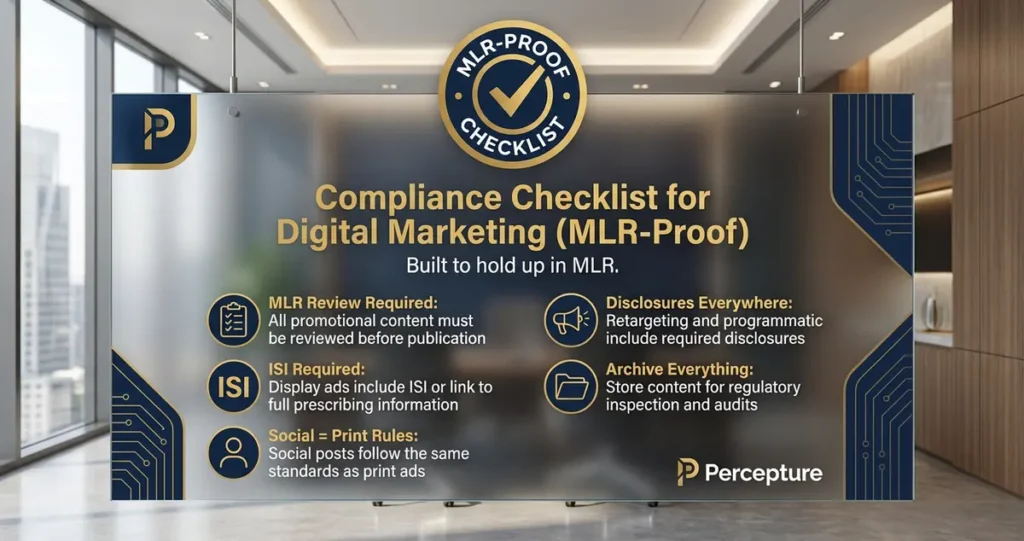
Compliance checklist for digital marketing:
- All promotional content must go through MLR review before publication
- Display ads must include ISI or link to full prescribing information
- Social media posts must follow the same rules as print ads
- Retargeting and programmatic ads must include required disclosures
- Influencer and KOL content must be clearly labeled as promotional
- Patient testimonials must include disclaimers and avoid atypical results
- Off-label promotion is prohibited in all channels
- Adverse event reporting must be monitored across all digital properties
- All content must be archived for regulatory inspection
- Global campaigns must comply with local regulations in each market
15 SEO Best Practices for Pharma Digital Marketing
- Optimize disease state content for unbranded search terms
- Create separate pages for branded and generic drug names
- Structure prescribing information for search visibility
- Use schema markup for drugs, clinical trials, and FAQs
- Build backlinks from trusted medical and educational sites
- Optimize for voice search and question-based queries
- Create b2b content marketing that answers HCP and patient questions
- Use internal linking to connect related clinical topics
- Optimize page speed and mobile experience
- Track branded and unbranded keyword rankings
- Monitor competitor content and search visibility
- Create content for every stage of the patient journey
- Optimize video content with transcripts and captions
- Use local SEO for treatment centers and specialty pharmacies
- Align SEO strategy with digital marketing for life sciences best practices
14 GEO Best Practices for Pharma (Generative Engine Optimization)
- Write clear, citable definitions for drugs and conditions
- Structure content with FAQ sections that AI can quote
- Include clinical data with sources and citations
- Use simple language that AI models can parse
- Create content that answers specific HCP questions
- Optimize for conversational and long-tail queries
- Build authority through mentions in medical publications
- Use structured data to help AI understand your content
- Create comparison content that AI can summarize
- Monitor AI citations in ChatGPT, Perplexity, and Google AI Overviews
- Optimize for “how,” “what,” and “why” questions
- Include mechanism of action explanations
- Create content that is referenced by trusted medical sites
- Use tables and lists that AI can easily extract
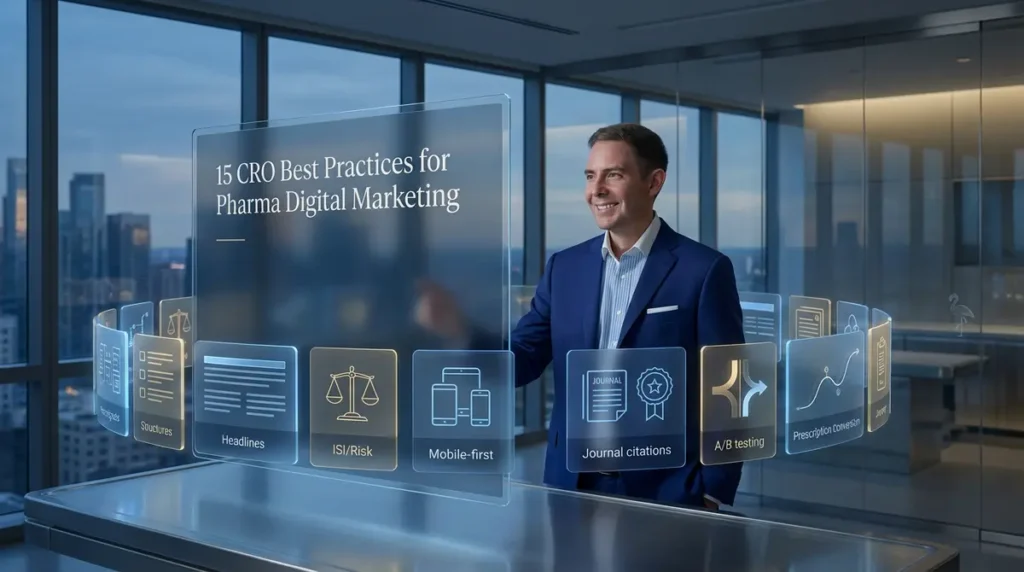
13 CRO Best Practices for Pharma Digital Marketing
- Use clear, benefit-focused headlines
- Include ISI and risk information without hiding it
- Design mobile-first experiences for HCPs and patients
- Use video to explain complex clinical concepts
- Create separate landing pages for HCP and patient audiences
- Test CTA placement and button copy
- Use progressive disclosure for long-form content
- Include trust signals: clinical data, peer reviews, congress coverage
- Optimize forms for mobile completion
- Use retargeting to bring visitors back
- Create urgency with limited-time offers (where compliant)
- Use social proof: HCP testimonials, patient stories
- Optimize page speed to reduce bounce rate
Frequently Asked Questions
1. What is pharma digital marketing?
Pharma digital marketing is the practice of planning, executing, and measuring compliant promotional and educational content across digital channels to influence healthcare professionals, patients, payers, and internal stakeholders.
2. Why is digital marketing important for pharma companies?
Digital marketing is critical because HCP access has declined significantly, digital channels now represent the majority of marketing spend, and patients increasingly research treatments online before talking to their doctor.
3. What is omnichannel pharma marketing?
Omnichannel pharma marketing is the synchronized delivery of brand messages across field, digital, and medical affairs channels to create a consistent, compliant experience for HCPs and patients.
4. How does MLR review work for digital content?
MLR (Medical, Legal, Regulatory) review ensures all promotional content meets FDA requirements for fair balance, truthful claims, and risk disclosure before it is published in any digital channel.
5. What channels are most effective for pharma digital marketing?
The most effective channels are SEO, AI search, LinkedIn, programmatic advertising, email, field-enabled content, and medical affairs portals, depending on your audience and objectives.
6. How do you measure ROI in pharma digital marketing?
ROI is measured by tracking prescription lift, market share growth, marketing contribution to revenue, HCP engagement, and patient conversion, not just clicks and impressions.
7. What is the role of AI in pharma marketing?
AI is used for generative engine optimization, predictive analytics, content personalization, automated compliance checks, and improving the efficiency of campaign planning and execution.
8. How does field enablement connect to digital marketing?
Field enablement provides reps with pre-approved content, post-call follow-up tools, and synchronized messaging that reinforces digital exposure and increases prescription conversion.
9. What is the difference between promotional and medical content in pharma?
Promotional content is designed to influence prescribing and must go through MLR review, while medical content is educational, can include off-label data, and is managed by medical affairs.
10. How do you optimize pharma content for AI search engines?
Optimize for AI search by writing clear definitions, using FAQ sections, including clinical data with sources, using structured data, and creating content that is referenced by trusted medical sites.
11. What are the biggest compliance risks in pharma digital marketing?
The biggest risks are off-label promotion, inadequate risk disclosure, misleading efficacy claims, failure to include ISI, and not archiving content for regulatory inspection.
12. How is pharma digital marketing different from other industries?
Pharma digital marketing operates under FDA regulations that require fair balance, risk disclosure, and MLR approval for all promotional content, making it more complex and slower than other industries.
Connect with us today!
About Percepture
Percepture is a life sciences marketing agency that specializes in compliant omnichannel systems for pharma and biotech brands. Our services include enterprise SEO, digital PR, public relations, and AI-powered content marketing. We work with commercial teams, medical affairs, and market access to build integrated systems that hold up in MLR and drive measurable outcomes.