


A buyer can no longer judge search visibility from rankings and traffic alone. ChatGPT brand mentions add another view: whether an AI assistant recognizes the company, includes it in relevant answers, describes it accurately, or leaves it out when buyers ask category-level questions.
The useful question is not whether the brand appeared once. Leaders need a repeatable way to test prompts, record the answer context, compare competitors, inspect cited sources when available, and connect each visibility gap to work the marketing team can control.
What should a company track in ChatGPT?
ChatGPT brand mentions are references to a company, product, service, or executive in answers generated for relevant prompts. A useful tracking program records whether the brand appears, how it is described, which competitors appear beside it, what sources are cited, and whether the answer supports the buyer’s actual question.
The executive view
Measure a prompt set
Use prompts tied to real buyer needs, not one broad test that flatters the brand.
Keep evidence with the result
Save the prompt, response, date, model or surface, brand context, competitors, and cited sources.
Improve the underlying signals
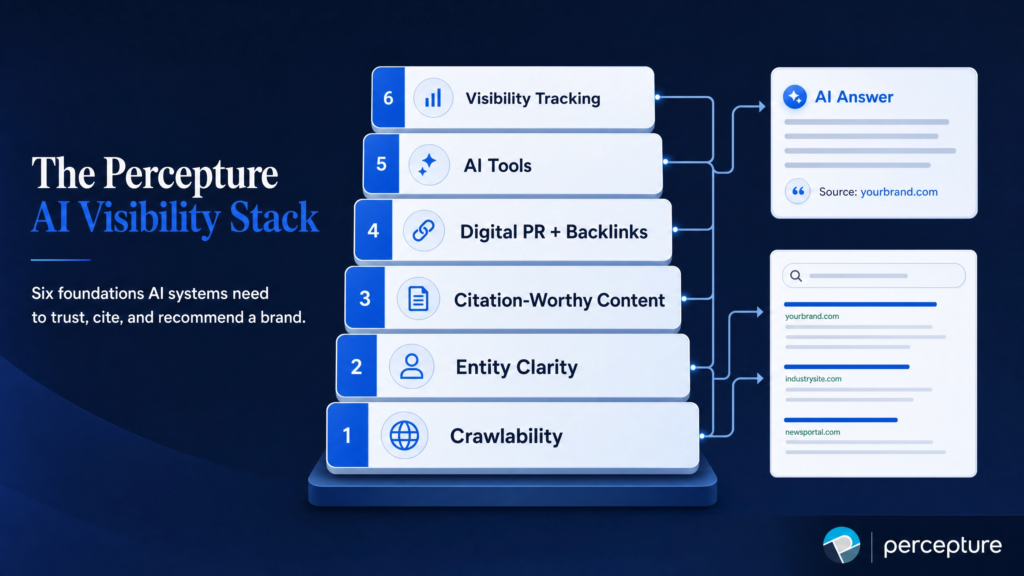
Strengthen clear entity information, useful owned content, credible third-party coverage, and technically accessible pages.
What counts as a brand mention?
A mention can be direct or contextual. A direct mention names the company or product. A contextual mention may describe an executive, service, research asset, comparison page, or category relationship that helps the assistant explain an answer. Both can matter, but they should not be scored as if they carry the same value.
The best analysis of ChatGPT brand mentions separates four outcomes:
- Recommended: The brand is presented as an option for the user’s stated need.
- Referenced: The brand is named as an example, source, provider, or participant.
- Cited: A page connected to the brand appears as a source or supporting link.
- Absent or inaccurate: The brand is missing, confused with another entity, or described in a way that does not match its current positioning.
A name alone is weak evidence of commercial visibility. A recommendation for a relevant buyer question is more useful than an incidental reference. When a citation is shown, record the linked page; when no citation is shown, record that absence rather than infer why the brand appeared.
This is why ChatGPT brand mentions should be reviewed in context. The same company can be visible for an educational question, absent from a vendor comparison, and poorly described in an industry-specific prompt.
Why does this visibility matter?
AI assistants can sit between a buyer’s question and the shortlist that buyer investigates. A brand that is not represented in useful category answers may have less opportunity to enter that research path. A brand that appears with an inaccurate description faces a different problem: recognition exists, but the surrounding information is weak or outdated.
ChatGPT brand mentions also help expose marketing gaps that ordinary rank reports may not show. The brand may have strong pages but weak category clarity. It may be recognized for one service and ignored for another. Competitors may be associated with specific buyer needs because their positioning is easier to retrieve and explain.
Use ChatGPT brand mentions as one diagnostic input, and do not present them as a promise of revenue. Visibility can guide content, public relations, technical SEO, and entity work, but a mention does not prove that a prospect visited, converted, or bought.
How does tracking work in practice?
The process starts with a controlled prompt set. Each prompt represents a buyer question, comparison, problem, location, industry, or decision stage. The team runs the prompts on a defined schedule and records the resulting ChatGPT brand mentions in a format that supports comparison over time.
The prompt set should include more than the company name. Branded prompts test recognition and accuracy, but unbranded prompts show whether the company enters an answer before the buyer already knows it. Competitor and category prompts reveal who owns the surrounding conversation.
A useful prompt library usually covers:
- Category discovery, such as asking for types of providers or approaches
- Problem diagnosis, where the buyer describes a need without naming a solution
- Comparison and shortlist questions
- Industry, location, or use-case qualifiers
- Questions about methods, risks, costs, implementation, and measurement
- Branded questions that test entity accuracy and positioning
Keep the wording stable for recurring tests. If every run uses a different question, the team cannot tell whether the result changed because visibility improved or because the prompt changed.
Build a baseline before trying to improve it
A baseline turns scattered observations into a usable record. For every prompt, capture the full question, answer date, answer surface, whether the brand appeared, the exact context of the mention, cited sources when shown, and the competitors included in the same response.
When reviewing ChatGPT brand mentions, label the answer by buyer relevance. A favorable mention for an unrelated question should not score higher than an accurate mention for a core service. The scoring rules should reflect the company’s markets, offers, and buying cycle.
Review ChatGPT brand mentions against the same written scoring rules in each reporting cycle.
| Signal | What to record | What it may reveal |
|---|---|---|
| Presence | Named, cited, recommended, or absent | Basic visibility for the prompt |
| Positioning | The description and category assigned to the brand | Entity clarity or messaging drift |
| Competitive context | Other companies named in the answer | Who is associated with the buyer’s need |
| Source context | Citations or links shown with the response | Pages and publishers connected to the answer |
| Answer quality | Accuracy, relevance, specificity, and completeness | Whether presence is useful or misleading |
Do not combine every signal into one unexplained score. Keep the supporting observations available so leaders can see why a result changed. A score without its prompt and answer context is difficult to audit and easy to overstate.
A practical monitoring workflow
The following workflow keeps ChatGPT brand mentions connected to decisions rather than screenshots and anecdotes.
1. Define the buyer questions
Start with the questions prospects ask before they know the company. Add branded questions later to test accuracy. Group prompts by service, industry, problem, comparison, and buying stage so the findings can be assigned to the right team.
The ChatGPT brand mentions tracked in this step should map to commercial priorities. If a service is not important to the business, a visibility gap for that service should not outrank a weak result for a core offer.
2. Run a controlled baseline
Use the same prompt set, testing conditions, and recording format for the baseline. Note the model or interface used when that information is available. Preserve the complete answer rather than copying only the sentence that names the brand.
This gives each ChatGPT brand mentions review enough context to distinguish a recommendation from an incidental reference. It also makes inaccurate descriptions easier to spot.
3. Classify the gaps
Assign each weak result to a practical cause category. Common working categories include unclear entity information, thin topic coverage, weak comparison content, limited third-party corroboration, inaccessible pages, or messaging that does not match the buyer’s language.
Do not claim that one category caused the answer unless the evidence supports that conclusion. For ChatGPT brand mentions, use cause categories to set testable priorities rather than claim certainty about a closed system.
4. Improve one signal group at a time
Choose a focused set of pages, entity references, or authority opportunities connected to the weak prompts. Record what changed and when. The next ChatGPT brand mentions run can then be compared with a known intervention instead of a long list of unrelated marketing activity.
5. Review movement and answer quality
Repeat the controlled prompt set. Compare presence, positioning, citations, competitors, and accuracy. Investigate meaningful changes at the prompt level before reporting a broad trend.
ChatGPT brand mentions that increase while accuracy falls are not a clean win. The measurement program should reward useful representation, not raw name frequency.
How can a company improve AI search visibility?
Improvement begins with information that is easy to identify, understand, and corroborate. The website should state what the company is, who it serves, what it offers, and how its services relate to the problems buyers describe. Important claims should be supported on the page where they appear.
For weak ChatGPT brand mentions, compare the language in the prompt with the language on the relevant page. A company may use internal terms that do not match how buyers describe the problem. Closing that gap does not mean repeating keywords. It means answering the same decision clearly and completely.
Strengthen the content connected to buyer decisions
Build pages around material questions rather than isolated phrases. A strong resource can define the topic, explain options, identify tradeoffs, describe a process, and show how a buyer should evaluate the next step. It should make the company’s role clear without turning every paragraph into a sales pitch.
Use an evidence-based AI content citation strategy when deciding which facts require support and which pages deserve deeper sourcing. Citability depends on having useful, attributable material—not simply adding a sources list to thin content.
Make the entity consistent
Review how the company name, services, leaders, industries, locations, and relationships are described across important owned pages. Conflicting descriptions can make the entity harder to understand. Keep current information specific and consistent without copying the same paragraph across the site.
For ChatGPT brand mentions, the consistency review should focus on information visible across important owned pages.
Earn relevant third-party coverage
Independent articles, interviews, directories, reviews, research references, and trade coverage can provide external context around an entity. Relevance and editorial quality matter more than placing the company name on unrelated sites.
Keep important pages accessible
A page cannot contribute much if it is blocked, broken, buried, or difficult to interpret. Technical teams should review crawl access, canonical handling, status codes, rendering, structured data, internal links, and page clarity as part of broader generative engine optimization services.
Technical work should support useful content rather than substitute for it. Schema can clarify visible information, but it should not introduce facts that readers cannot see on the page.
How should tracking tools be evaluated?
The best tool depends on the prompt set, reporting needs, supported answer surfaces, and the level of evidence a team needs to retain. A polished dashboard is not enough if the underlying prompts and responses cannot be inspected.
When comparing tools for ChatGPT brand mentions, ask whether the platform can:
- Preserve the exact prompt and response
- Separate direct mentions, recommendations, and citations
- Track competitors within the same prompt set
- Show changes at the prompt level
- Export data for independent analysis
- Record the answer surface and collection date
- Support tags for market, service, persona, and buying stage
- Let reviewers inspect the evidence behind a score
A tool for ChatGPT brand mentions should retain enough detail for reviewers to inspect individual results.
Manual tracking can work for a small, stable prompt set. A spreadsheet becomes harder to manage as markets, competitors, answer surfaces, and testing frequency expand. Software becomes more useful when it reduces collection work without hiding the evidence needed for interpretation.
Avoid selecting a platform only because it produces a single visibility score. Ask how that score is calculated, what it omits, and whether a stakeholder can trace it back to individual answers.
What mistakes should companies avoid?
A weak ChatGPT brand mentions program often begins with an executive entering the company name, seeing one favorable answer, and treating it as a benchmark. That test says little about whether the brand appears during unbranded buyer research.
Other mistakes include:
- Changing the prompt set during every reporting cycle
- Counting every mention as equally valuable
- Ignoring inaccurate or outdated descriptions
- Reporting a score without the underlying prompts and responses
- Treating citations, mentions, and recommendations as the same signal
- Chasing mention volume for topics unrelated to the business
- Publishing repetitive pages for small keyword variations
- Making unsupported claims to sound more authoritative
- Assuming a competitor’s presence reveals the exact reason it was selected
Another mistake is separating AI visibility from the rest of marketing. Entity clarity, useful content, public relations, technical access, and distribution often cross team boundaries. An omnichannel marketing strategy can help coordinate those workstreams around the same audience and positioning.
How should success be measured?
A useful report ties ChatGPT brand mentions to a fixed prompt set and a defined business priority. It shows movement without pretending that every answer is stable or that every mention caused a commercial outcome.
Track several layers:
- Prompt coverage: The share of priority prompts where the brand appears in a relevant role.
- Recommendation quality: Whether the answer presents the brand as a plausible option for the stated need.
- Description accuracy: Whether the company, services, and positioning are represented correctly.
- Citation presence: Whether owned or earned sources connected to the brand appear when citations are shown.
- Competitive share: How often priority competitors appear within the same controlled prompt set.
- Gap resolution: Whether targeted weak prompts improve after a documented content, authority, or technical change.
Use trend lines carefully. A reporting period should identify the prompts that moved, the prompts that did not, and the marketing work completed between runs. That is more useful than announcing that visibility increased without showing where or why.
Leaders should also separate leading and business measures. Prompt coverage and citation presence are visibility indicators. Qualified visits, inquiries, opportunities, and revenue are business indicators. Connect them when reliable attribution exists, but do not present one as proof of the other.
A quick readiness scorecard
- Prompt set: Do priority prompts reflect real buyer questions?
- Baseline: Are complete responses stored with dates and answer context?
- Accuracy: Can the team flag misleading descriptions separately from absence?
- Ownership: Does every gap have a content, PR, technical, or strategy owner?
- Evidence: Can every reported score be traced to individual prompts?
- Review cycle: Is the testing schedule consistent enough to compare results?
Evaluate the work behind the dashboard
Before choosing a visibility partner, review how it handles evidence, implementation, and reporting—not just how the final score looks.
Turn monitoring into an operating decision
ChatGPT brand mentions become useful when the findings change what the team does next. A missing category association may call for clearer service content. An inaccurate description may point to entity inconsistency. A competitor-heavy answer may expose a weak comparison or authority footprint.
Keep the process controlled: define the prompts, preserve the answers, classify gaps, improve a focused signal group, and retest. That approach gives marketing leaders a structured view of AI search visibility without treating a single answer as a market-wide result.