

Enterprise SEO is a mathematical equation, so I built this ROI calculator to help you forecast results. We help you measure performance to justify SEO spend with your CFO. Today, can your enterprise SEO agency answer one simple question: “What’s their SEO actually worth?”
They see traffic numbers and are taught to just track rankings. But when the CFO asks for ROI, they’re stuck showing vanity metrics instead of revenue impact. This guide shows you how to calculate enterprise SEO ROI using the same framework that helped a global Contract Manufacturer grow traffic by 435%, triple inbound leads, and scale from $250M to over $1B in annual sales.

What Is an Enterprise SEO ROI Calculator?
An enterprise SEO ROI calculator is a tool that measures the financial return on your organic search investment. It answers three critical questions:
- How much revenue did SEO generate?
- What did it cost to generate that revenue?
- Was it worth it?
Unlike basic calculators that only track traffic, an enterprise-grade tool factors in:
- Customer lifetime value (LTV)
- Customer acquisition cost (CAC)
- Churn rate and retention period
- Gross margin and discount rate
- Time-to-rank and velocity metrics
Think of it this way: SEO is leaving your sales deck on the buyer’s desk. When someone searches “enterprise data center colocation” or “FDA-compliant LIMS software,” your brand appears. First, they read your content. Secondly, they trust your expertise. Next, they reach out.
That’s not luck. That’s predictable, measurable revenue.
The Core Formula: How to Calculate SEO ROI
The basic formula is simple:
SEO ROI = (Revenue from SEO – Cost of SEO) / Cost of SEO × 100
But enterprise SEO requires a deeper model. Here’s what you actually need to track:

Inputs You Must Measure
1. Total SEO Investment
Include everything:
- Internal team salaries (content, SEO, dev)
- Agency or contractor fees
- Tools (Ahrefs, Semrush, Screaming Frog)
- Content production costs
- Technical implementation (dev hours)
2. Customers Acquired from Organic Search
Track leads that convert to customers. Use UTM parameters, CRM attribution, and closed-loop reporting. If your attribution is messy, start with “first-touch organic” as a baseline.
3. Average Revenue Per Customer (ARPC)
Calculate total revenue divided by number of customers. For enterprise B2B, this might be $50K–$500K+ per deal.
4. Customer Lifetime Value (LTV)
Multiply ARPC by average retention period. If your average customer stays 3 years and spends $100K/year, LTV = $300K.
5. Churn Rate
The percentage of customers lost annually. Lower churn = higher LTV. Retention period = 1 / Churn Rate.
6. Gross Margin
The percentage of revenue retained after cost of goods sold (COGS). Only count profit, not gross revenue.
7. Discount Rate
Reflects the time value of money. Typically 5–10%. This adjusts future revenue to present value.
Meet with Enterprise SEO Team
Each expert has over 15 years of B2B SEO Experience
Outputs That Matter
Customer Acquisition Cost (CAC)
CAC = Total SEO Investment / Customers Acquired
Net Present Value of LTV (NPV of LTV)
NPV of LTV = LTV / (1 + Discount Rate)
ROI Percentage
ROI = ((NPV of LTV – CAC) / CAC) × 100
LTV:CAC Ratio
Aim for at least 3:1. Higher ratios indicate efficient customer acquisition.
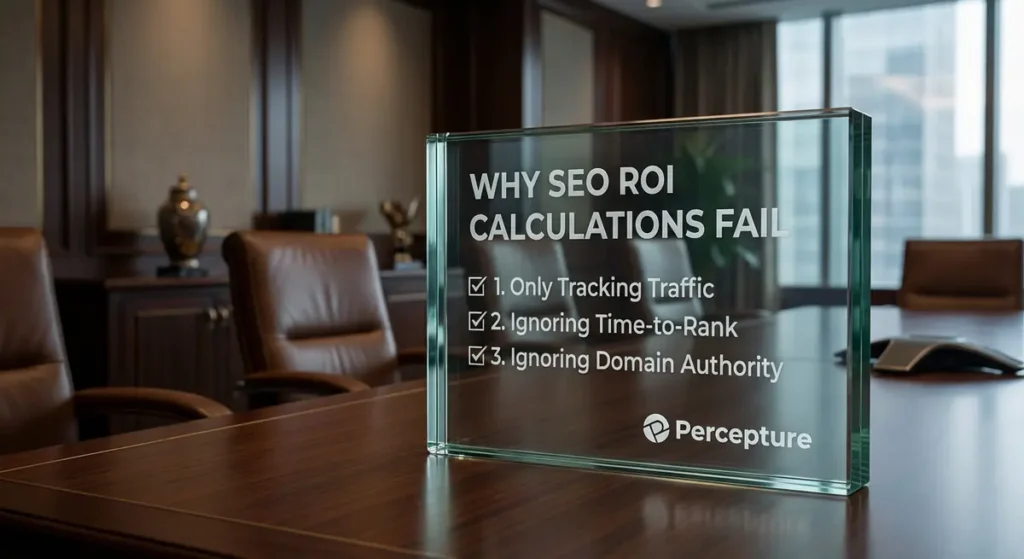
Why Most Enterprise SEO ROI Calculations Fail
Three mistakes kill accurate ROI measurement:
1. They Only Track Traffic
Traffic doesn’t pay the bills. Customers do. If you’re measuring sessions instead of revenue, you’re optimizing for the wrong metric.
2. They Ignore Time-to-Rank
SEO isn’t instant. It takes 6–12 months to see meaningful results. If you’re measuring ROI after 90 days, you’re quitting before the compound effect kicks in.
3. They Don’t Factor in Domain Authority
Your ability to rank depends on your Domain Authority (DA). If your DA is 35, you can realistically target keywords with difficulty scores around 37 (DA +2). If you’re chasing keywords with difficulty 60, you’ll waste months.
This is the DA +2 Rule: Target keywords roughly 2 points above your current DA. As your authority grows, so does your ranking potential.
The 5-vs-10 Article Rule: Content Coverage That Compounds
Here’s a framework most agencies miss: topical closure beats keyword stuffing.
If you publish 5 deep, authoritative articles on a topic, you’ll outrank competitors who publish 10 shallow posts. Why? Because Google (and AI models) reward depth, not volume.
For example, if you’re targeting “enterprise SEO,” don’t just write one blog post. Build a content cluster:
- Definition article: “What is Enterprise SEO?”
- Pillar guide: “Enterprise SEO Strategy: The Complete Guide”
- Industry-specific: “Enterprise SEO for SaaS Companies”
- Proof: “Enterprise SEO Case Study: How We Scaled Traffic 435%”
- Tactical: “Enterprise SEO Checklist: 15 Steps to Rank Faster”
- Service page: “Enterprise SEO Services”
- Tool: “Enterprise SEO ROI Calculator” (this article)
This is content coverage. When you own the topic, you own the rankings.
Trust Velocity: The Hidden Multiplier
SEO isn’t just about keywords. It’s about trust signals.
Trust velocity is how fast your brand builds authority. Two factors accelerate it:
1. Digital PR & Backlinks
Every high-authority link (DA 70+) from a credible source (Forbes, TechCrunch, industry publications) boosts your domain authority. This shortens time-to-rank.
2. AI Citations (GEO)
When ChatGPT, Perplexity, or Google AI Overviews cite your brand, you build trust faster. This is Generative Engine Optimization (AI Search) services, optimizing for AI-generated answers, not just search results.
Think of it this way: PR + SEO = Trust Velocity. The faster you build trust, the faster you rank. There is a reason we did a Digital PR services promotion in 2024, writing how ChatGPT is going to evolve into a synthesized search engine with an organic and paid ecosystem back in 2023.
Case Study: How a Global CDMO Scaled with Enterprise SEO
A leading contract development and manufacturing organization (CDMO) partnered with Percepture, a specialized life sciences marketing agency, to overhaul its digital presence.
Challenge: Low organic visibility. Competitors dominated search results for key therapeutic areas.
Solution: A comprehensive enterprise SEO strategy focused on content depth, technical optimization, and strategic link building. (don’t forget social signals)
Results:
- Web traffic increased by 435%
- Inbound leads tripled (3x)
- One division scaled from $250M to over $1B in annual sales
- Growth led to new acquisitions to handle increased capacity
This wasn’t luck. It was a systematic approach: keyword mapping, content clusters, technical life science SEO, and trust-building through PR.

How to Use an Enterprise SEO ROI Calculator
Here’s the step-by-step process:
Step 1: Gather Your Data
Pull numbers from your CRM, analytics, and finance team:
- Total SEO investment (last 12 months)
- Customers acquired from organic search
- Average revenue per customer
- Churn rate
- Gross margin
- Discount rate (use 5% if unsure)
Step 2: Calculate CAC
Divide total SEO investment by customers acquired.
Step 3: Calculate LTV
Multiply ARPC by retention period (1 / churn rate), then multiply by gross margin.
Step 4: Calculate NPV of LTV
Divide LTV by (1 + discount rate).
Step 5: Calculate ROI
ROI = ((NPV of LTV – CAC) / CAC) × 100
Step 6: Check Your LTV:CAC Ratio
Divide NPV of LTV by CAC. Aim for 3:1 or higher.
Enterprise SEO Calculator
Enterprise SEO ROI Calculator
Predict ROI, CAC, LTV, payback, and your likelihood to rank for a topic based on authority and trust velocity.
Inputs
Use this if you want to model a ramp, not just historical ROI.
Note: This tool provides directional estimates. Use your CRM and finance system as the source of truth.
Results
Forecast (incremental)
Enter forecast inputs to estimate payback and incremental value after ramp.
What to improve next
- Enter your inputs, then click Calculate.
About the methodology
This calculator uses your enterprise SEO framework: CAC equals total investment divided by customers acquired. LTV is revenue per customer multiplied by retention period (1 divided by churn), then adjusted by gross margin. NPV of LTV discounts future value by your discount rate. ROI is calculated using NPV of LTV relative to CAC.
Rank Feasibility uses the DA plus 2 rule. Trust Velocity uses high authority links and AI citations as accelerants. Content Coverage rewards clusters that achieve topical closure with depth, not fluff.
15 Best Practices for Enterprise SEO ROI
- Track revenue, not traffic. Traffic is a vanity metric. Revenue is what matters.
- Use closed-loop attribution. Connect organic leads to closed deals in your CRM.
- Factor in time-to-rank. SEO takes 6–12 months. Measure ROI annually, not quarterly.
- Apply the DA +2 rule. Target keywords 2 points above your current Domain Authority.
- Build content clusters. Own topics, not just keywords.
- Earn high-DA backlinks. PR accelerates trust velocity.
- Optimize for AI citations (GEO). Get cited in ChatGPT and AI Overviews.
- Measure LTV:CAC ratio. Aim for 3:1 or higher.
- Include all costs. Don’t forget tools, dev hours, and internal salaries.
- Segment by buyer journey. Track ROI for awareness, consideration, and decision-stage content.
- Use UTM parameters. Tag all organic campaigns for accurate attribution.
- Monitor churn rate. Lower churn = higher LTV = better ROI.
- Adjust for seasonality. Some industries see traffic spikes in Q4. Normalize your data.
- Benchmark against paid channels. Compare SEO ROI to PPC, LinkedIn Ads, and events.
- Report to the C-suite in their language. Show ROI, LTV:CAC, and revenue impact—not rankings.
FAQ: Enterprise SEO ROI Calculator
Q: How long does it take to see ROI from enterprise SEO?
Most companies see initial ranking improvements in 3–4 months. Significant traffic and lead growth typically takes 6–12 months. Enterprise SEO is a long-term investment.
Q: What’s a good SEO ROI percentage?
For enterprise B2B, aim for 300%+ ROI within 12–18 months. Top performers see 500–1,000%+ ROI over 2–3 years.
Q: How do I calculate SEO ROI if attribution is messy?
Start with “first-touch organic” attribution. Track leads that first discovered you via organic search. As your data improves, layer in multi-touch attribution.
Q: What’s the difference between SEO ROI and LTV:CAC ratio?
SEO ROI measures percentage return. LTV:CAC measures efficiency. Both matter. Aim for 300%+ ROI and 3:1 LTV:CAC.
Q: Should I include brand search in SEO ROI calculations?
Yes, but segment it. Brand search (people searching your company name) has different economics than non-brand search (people searching solutions).
Q: How do I prove SEO ROI to my CFO?
Show three numbers: (1) Revenue from organic customers, (2) Total SEO investment, (3) ROI percentage. (4) compare to other channels (PPC, events, etc.).

Video Transcript:
Enterprise SEO is often misunderstood. Most executives ask:
- How long will it take?
- Is it predictable?
- What is the ROI?
The truth is, enterprise SEO is not random. It is a probability model. If you know your domain authority, keyword difficulty, ranking position, and conversion rate, you can estimate revenue impact.
The Enterprise SEO ROI Calculator helps you understand:
- How long it may take to rank.
- How much traffic that ranking can generate.
- What percentage of that traffic converts.
- And how much pipeline that represents.
For enterprise companies with long sales cycles and high deal values, SEO must be measured in revenue influence, not just traffic.
If moving from position nine to position three adds 2,000 visitors per month, and 1 percent convert, what does that mean in qualified pipeline? That’s the calculation.
This tool helps you make SEO a board-level growth lever, not a marketing experiment.
Use the calculator.
Model your opportunity.
And decide how aggressively you want to invest in visibility.
Get Enterprise SEO ROI Plan
Most enterprise marketing teams waste 6 months figuring out what to track. You don’t have to. Here’s what you get when you work with Percepture:
- A keyword map + page plan tailored to your buyers
- A 90-day action list your team can execute immediately
- ROI tracking dashboard that connects SEO to revenue
Proven model. No theory. Just a clear plan that drives results.
Connect with us today!

About Bob Generale: Enterprise SEO & AI Search Pioneer
Bob Generale is an Enterprise SEO and Generative Engine Optimization (GEO) / AI search expert who has driven organic growth for Fortune 500 companies since 2006. His client portfolio includes Prudential, Ferrari, Vodafone, and Century 21—where he achieved 80% of the national real estate search market share. He focuses mostly on his work today in complex industries of telecom, life sciences, and healthcare, and now sits on the Board of the Ferrari Club of America.
Predictable SEO Methodology
Generale’s approach treats search visibility as a mathematical system, not guesswork. His proprietary framework, the Generale Calculus, combines Domain Authority analysis, topical depth mapping, and competitive gap analysis to forecast ROI with precision.
“SEO is the digital equivalent of leaving your sales deck on a buyer’s desk,” Generale explains. “Our job is to ensure that when the buyer is ready to act, your deck is the only one they see.”
His Enterprise ROI Forecasting Models analyze content length, semantic structure, and authority signals to create roadmaps for Top 3 rankings and AI search citations.
AI Search & Generative Engine Optimization
As co-founder of PyraBuilds.ai and co-inventor of Social Incentive Marketing (SIM), Generale specializes in optimizing and pioneering b2b content marketing for Large Language Models (LLMs). Working with industry pioneer Hunter Newby, he focuses on the “Retrieval” layer of AI search—conditioning LLMs to prioritize authoritative sources through entity relationships and industry ecosystems.
Leadership & Recognition
- Co-founder, PyraBuilds.ai
- Board Member, Ferrari Club of America
- Strategic Advisor to Fortune 500 companies
- 20+ years in enterprise SEO (since 2006)
- Partner and President, Percepture (est. 2004)
- Co-Inventor of Social Incentive Marketing (Web 3 Tech)
- Partner, Unicorm Farms (Venture Capital)