
Quick Answer
Telecom Expense Management (TEM) is the process of tracking, auditing, and optimizing an organization’s telecommunications spending across voice, data, mobile, and cloud services. While a telecom marketing agency focuses on driving growth and customer acquisition, TEM solutions combine software, services, and automation to help enterprises reduce telecom costs by 20-40%, eliminate billing errors, and gain visibility into complex multi-vendor environments. Companies with 500+ employees, multiple locations, or annual telecom spend exceeding $500K typically see the fastest ROI from TEM platforms. The market is shifting toward AI-powered automation that goes beyond traditional invoice processing to include anomaly detection, dispute routing, and predictive cost modeling.
Turn telecom spend chaos into board-pack clarity and real cost takeout.
If you have multi-vendor invoices, messy inventory, or renewal pressure, we’ll map the savings plan, timeline, and governance so finance, IT, and procurement stay aligned.
Key Takeaways
- ✅ TEM solutions reduce telecom costs by 20-40% through invoice auditing, contract optimization, and waste elimination
- ✅ Three approaches exist: TEM software (DIY), TEM services (fully managed), and hybrid models
- ✅ AI-powered TEM delivers 33-40% cost reduction vs. 20% with manual or software-only approaches
- ✅ Billing errors cost enterprises 5-12% of total telecom spend annually without proper auditing
- ✅ Implementation takes 30-90 days depending on inventory complexity and vendor count
- ✅ ROI typically appears within 3-6 months for mid-market and enterprise deployments
- ✅ AI agent layers now handle tasks TEM software can’t: anomaly detection, dispute routing, and real-time alerting

What is Telecom Expense Management?
Definition: Telecom Expense Management (TEM) describes the tasks, processes, technologies, and services that enable organizations to control costs and assets related to telecommunications services. This includes fixed wireline (voice, data, network), mobile devices, cloud communications (UCaaS), and SaaS applications with telecom components.
TEM solutions help IT, finance, and procurement teams answer critical questions:
- What telecom services do we actually have?
- Who uses them, and are any going to waste?
- How much are we spending with each provider?
- Where can we consolidate vendors and reduce costs?
- Are we being billed correctly?
According to Tangoe’s 2024 IT Trends Report, enterprises without TEM systems overpay by an average of 12-18% due to billing errors, unused services, and outdated contracts.
Who Needs Telecom Expense Management?
TEM solutions deliver the strongest ROI for:
Enterprise IT Teams managing 500+ locations, multiple carriers, and complex SD-WAN or MPLS networks
Finance Leaders seeking budget predictability and cost allocation across departments
Procurement Teams negotiating multi-year contracts with carriers and needing benchmark data
Multi-Location Businesses (retail, healthcare, logistics) with distributed telecom footprints
Telecom-Heavy Industries like call centers, financial services, and healthcare systems
If your organization spends more than $50K monthly on telecom services, you likely have hidden costs that TEM can recover.
Where Telecom Spend Leaks: The Hidden Cost Categories
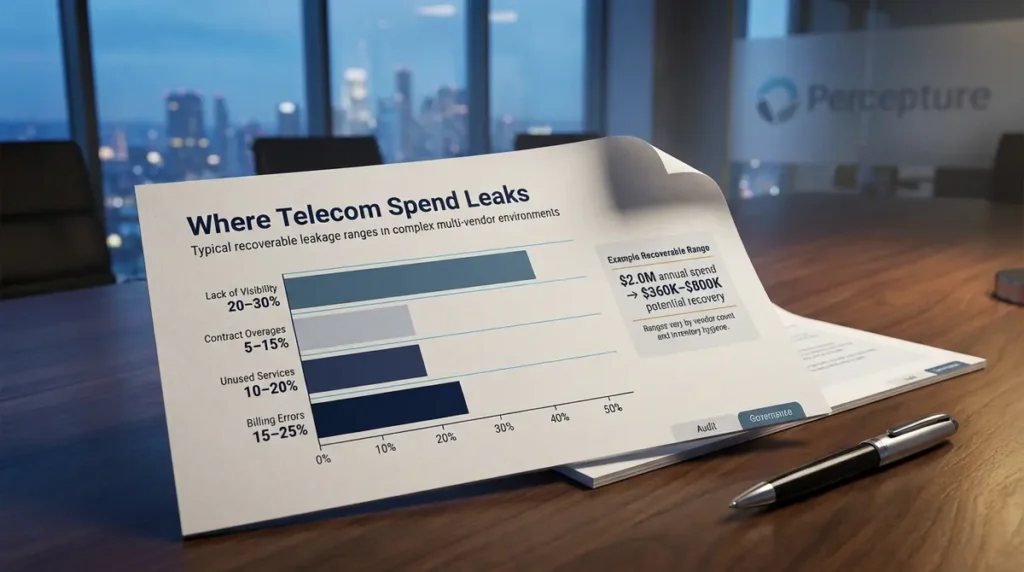
Telecom spending leaks through four primary channels:
- Billing Errors (15-25% of invoices): Incorrect rates, duplicate charges, services billed after cancellation
- Unused Services (10-20% of inventory): Legacy POTS lines, disconnected circuits, orphaned mobile devices
- Contract Overages (5-15% of spend): Data overages, out-of-contract rate increases, penalty fees
- Lack of Visibility (20-30% waste): Shadow IT purchases, untracked SaaS subscriptions, decentralized ordering
A 2025 study by Ascend Technologies found that companies deploying TEM solutions recover an average of $127 per employee annually in previously hidden costs.
The Telecom Expense Audit Process: Unlock Savings
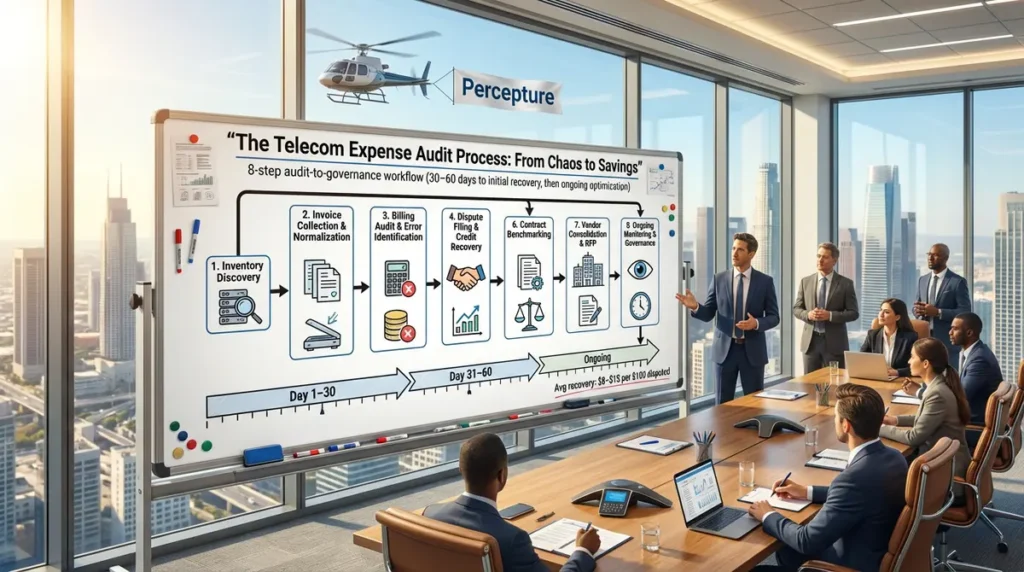
Effective TEM follows a structured audit-to-savings workflow:
Step 1: Inventory Discovery
Catalog all existing telecom services across locations, vendors, and service types. This includes circuit IDs, account numbers, contract terms, and monthly recurring charges (MRC).
Step 2: Invoice Collection & Normalization
Gather 6-12 months of invoices from all carriers. Normalize data formats so you can compare apples-to-apples across vendors.
Step 3: Billing Audit & Error Identification
Compare invoices against contracted rates, service orders, and usage patterns. Flag discrepancies like incorrect taxes, phantom charges, or services billed post-cancellation.
Step 4: Dispute Filing & Credit Recovery
Submit disputes to carriers with supporting documentation. Track credits owed and ensure refunds are applied. Industry average recovery: $8-15 per $100 disputed.
Step 5: Usage Analysis & Optimization
Identify underutilized services, right-size bandwidth allocations, and eliminate redundant circuits. This step typically yields 10-20% cost reduction.
Step 6: Contract Benchmarking
Compare your rates against market benchmarks. Carriers often increase prices 3-5% annually for customers who don’t renegotiate.
Step 7: Vendor Consolidation & RFP
Consolidate services with fewer vendors to leverage volume discounts. Run competitive RFPs for contracts nearing renewal.
Step 8: Ongoing Monitoring & Governance
Implement approval workflows for new orders, set up automated alerts for cost overruns, and schedule quarterly audits.
Timeline: Steps 1-4 take 30-60 days. Steps 5-8 are ongoing processes that require automation or dedicated resources.
TEM Software vs TEM Services vs Hybrid: Which is Right for You?
| Factor | TEM Software | TEM Services | Hybrid Model |
|---|---|---|---|
| What You Get | Self-service platform for invoice processing, inventory tracking, reporting | Fully managed service: auditors handle everything | Software platform + dedicated account team |
| Best For | Companies with in-house telecom expertise and 2+ FTEs available | Organizations lacking internal resources or expertise | Mid-market to enterprise needing flexibility |
| Cost Structure | $5K-50K/year (flat fee or per-service) | 10-20% of identified savings or % of total spend | $10K-100K/year + performance fees |
| Implementation Time | 2-4 weeks | 4-8 weeks | 4-6 weeks |
| Ongoing Effort | High (requires dedicated staff) | Low (outsourced) | Medium (collaborative) |
| Customization | High (you control workflows) | Low (standardized processes) | Medium (configurable) |
| ROI Timeline | 3-6 months | 6-12 months | 3-9 months |
| Examples | Lightyear, Genuity, Asignet | Tangoe Advisory, Cass, Brightfin | Calero, Sakon, Tangoe One |
Decision Logic:
1) Choose TEM Software if:
- You have 2+ FTEs who can dedicate 10-15 hours/week to telecom management
- Your telecom environment is relatively simple (1-3 carriers, <100 locations)
- You want full control over processes and data
2) Choose TEM Services if:
- You lack internal telecom expertise
- Your team is stretched thin and can’t dedicate resources
- You have a complex, global telecom footprint
3) Choose Hybrid if:
- You want software flexibility with expert support
- Your environment is complex but you have some internal capability
- You need help with initial cleanup but want to self-manage long-term
12 Must-Have TEM Software Features
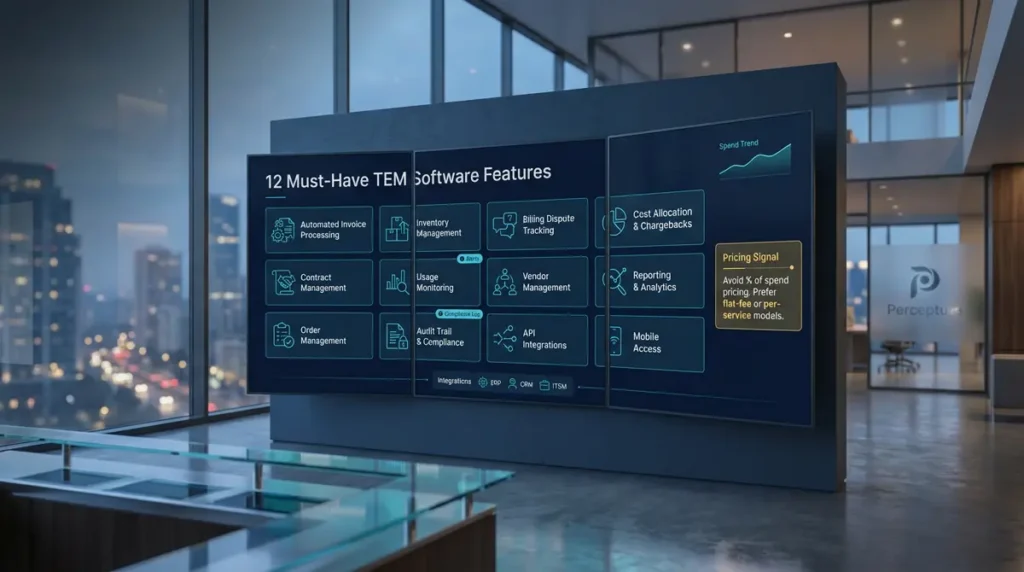
When evaluating TEM platforms, prioritize these capabilities:
- ✅ Automated Invoice Processing: AI-powered parsing of carrier invoices in any format
- ✅ Inventory Management: Centralized database tracking 30+ data points per service
- ✅ Billing Dispute Tracking: Workflow for submitting, tracking, and recovering credits
- ✅ Cost Allocation & Chargebacks: Allocate expenses to departments, cost centers, or GL codes
- ✅ Contract Management: Track renewal dates, terms, and rate escalations
- ✅ Usage Monitoring: Real-time alerts for data overages or unusual consumption
- ✅ Vendor Management: Centralized contact info, SLAs, and performance tracking
- ✅ Reporting & Analytics: Customizable dashboards showing spend trends and KPIs
- ✅ Order Management: Approval workflows for new service requests
- ✅ Audit Trail & Compliance: Detailed logs for SOX, HIPAA, or internal audit requirements
- ✅ API Integrations: Connect to ERP, CRM, ITSM, and procurement systems
- ✅ Mobile Access: Approve orders and view dashboards from mobile devices
Pro Tip: Avoid platforms that charge a percentage of your telecom spend. This creates a conflict of interest where the vendor profits when your costs increase. Look for flat-fee or per-service pricing models like Lightyear’s approach.
How to Choose the Right TEM Approach: Decision Tree
| Your Situation | Recommended Approach | Why |
|---|---|---|
| Annual telecom spend <$500K, <50 locations | TEM Software (Genuity, Lightyear) | Cost-effective, simple implementation |
| Annual spend $500K-$5M, 50-500 locations | Hybrid Model (Calero, Sakon) | Balance of automation and expert support |
| Annual spend >$5M, 500+ locations, global | TEM Services (Tangoe Advisory, Cass) | Complexity requires dedicated experts |
| High billing error rate (>10% of invoices) | TEM Services or Hybrid | Need aggressive audit and dispute management |
| Upcoming contract renewals (next 6 months) | TEM Services with RFP support | Negotiation expertise pays for itself |
| Strong internal telecom team (2+ FTEs) | TEM Software | Leverage existing expertise, maintain control |
| No internal telecom expertise | TEM Services | Outsource complexity entirely |
| Need AI-powered automation | Hybrid + AI Agent Layer | Combine TEM platform with intelligent automation |
What does an AI Agent for TEM Do?
Definition: An AI agent layer sits on top of traditional TEM software to handle tasks that require judgment, context, and real-time decision-making. Unlike rule-based automation, AI agents use machine learning to adapt to new patterns, detect anomalies, and route issues intelligently.
What AI Agents Do in TEM:
Inventory Reconciliation: Automatically match invoices to service orders and flag discrepancies
Anomaly Detection: Identify unusual spending patterns (e.g., 40% spike in data usage at one location)
Dispute Routing: Determine which disputes are worth pursuing based on historical recovery rates
Alerting & Summarization: Send executive summaries of key cost drivers and optimization opportunities
Predictive Modeling: Forecast future spend based on usage trends and contract terms
RFP Automation: Generate first-draft RFP responses for carrier proposals
What AI Agents Don’t Replace:
AI agents are not a substitute for billing systems, procurement platforms, or human judgment on strategic decisions. They augment TEM software by handling repetitive analysis and escalating edge cases to humans.

30/60/90 Day AI Agent Implementation Blueprint
Days 1-30: Foundation
- Integrate AI agent with existing TEM platform and CRM
- Train agent on historical invoice data (12+ months)
- Set up approval workflows and escalation rules
- Deploy in “shadow mode” (agent recommends, human approves)
Days 31-60: Optimization
- Review agent performance weekly
- Adjust thresholds for anomaly detection
- Expand agent responsibilities (e.g., add dispute routing)
- Measure time savings and error reduction
Days 61-90: Scale
- Move agent to autonomous mode for low-risk tasks
- Add voice/phone capabilities for carrier interactions
- Integrate with procurement systems for RFP automation
- Measure ROI: cost savings, time saved, error reduction
Expected Results: Companies using AI-powered TEM achieve 33-40% cost reduction vs. 20% with manual or software-only approaches, according to a 2026 study by Socium IT.
Case Study #1: Enterprise Ops Acceleration with AI Proposal Agents
Company: Global technology services firm with 2,500 employees
Challenge: Sales team spent 15-20 hours per RFP response, limiting capacity to 8 RFPs/month
Solution: Deployed Percepture AI Proposal Agent to automate security questionnaires and technical requirements
Results:
- 65% reduction in proposal turnaround time (2 weeks → 3 days)
- 3x increase in RFP capacity (8 → 24 per month)
- 28% higher win rate due to faster response times
- $1.2M additional revenue in first 90 days from increased RFP volume
Key Insight: The AI agent handled 80% of each RFP automatically by pulling content from the company’s knowledge base. Human reviewers focused on customization and strategy, not copy-paste work.
“We went from drowning in RFPs to having a competitive advantage. The AI agent gave us speed without sacrificing quality.” — VP of Sales Operations
Ready to automate your TEM workflow and unlock faster cost takeout?
We deploy AI agent layers that sit on top of your TEM platform to detect anomalies, route disputes, summarize cost drivers, and forecast spend. Humans stay in control. The repetitive work disappears.
ROI Model: Manual vs Agent-Assisted TEM
[Chart #3 Placement: Side-by-side bar chart comparing costs and savings]
| Metric | Manual TEM | Software-Only TEM | AI Agent-Assisted TEM |
|---|---|---|---|
| Annual Telecom Spend | $2M | $2M | $2M |
| Cost Reduction Achieved | 8-12% | 18-22% | 33-40% |
| Annual Savings | $160K-240K | $360K-440K | $660K-800K |
| FTE Hours Required | 2,080 hrs (1 FTE) | 520 hrs (0.25 FTE) | 104 hrs (0.05 FTE) |
| Implementation Cost | $0 (internal) | $25K-50K | $50K-75K |
| Ongoing Cost | $120K/year (salary) | $15K-30K/year | $30K-50K/year |
| Net Savings (Year 1) | $40K-120K | $280K-405K | $535K-720K |
| Payback Period | N/A | 1-2 months | 1-2 months |
Data Source: Analysis based on Ascend Technologies TEM study and Percepture client data (2025-2026).
Key Takeaway: AI agent-assisted TEM delivers 2-3x higher savings than software-only approaches while requiring 80% less human effort.
Case Study #2: AI Visibility & Pipeline Narrative Packs Drive GEO Results

Company: Mid-market telecom infrastructure provider
Challenge: Low visibility in AI search results (ChatGPT, Perplexity, Google AI Overviews)
Solution: Implemented Percepture GEO (Generative Engine Optimization) strategy with AI-generated narrative packs
Results:
- +3,000% increase in AI search visibility within 90 days
- 180% growth in qualified pipeline from AI-driven discovery
- 40% faster lead response times using AI sales agents
- 2.3x more meetings booked per sales rep per month
Key Insight: The company combined GEO content optimization with AI sales agents to create a closed-loop system. When prospects discovered them via AI search, agents immediately engaged with personalized outreach.
“We went from invisible in AI search to being cited by ChatGPT and Gemini as a top provider. The pipeline impact was immediate.” — CMO, Telecom Infrastructure Provider
Learn More: Read the full Telecom GEO Guide to understand how AI search is changing buyer behavior.
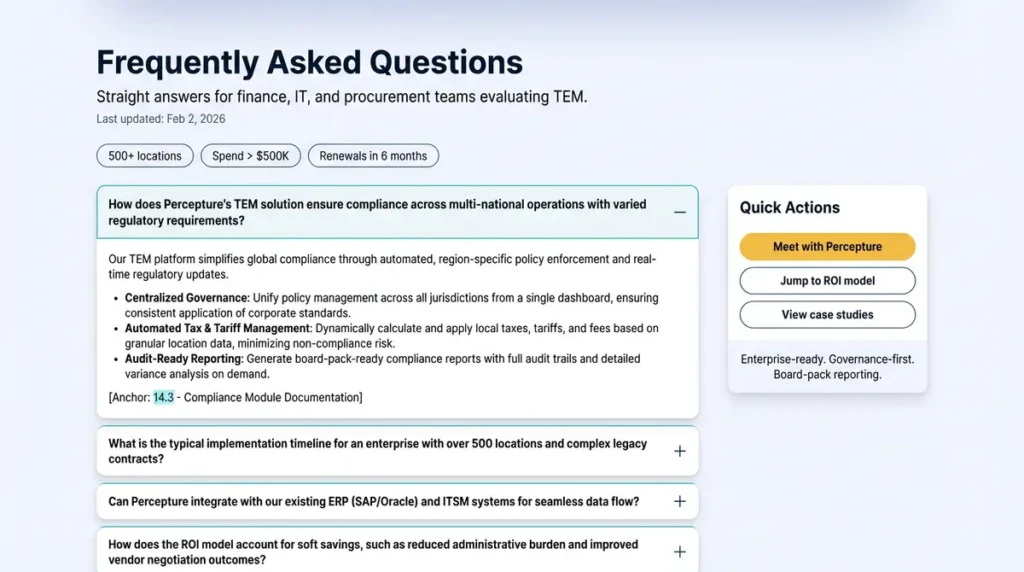
Frequently Asked Questions (FAQ)
1. What is telecom expense management?
Telecom expense management (TEM) is the process of tracking, auditing, and optimizing an organization’s spending on telecommunications services including voice, data, mobile, and cloud communications. TEM solutions combine software, services, and automation to reduce costs by 20-40% through invoice auditing, contract optimization, and waste elimination.
2. How much does telecom expense management software cost?
TEM software costs range from $5,000 to $50,000 annually depending on company size, service count, and features. Pricing models include flat fees, per-service charges, or percentage of spend (avoid the latter). Fully managed TEM services typically charge 10-20% of identified savings or 2-5% of total telecom spend.
3. What is the ROI of telecom expense management?
Most organizations see ROI within 3-6 months. Typical cost reductions range from 20-40% of annual telecom spend. For a company spending $2M annually, TEM can save $400K-800K per year. AI-powered TEM delivers 33-40% savings vs. 20% with manual approaches.
4. What is the difference between TEM software and TEM services?
TEM software is a self-service platform you manage internally, requiring 2+ FTEs and telecom expertise. TEM services are fully outsourced, where a provider handles all auditing, optimization, and vendor management. Hybrid models combine software with dedicated account teams.
5. How long does it take to implement TEM?
Implementation takes 2-8 weeks depending on complexity. Simple TEM software deployments take 2-4 weeks. Fully managed services with deep inventory audits take 6-8 weeks. The first savings typically appear within 30-60 days of go-live.
6. What are the biggest sources of telecom waste?
The four biggest cost leaks are: (1) billing errors (15-25% of invoices), (2) unused services (10-20% of inventory), (3) contract overages (5-15% of spend), and (4) lack of visibility causing shadow IT purchases (20-30% waste).
7. Can TEM help with mobile device management?
Yes. Most TEM platforms include mobile expense management (MEM) features for tracking device inventory, usage, plan optimization, and BYOD reimbursements. Some vendors like Tangoe and Calero offer dedicated mobile management modules.
8. What is an AI agent in telecom expense management?
An AI agent is software that autonomously performs TEM tasks like anomaly detection, dispute routing, and predictive cost modeling. Unlike rule-based automation, AI agents learn from data and adapt to new patterns. They handle tasks requiring judgment that traditional TEM software can’t automate.
9. How do I choose between TEM software and services?
Choose TEM software if you have internal telecom expertise and 2+ FTEs available. Proceed with TEM services if you lack resources or have a complex global footprint. Choose hybrid if you want software flexibility with expert support for audits and contract negotiations.
10. What is a telecom expense audit?
A telecom expense audit is a systematic review of all telecom invoices, contracts, and services to identify billing errors, unused services, and optimization opportunities. Audits typically recover 5-15% of annual spend through error corrections and waste elimination.
11. Can TEM integrate with my ERP or procurement system?
Yes. Modern TEM platforms offer API integrations with ERP systems (SAP, Oracle, NetSuite), procurement tools (Coupa, Ariba), and ITSM platforms (ServiceNow). This enables automated GL coding, purchase order matching, and approval workflows.
12. What industries benefit most from TEM?
Industries with high telecom spend see the strongest ROI: financial services, healthcare systems, retail chains, call centers, logistics companies, and enterprises with 500+ locations. Any organization spending $50K+ monthly on telecom should evaluate TEM.